Alprostadil
JFDA label: CAVERJECT POWD FOR INJ
- Apnea (Prostin VR Pediatric):
Mechanism of Action
Agonist of Prostaglandin E2 receptor EP1 subtype — Prostanoid EP1 receptor agonist; Agonist of Prostaglandin E2 receptor EP2 subtype — Prostanoid EP2 receptor agonist
| Target | Action | Gene / class |
|---|---|---|
| Prostaglandin E2 receptor EP1 subtype efficacy | AGONIST | PTGER1 |
| Prostaglandin E2 receptor EP2 subtype efficacy | AGONIST | PTGER2 |
Indications
Approved
- Caverject, Edex, Caverject Impulse
- Erectile dysfunction
- Muse
- Patent ductus arteriosus (Prostin VR Pediatric)
Off-label
- Raynaud phenomenon
Contraindications
Source: Lexicomp
- Intracavernous: Hypersensitivity to alprostadil or any component of the formulation Absolute
- conditions predisposing men to priapism (eg, sickle cell anemia or trait, multiple myeloma, leukemia) Absolute
- men who are prone to venous thrombosis or who have a hyperviscosity syndrome (eg, sickle cell anemia or trait, thrombocythemia, polycythemia, multiple myeloma) predisposing them to priapism Absolute
- men with anatomical deformation or fibrotic conditions of the penis (eg, angulation, cavernosal fibrosis, or Peyronie disease) Absolute
- penile implants IV: There are no contraindications listed in the manufacturer's labeling. Transurethral: Hypersensitivity to alprostadil or any component of the formulation Absolute
- sexual intercourse with a pregnant woman unless a condom barrier is being used Documentation of allergenic cross-reactivity for prostaglandins is limited. However, because of similarities in chemical structure and/or pharmacologic actions, the possibility of cross-sensitivity cannot be ruled out with certainty Absolute
- urethral stricture, balanitis, severe hypospadias and curvature, and in men with acute or chronic urethritis Absolute
- use in men for whom sexual activity is inadvisable Absolute
Adverse Reactions
Cardiac disorders (7)
Very Common Flushing
Common Bradycardia · cardiac arrest · edema · Hypertension · hypotension · tachycardia
Nervous system disorders (4)
Common Dizziness · headache · pain · seizure
Renal and urinary disorders (8)
Common penile disease · penile rash · penile swelling · Peyronie's disease · Prolonged erection · Testicular pain · urethral bleeding (minor) · vulvovaginal pruritus (female partner)
Blood and lymphatic system disorders (1)
Common Disseminated intravascular coagulation
Metabolism and nutrition disorders (1)
Common Hypokalemia
Gastrointestinal disorders (1)
Common Diarrhea
Musculoskeletal and connective tissue disorders (1)
Common Back pain
Infections and infestations (1)
Common Sepsis
General disorders and administration site conditions (4)
Very Common Fever
Common Bruising at injection site · hematoma at injection site · Local pain (in structures other than the injection site)
Other (2)
Very Common Genitourinary: Penile pain · urethral burning
Respiratory, thoracic and mediastinal disorders (6)
Very Common Apnea
Common Cough · flu-like symptoms · nasal congestion · sinusitis · upper respiratory tract infection
Dosing
Source: Lexicomp
Warnings & Precautions
Source: Lexicomp
Apnea
Prostin VR Pediatric: Apnea may occur in 10% to 12% of neonates with congenital heart defects, especially in those weighing Apnea usually appears during the first hour of drug infusion.
Hypotension/syncope
Intracavernous injections can increase peripheral blood levels of alprostadil, resulting in hypotension. Syncope has also been reported. Avoid use in men with known cavernosal venous leakage. Patients must be cautioned to avoid tasks such as operating machinery or driving following administration where injury could result if hypotension or syncope were to occur.
Penile fibrosis
May occur when used for erectile dysfunction; discontinue use in men who develop penile angulation or cavernosal fibrosis.
Priapism/prolonged erection
May occur when used for erectile dysfunction; instruct patient to seek immediate medical assistance if an erection persists ≥4 hours; discontinue therapy if priapism or prolonged erection occurs or if signs of penile fibrosis develop (penile angulation, cavernosal fibrosis, or Peyronie disease). To minimize the chances of prolonged erection or priapism, titrate slowly to the lowest effective dose. Use is contraindicated in men who have conditions that predispose them to priapism (eg, sickle cell anemia or trait, multiple myeloma, leukemia). Underlying causes of erectile dysfunction should be evaluated and treated prior to therapy. Disease related concerns:
Cardiovascular disease
Treatment for erectile dysfunction should not be used in men whom sexual activity is inadvisable because of underlying cardiovascular status. Concurrent drug therapy issues:
Drug-drug interactions
Potentially significant interactions may exist, requiring dose or frequency adjustment, additional monitoring, and/or selection of alternative therapy. Consult drug interactions database for more detailed information. Special populations:
Neonates
Prostin VR Pediatric: Use with caution in neonates with bleeding tendencies. Dosage form specific issues:
Benzyl alcohol and derivatives
Some dosage forms may contain benzyl alcohol; large amounts of benzyl alcohol (≥99 mg/kg/day) have been associated with a potentially fatal toxicity (“gasping syndrome”) in neonates; the “gasping syndrome” consists of metabolic acidosis, respiratory distress, gasping respirations, CNS dysfunction (including convulsions, intracranial hemorrhage), hypotension, and cardiovascular collapse (AAP ["Inactive" 1997]; CDC 1982); some data suggests that benzoate displaces bilirubin from protein binding sites (Ahlfors 2001); avoid or use dosage forms containing benzyl alcohol with caution in neonates. See manufacturer's labeling. Other warnings/precautions:
Administration
Muse: Urethral abrasion resulting in minor bleeding or spotting may occur from improper administration.
Needle breakage
Caverject and Caverject Impulse: A superfine needle is used for administration. Needle breakage (a portion of the needle remaining in the penis) has been reported; hospitalization and surgical removal may be necessary.
Patency of ductus arteriosus
Appropriate use: Prostin VR Pediatric: Infuse for the shortest time at the lowest dose consistent with good patient care. Use for >120 hours has been associated with antral hyperplasia and gastric outlet obstruction.
Pregnancy & Lactation
Pregnancy
Adverse events have been observed in animal reproduction studies. Alprostadil is not indicated for use in women. The manufacturer of Muse recommends a condom barrier when being used during sexual intercourse with a pregnant woman.
Lactation
Alprostadil is not indicated for use in women.
Monitoring
| Clinical pearl | Blood pressure, respiratory rate, heart rate, temperature, degree of penile pain, duration of erection, adequate detumescence after dosing, signs of infection |
|---|
Chemistry & Properties
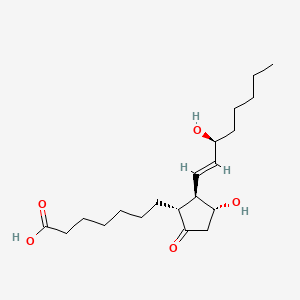
| Formula | C20H34O5 |
|---|---|
| Molecular weight | 354.49 g/mol |
| IUPAC name | 7-[(1R,2R,3R)-3-hydroxy-2-[(E,3S)-3-hydroxyoct-1-enyl]-5-oxocyclopentyl]heptanoic acid |
| CAS | 745-65-3 |
| PubChem CID | 5280723 |
| InChIKey | GMVPRGQOIOIIMI-DWKJAMRDSA-N |
| logP | 3.48 (XLogP 3.2) |
| Polar surface area | 94.83 Ų |
| H-bond acceptors / donors | 4 / 3 |
| Drug-likeness (QED) | 0.35 |
| Lipinski violations | 0 |
SMILES
CCCCC[C@H](O)/C=C/[C@H]1[C@H](O)CC(=O)[C@@H]1CCCCCCC(=O)OBiology & Pharmacokinetics
Pharmacokinetics
| BBB penetrant | No |
|---|
Enzyme interactions
| Enzyme | Role | Detail |
|---|---|---|
| CYP2B6 | Inhibitor | — |
Receptor binding (top 9)
| Target | Action | Affinity |
|---|---|---|
| EP4 receptor (PTGER4) | Agonist | pEC50 9.5 |
| EP4 receptor (PTGER4) | Agonist | pKi 8.8 |
| EP2 receptor (PTGER2) | Agonist | pKi 8.0 |
| DP1 receptor (PTGDR) | Agonist | pKi 7.3 |
| EP1 receptor (PTGER1) | Agonist | pKi 6.8 |
| CatSper1 (CATSPER1) | Activator | pEC50 6.3 |
| CatSper2 (CATSPER2) | Activator | pEC50 6.3 |
| CatSper3 (CATSPER3) | Activator | pEC50 6.3 |
| CatSper4 (CATSPER4) | Activator | pEC50 6.3 |
Transporters
BCRP (Inhibitor)BSEP (Inhibitor)BSEP (Inhibitor)MDR1 (Inhibitor)MRP1 (Inhibitor)MRP2 (Inhibitor)MRP3 (Inhibitor)MRP4 (Inhibitor)MRP5 (Inhibitor)OAT1 (Inhibitor)OATP1B1 (Inhibitor)OATP1B3 (Inhibitor)OATP3A1 (Inhibitor)OATP4A1 (Inhibitor)P-gp (Inhibitor)MRP2 (Substrate)MRP3 (Substrate)MRP4 (Substrate)OATP3A1 (Substrate)OATP4A1 (Substrate)P-gp (Substrate)
Drug–drug interactions (16, DDInter)
| Interacting drug | Severity | Management |
|---|---|---|
| Brimonidine (ophthalmic) | moderate | |
| Brimonidine (topical) | moderate | |
| Canagliflozin | moderate | |
| Dapagliflozin | moderate | |
| Empagliflozin | moderate | |
| Epoprostenol | moderate | |
| Ertugliflozin | moderate | |
| Heparin | moderate | |
| Iloprost | moderate | |
| Lorcaserin | moderate | |
| Minoxidil (topical) | moderate | |
| Nitrous acid | moderate | |
| Pentoxifylline | moderate | |
| Sapropterin | moderate | |
| Selexipag | moderate | |
| Treprostinil | moderate |
Registered Products (3)
| Brand | Form / strength | Pack | Agent | Citizen (JOD) |
|---|---|---|---|---|
| CAVERJECT POWD FOR INJ | Powder for Injection 10 mcg | Vial+Dil. | Khoury Drug Store | 8.170 |
| CAVERJECT | Pre-filled Syringe 20 mcg | 1 vial | Khoury Drug Store | 10.420 |
| Prostavasin Infusion Ampoules | Infusion 20 mcg | 10 | Suleiman Tannous & Sons Co. Ltd | — |