Adefovir Dipivoxil
Active form: Adefovir Diphosphate.
JFDA label: Hepsera
- Severe acute exacerbations of hepatitis:
- Nephrotoxicity:
- HIV resistance:
- Lactic acidosis/severe hepatomegaly with steatosis:
Mechanism of Action
Inhibitor of DNA polymerase/reverse transcriptase — DNA polymerase/reverse transcriptase inhibitor
| Target | Action | Gene / class |
|---|---|---|
| DNA polymerase/reverse transcriptase efficacy | INHIBITOR | P |
Indications
Approved
- Hepatitis B, Chronic — hepatitis B virus infection
- Virus Diseases — viral disease
Off-label
- Cytomegalovirus Infections
- HIV Infections
Antimicrobial Spectrum
Expected / intrinsic spectrum (EUCAST breakpoints & labels) — not local resistance. Source: openfda-label.
Viruses
| Organism | Activity | MIC |
|---|---|---|
| Hepatitis B | Active | — |
Class profile
| targetVirus | HBV |
|---|---|
| viralClass | Hepadnaviridae (dsDNA/RT) |
| targetStep | HBV reverse transcriptase (NRTI) |
| resistanceBarrier | Moderate (rtN236T, rtA181T/V after 5+ years) |
| crossResistance | rtN236T cross-resistant with other NRTIs partially |
| source | DHHS/AASLD/manufacturer-PIL |
Contraindications
Source: Lexicomp
- Hypersensitivity to adefovir or any component of the formulation Absolute
Adverse Reactions
Nervous system disorders (1)
Very Common Headache
Hepatobiliary disorders (1)
Very Common Hepatitis
Renal and urinary disorders (3)
Very Common Hematuria
Common Increased serum creatinine · renal failure
Metabolism and nutrition disorders (1)
Common Hypophosphatemia, dyspepsia, nausea, vomiting
Gastrointestinal disorders (2)
Very Common Abdominal pain · diarrhea
Skin and subcutaneous tissue disorders (2)
Common Pruritus · skin rash
Musculoskeletal and connective tissue disorders (2)
Very Common Weakness
Common Back pain
Respiratory, thoracic and mediastinal disorders (2)
Common Cough · rhinitis
Dosing
Source: Lexicomp
Warnings & Precautions
Source: Lexicomp
Lactic acidosis/hepatomegaly
Fatal cases of lactic acidosis and severe hepatomegaly with steatosis have been reported with the use of nucleoside analogues alone or in combination with other antiretrovirals; use with caution in patients with risk factors for liver disease (risk may be increased with female gender, obesity, pregnancy or prolonged exposure) and suspend treatment in any patient who develops clinical or laboratory findings suggestive of lactic acidosis or hepatotoxicity (transaminase elevation may/may not accompany hepatomegaly and steatosis). Disease-related concerns:
Chronic hepatitis B
Severe, acute exacerbation of hepatitis B may occur upon discontinuation. Exacerbations may occur in up to 25% of patients and usually within 12 weeks and may be self-limited or resolve upon resuming treatment; risk may be increased with advanced liver disease or cirrhosis. Monitor liver function several months after stopping treatment; reinitiation of antihepatitis B therapy may be required. Ethanol should be avoided in hepatitis B infection due to potential hepatic toxicity.
HIV
May cause the development of HIV resistance in chronic hepatitis B patients with unrecognized or untreated HIV infection. Determine HIV status prior to initiating treatment with adefovir.
Renal impairment
Use with caution in patients with renal dysfunction or in patients at risk of renal toxicity (including concurrent nephrotoxic agents or NSAIDs). Chronic administration may result in nephrotoxicity. Dosage adjustment is required in adult patients with renal dysfunction or in patients who develop renal dysfunction during therapy; no data available for use in children ≥12 years or adolescents with renal impairment. Calculation of creatinine clearance in all patients is recommended prior to initiating therapy. Concurrent drug therapy:
Tenofovir
Do not use concurrently with tenofovir (Viread®) or any product containing tenofovir (eg, Truvada, Atripla, Complera). Other warnings/precautions:
Appropriate use
Current clinical hepatitis B practice guidelines do not recommend adefovir for initial use in the management of chronic HBV due to high rate of resistance with long-term use; other antiviral agents with a high barrier to drug resistance are preferred (eg, tenofovir or entecavir). In the setting of lamivudine-resistant HBV, adefovir (including when combined with lamivudine) is also not a preferred strategy to manage antiviral resistance; consult current clinical practice guidelines for recommendations (AASLD [Terrault 2016]). If used, combination therapy with lamivudine should be used to decrease the risk of resistance in patients with lamivudine-resistant HBV.
Pregnancy & Lactation
Pregnancy
Adverse events have been observed in animal reproduction studies. Health care providers are encouraged to enroll women exposed to adefovir during pregnancy in the Hepsera pregnancy registry (800-258-4263).
Lactation
It is not known if adefovir is excreted in breast milk. Due to the potential for serious adverse reactions in the nursing infant, the manufacturer recommends a decision be made whether to discontinue nursing or to discontinue the drug, taking into account the importance of treatment to the mother.
Monitoring
| Efficacy | Viral load (undetectable = success); CD4 count (HIV); hepatic enzymes and HBV/HCV DNA (hepatitis); clinical resolution of acute viral illness |
|---|---|
| Toxicity | Renal function (most antivirals are renally cleared); LFTs; resistance testing if virological failure; CBC |
| Clinical pearl | For HIV, undetectable viral load at 6 months predicts long-term treatment success. Resistance testing is mandatory at virological failure. |
| Counseling | Do not miss doses — even brief interruptions can cause viral rebound and resistance selection. Report any side effects early rather than stopping independently. |
Chemistry & Properties
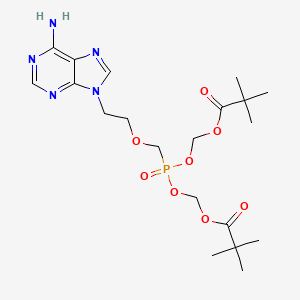
| Formula | C20H32N5O8P |
|---|---|
| Molecular weight | 501.48 g/mol |
| IUPAC name | [2-(6-aminopurin-9-yl)ethoxymethyl-(2,2-dimethylpropanoyloxymethoxy)phosphoryl]oxymethyl 2,2-dimethylpropanoate |
| CAS | 142340-99-6 |
| PubChem CID | 60871 |
| InChIKey | WOZSCQDILHKSGG-UHFFFAOYSA-N |
| logP | 2.7 (XLogP 1.8) |
| Polar surface area | 166.98 Ų |
| H-bond acceptors / donors | 13 / 1 |
| Drug-likeness (QED) | 0.21 |
| Lipinski violations | 2 |
SMILES
CC(C)(C)C(=O)OCOP(=O)(COCCn1cnc2c(N)ncnc21)OCOC(=O)C(C)(C)CBiology & Pharmacokinetics
Pharmacokinetics
| BBB penetrant | No |
|---|
Enzyme interactions
| Enzyme | Role | Detail |
|---|---|---|
| CYP2B6 | Inhibitor | — |
| CYP2C8 | Inhibitor | — |
| CYP3A4 | Inhibitor | — |
| CYP3A4 | Substrate | — |
Transporters
BCRP (Inhibitor)BSEP (Inhibitor)BSEP (Inhibitor)MRP1 (Inhibitor)MRP2 (Inhibitor)MRP4 (Inhibitor)OAT1 (Inhibitor)OATP1B1 (Inhibitor)OATP1B3 (Inhibitor)P-gp (Inhibitor)BCRP (Substrate)MDR1 (Substrate)MRP2 (Substrate)MRP4 (Substrate)NTCP (Substrate)OAT (Substrate)OAT1 (Substrate)OAT3 (Substrate)OCT3 (Substrate)P-gp (Substrate)
Registered Products (1)
| Brand | Form / strength | Pack | Agent | Citizen (JOD) |
|---|---|---|---|---|
| Hepsera | Tablet 10 mg | 30 tab | Suleiman Tannous & Sons Co. Ltd | — |