Articaine
🧬 Cross-allergy: Amide local anesthetics
JFDA label: Ubistesin Inj. Sol.
Mechanism of Action
Articaine: Blocks both the initiation and conduction of nerve impulses by increasing the threshold for electrical excitation in the nerve, slowing the propagation of the nerve impulse, and reducing the rate of rise of the action potential. Epinephrine: Increases the duration of action of articaine by causing vasoconstriction (via alpha effects) which slows the vascular absorption of articaine.
Indications
Approved
- Dental anesthesia
Contraindications
Source: Lexicomp
- Additional contraindications (not in US labeling): Allergies to dental anesthetics Absolute
- Sulfite hypersensitivity. Documentation of allergenic cross-reactivity for local anesthetics is limited. However, because of similarities in chemical structure and/or pharmacologic actions, the possibility of cross-sensitivity cannot be ruled out with certainty Absolute
- patients with sepsis near the proposed injection site, severe shock, paroxysmal tachycardia, frequent arrhythmia, neurological disease, or severe hypertension Absolute
Adverse Reactions
Cardiac disorders (3)
Not Known cardiac arrhythmia · cardiac insufficiency · Facial edema
Nervous system disorders (4)
Not Known headache · Pain · paresthesia · seizure
Immune system disorders (1)
Not Known Hypersensitivity reaction
Gastrointestinal disorders (1)
Not Known Gingivitis
General disorders and administration site conditions (2)
Not Known Injection site reaction · Tissue necrosis
Respiratory, thoracic and mediastinal disorders (1)
Not Known Asthma
Dosing
Source: Lexicomp
Warnings & Precautions
Source: Lexicomp
Local toxicity
Epinephrine may cause local toxicity, including ischemic injury or necrosis.
Methemoglobinemia
Local anesthetics containing a vasoconstrictor may cause methemoglobinemia, especially in combination with methemoglobin-inducing agents. Do not use in patients with congenital or idiopathic methemoglobinemia, or in patients who are receiving treatment with methemoglobin-inducing agents.
Systemic toxicity
May occur. Systemic absorption of local anesthetics may produce cardiovascular and/or CNS effects. Toxic blood concentrations of local anesthetics depress cardiac conduction and excitability, which may lead to AV block, ventricular arrhythmias, and cardiac arrest (sometimes resulting in death). In addition, myocardial contractility is depressed and peripheral vasodilation occurs, leading to decreased cardiac output and arterial blood pressure. Restlessness, anxiety, tinnitus, dizziness, blurred vision, tremors, depression, or drowsiness may be early warning signs of CNS toxicity. Small doses of local anesthetics injected into dental blocks may produce adverse reactions similar to systemic toxicity, including confusion, convulsions, respiratory depression and/or respiratory arrest, and cardiovascular stimulation or depression; these reactions may be due to intra-arterial injection of the local anesthetic with retrograde flow to the cerebral circulation. Constantly monitor cardiovascular and respiratory vital signs and patient’s state of consciousness carefully following each injection. Disease-related concerns:
Cardiovascular disease
Use with caution in patients with impaired cardiovascular function, including patients with heart block. Use local anesthetics containing a vasoconstrictor with caution in patients with vascular disease; patients with peripheral vascular disease or hypertensive vascular disease may exhibit exaggerated vasoconstrictor response, possibly resulting in ischemic injury or necrosis. Dosages should be reduced for patients with cardiac disease.
Hepatic impairment
Use with caution in patients with severe hepatic disease (has not been studied). Concurrent drug therapy issues:
Drug-drug interactions
Potentially significant interactions may exist, requiring dose or frequency adjustment, additional monitoring, and/or selection of alternative therapy. Consult drug interactions database for more detailed information. Special populations:
Acutely-ill/debilitated patients
Administer reduced dosages, commensurate with age and physical condition, to debilitated and/or acutely-ill patients.
Elderly
Use with caution in the elderly; administer reduced dosages to commensurate with age and physical condition.
Pediatric
Administer reduced dosages, commensurate with age and physical condition, to pediatric patients. Dosage form specific issues:
Sodium metabisulfite
May contain sodium metabisulfite, which may cause allergic-type reactions (including anaphylactic symptoms, and life-threatening or less severe asthmatic episodes) in certain susceptible patients. The overall prevalence of the sulfite sensitivity in the general population is unknown, and is seen more frequently in asthmatic than in nonasthmatic persons. Other warnings/precautions:
Administration
Avoid intravascular injection; accidental intravascular injection may be associated with convulsions, followed by CNS or cardiorespiratory depression and coma, progressing ultimately to respiratory arrest. Aspiration should be performed prior to administration; the needle must be repositioned until no return of blood can be elicited by aspiration; however, absence of blood in the syringe does not guarantee that intravascular injection has been avoided.
Appropriate use
To avoid serious adverse effects and high plasma levels, use the lowest dosage resulting in effective anesthesia. Repeated doses may cause significant increases in blood levels due to the possibility of accumulation of the drug or its metabolites. Dosage recommendations should not be exceeded.
Trained personnel
Health care providers should be well trained in diagnosis and management of emergencies that may arise from the use of these agents. Resuscitative equipment, oxygen, and other resuscitative drugs should be available for immediate use.
Pregnancy & Lactation
Pregnancy
Adverse events have been observed in some animal reproduction studies using this combination. Articaine crosses the placenta (Strasser 1977).
Lactation
It is not known if articaine or epinephrine are excreted in breast milk. The manufacturer recommends that caution be exercised when administering articaine/epinephrine to breast-feeding women; consideration may be given to pumping and discarding milk for 4 hours after the last dose. In general, women administered single dose local anesthesia for dental procedures may resume breast-feeding once they are awake and stable (Montgomery 2012).
Monitoring
| Clinical pearl | Cardiovascular and respiratory vital signs; state of consciousness after each injection; CNS toxicity. |
|---|
Chemistry & Properties
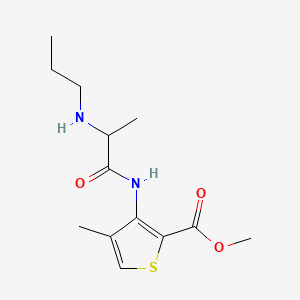
| Formula | C13H20N2O3S |
|---|---|
| Molecular weight | 284.38 g/mol |
| IUPAC name | methyl 4-methyl-3-[2-(propylamino)propanoylamino]thiophene-2-carboxylate |
| CAS | 23964-58-1 |
| PubChem CID | 32170 |
| InChIKey | QTGIAADRBBLJGA-UHFFFAOYSA-N |
| logP | 2.17 (XLogP 2.8) |
| Polar surface area | 67.43 Ų |
| H-bond acceptors / donors | 5 / 2 |
| Drug-likeness (QED) | 0.79 |
| Lipinski violations | 0 |
SMILES
CCCNC(C)C(=O)Nc1c(C)csc1C(=O)OCBiology & Pharmacokinetics
Pharmacokinetics predicted
| Bioavailability | 70.0% |
|---|---|
| Half-life | 0.557 h |
| Volume of distribution | 7.09 L/kg |
| Protein binding | 49.6% |
| BBB penetrant | No |
Enzyme interactions
| Enzyme | Role | Detail |
|---|---|---|
| CYP1A2 | Substrate | — |
Transporters
BCRP (Inhibitor)BSEP (Inhibitor)MRP1 (Inhibitor)OATP1B1 (Inhibitor)OATP1B3 (Inhibitor)P-gp (Inhibitor)P-gp (Substrate)
Drug–drug interactions (10, DDInter)
| Interacting drug | Severity | Management |
|---|---|---|
| Nitrous acid | major | |
| Benzocaine (topical) | moderate | |
| Cinchocaine (topical) | moderate | |
| Lidocaine (ophthalmic) | moderate | |
| Lidocaine (topical) | moderate | |
| Morphine (liposomal) | moderate | |
| Oxybuprocaine (ophthalmic) | moderate | |
| Tetracaine (ophthalmic) | moderate | |
| Tetracaine (topical) | moderate | |
| Hyaluronidase | minor |
Registered Products (13)
| Brand | Form / strength | Pack | Agent | Citizen (JOD) |
|---|---|---|---|---|
| ARTICAINE MEDIS ADRENALINE 1/100 000 | Cartridge 1 ml/100000 ml | 50 CTG/1 BOX | Professional Drug Store | — |
| Alexadricaine 1:100000 | Tablet 68 mg, 0.03306 mg/1.7 ml | 50 Catridge (BOX) | AL-Faiasel Drug Store | — |
| Alexadricaine 1:200000 | Tablet 68 mg, 0.0153 mg/1.7 ml | 50 Catridge (BOX) | AL-Faiasel Drug Store | — |
| Artinibsa 4% with Epinephrine 1:100000 | Cartridge 72 mg/1.8 ml, 32.4 mcg/1.8 ml | 1.8 MILLILITER/50 CARTRIDGE | Burqan Drug Store | — |
| Artinibsa 4% with Epinephrine 1:200000 | Cartridge 72 mg/1.8 ml, 16.2 mcg/1.8 ml | 50 Cart | Burqan Drug Store | — |
| Orabloc 1:100,000 | Cartridge (as Bitartrate) 0.01 mg/ml, 40 mg/ml | 1.8 ml | Almutanabbe Drug Store | — |
| Orabloc 1:200,000 | Cartridge 0.005 mg/ml, 40 mg/ml | 1.8 ml | Almutanabbe Drug Store | — |
| Posicaine 100 | Injection 0.010 mg/ml, 40 mg/ml | 50 vial | Ajyal Al Ghad Al Jadeed Drug Store | — |
| Posicaine 200 Solution for Injection | Injection 0.005 mg/ml, 40 mg/ml | 50 vial | Ajyal Al Ghad Al Jadeed Drug Store | — |
| Ubistesin Forte | Injection 40 mg/ml, 0.012 mg/ml | 1.7 ml | Khoury Drug Store | — |
| Ubistesin Inj. Sol. | Injection 40 mg/ml, 0.006 mg/ml | 1.7 ml | Khoury Drug Store | — |
| septanest with adrenaline 1/100,000 | Cartridge 0.01 mg/ml, 40 mg/ml | 1.8 ml | Ibn Rushd Drug Store | — |
| septanest with adrenaline 1/200,000 | Cartridge 40 mg, 0.005 mg | 1.8 ml | Ibn Rushd Drug Store | — |