Asciminib
JFDA label: Scemblix Tablets
Mechanism of Action
Inhibitor of Tyrosine-protein kinase ABL1 — Tyrosine-protein kinase ABL inhibitor
| Target | Action | Gene / class |
|---|---|---|
| Tyrosine-protein kinase ABL1 efficacy | INHIBITOR | ABL1 |
Indications
Approved
- Neoplasms — neoplasm
Off-label
- Leukemia, Myelogenous, Chronic, BCR-ABL Positive
Contraindications
Source: openFDA
- None. None. ( 4 ) Absolute
Adverse Reactions
Cardiac disorders (2)
Common Arrhythmia · Included Cardiac Failure Congestive
Vascular disorders (1)
Common Hemorrhage
Nervous system disorders (3)
Common And Peripheral Neuropathy · Dizziness · Headache
Hepatobiliary disorders (2)
Common Blood Bilirubin Increased · Hepatic Enzymes Increased
Blood and lymphatic system disorders (5)
Very Common And Neutropenia · Of Patients Included Thrombocytopenia
Common And Thrombocytopenia · Anemia · Neutropenia
Gastrointestinal disorders (6)
Common Abdominal Pain · Constipation · Included Abdominal Pain · Included Pancreatitis · Nausea · Vomiting
Skin and subcutaneous tissue disorders (1)
Common Pruritus
Musculoskeletal and connective tissue disorders (1)
Common Musculoskeletal Pain
Infections and infestations (2)
Common Pneumonia · Urinary Tract Infection
Investigations (1)
Common Of Patients Included Pancreatic Enzymes Increased
General disorders and administration site conditions (4)
Common Cardiovascular Toxicity · Fatigue · Pyrexia · Two Patients
Respiratory, thoracic and mediastinal disorders (1)
Common And Pleural Effusion
Dosing
Source: openFDA
Warnings & Precautions
Source: openFDA
Warnings & Precautions
Myelosuppression: Severe thrombocytopenia and neutropenia events may occur. Monitor complete blood counts regularly during therapy and manage by treatment interruption or dose reduction. ( 2.4 , 5.1 ) Pancreatic Toxicity: Monitor serum lipase and amylase. Interrupt, then resume at reduced dose or discontinue SCEMBLIX based on severity. Evaluate for pancreatitis when lipase elevation is accompanied by abdominal symptoms. ( 2.4 , 5.2 ) Hypertension: Monitor blood pressure and manage hypertension as clinically indicated. Interrupt, dose reduce, or stop SCEMBLIX if hypertension is not medically controlled. ( 2.4 , 5.3 ) Hypersensitivity: May cause hypersensitivity reactions. Monitor patients for signs and symptoms and initiate appropriate treatment as clinically indicated. ( 5.4 ) Cardiovascular Toxicity: Cardiovascular toxicity may occur. Monitor patients with history of cardiovascular risk factors for cardiovascular signs and symptoms. Initiate appropriate treatment as clinically indicated. ( 5.5 ) Embryo-Fetal Toxicity: Can cause fetal harm. Advise females of reproductive potential of the potential risk to a fetus and to use effective contraception. ( 5.6 , 8.1 , 8.3 )
Myelosuppression Thrombocytopenia, neutropenia, and anemia have occurr
Myelosuppression Thrombocytopenia, neutropenia, and anemia have occurred in patients receiving SCEMBLIX. Thrombocytopenia occurred in 156 of 556 (28%) patients receiving SCEMBLIX, with Grade 3 or 4 thrombocytopenia reported in 39 (7%) and 53 (10%) of patients, respectively. Among the patients with Grade 3 or 4 thrombocytopenia, median time to first occurrence of events was 6 weeks (range, 0.1 to 64 weeks). SCEMBLIX was permanently discontinued in 11 (2%) patients, while it was temporarily withheld in 70 (13%) patients due to thrombocytopenia. Neutropenia occurred in 121 (22%) patients receiving SCEMBLIX, with Grade 3 and 4 neutropenia reported in 42 (8%) and 35 (6%) patients, respectively. Among the patients with Grade 3 or 4 neutropenia, median time to first occurrence of events was 7 weeks (range, 0.1 to 180 weeks). SCEMBLIX was permanently discontinued in 7 (1.3%) patients, while it was temporarily withheld in 52 (9%) patients due to neutropenia. Anemia occurred in 72 (13%) patients receiving SCEMBLIX, with Grade 3 anemia occurring in 23 (4%) patients. Among the patients with Grade 3 or 4 anemia, median time to first occurrence of events was 24 weeks (range, 0.1 to 207 weeks). SCEMBLIX was temporarily withheld in 3 (0.5%) patients due to anemia [see Adverse Reactions (6.1)] . Perform complete blood counts every two weeks for the first 3 months of treatment and monthly thereafter or as clinically indicated. Monitor patients for signs and symptoms of myelosuppression. Based on the severity of thrombocytopenia and/or neutropenia, reduce dose, temporarily withhold, or permanently discontinue SCEMBLIX [see Dosage and Administration (2.4)] .
Pancreatic Toxicity Pancreatitis occurred in 11 of 556 (2%) patients r
Pancreatic Toxicity Pancreatitis occurred in 11 of 556 (2%) patients receiving SCEMBLIX, with Grade 3 pancreatitis occurring in 6 (1.1%) patients. SCEMBLIX was permanently discontinued in three (0.5%) patients, while it was temporarily withheld in 6 (1.1%) patients due to pancreatitis. Elevation of serum lipase and amylase occurred in 110 of 556 (20%) patients receiving SCEMBLIX, with Grade 3 and Grade 4 pancreatic enzyme elevations occurring in 41 (7%) and 11 (2%) patients, respectively. SCEMBLIX was permanently discontinued in 11 (2%) patients due to the elevation of serum lipase and amylase [see Adverse Reactions (6.1)] . Assess serum lipase and amylase levels monthly during treatment with SCEMBLIX, or as clinically indicated. Monitor patients for signs and symptoms of pancreatic toxicity. Perform more frequent monitoring in patients with a history of pancreatitis. If lipase and amylase elevation are accompanied by abdominal symptoms, temporarily withhold SCEMBLIX and consider appropriate diagnostic tests to exclude pancreatitis [see Dosage and Administration (2.4)] . Based on the severity of lipase and amylase elevation, reduce dose, temporarily withhold, or permanently discontinue SCEMBLIX [see Dosage and Administration (2.4)] .
Hypertension Hypertension occurred in 98 of 556 (18%) patients receivi
Hypertension Hypertension occurred in 98 of 556 (18%) patients receiving SCEMBLIX, with Grade 3 or 4 hypertension reported in 53 (10%) and 1 (0.2%) patients, respectively. Among the patients with Grade 3 or 4 hypertension, median time to first occurrence was 45 weeks (range, 0.1 to 365 weeks). SCEMBLIX was temporarily withheld in 5 (0.9%) patients due to hypertension [see Adverse Reactions (6.1)] . Monitor and manage hypertension using standard antihypertensive therapy during treatment with SCEMBLIX as clinically indicated; for Grade 3 or higher hypertension, temporarily withhold, reduce dose, or permanently discontinue SCEMBLIX depending on persistence of hypertension [see Dosage and Administration (2.4)] .
Hypersensitivity Hypersensitivity occurred in 172 of 556 (31%) patient
Hypersensitivity Hypersensitivity occurred in 172 of 556 (31%) patients receiving SCEMBLIX, with Grade 3 or 4 hypersensitivity reported in 6 (1.1%) patients [see Adverse Reactions (6.1)] . Reactions included rash, edema, and bronchospasm. Monitor patients for signs and symptoms of hypersensitivity and initiate appropriate treatment as clinically indicated; for Grade 3 or higher hypersensitivity, temporarily withhold, reduce dose, or permanently discontinue SCEMBLIX depending on persistence of hypersensitivity [see Dosage and Administration (2.4)] .
Cardiovascular Toxicity Cardiovascular toxicity (including ischemic ca
Cardiovascular Toxicity Cardiovascular toxicity (including ischemic cardiac and CNS conditions, arterial thrombotic and embolic conditions) and cardiac failure occurred in 65 (12%) and in 13 (2.3%) of 556 patients receiving SCEMBLIX, respectively [see Adverse Reactions (6.1)] . Grade 3 cardiovascular toxicity was reported in 14 (2.5%) patients, while Grade 3 cardiac failure was observed in 5 (0.9%) patients. Grade 4 cardiovascular toxicity occurred in 4 (0.7%) patients, with fatalities occurring in 5 (0.9%) patients. Grade 4 cardiac failure was reported in 1 (0.2%) patient with fatality occurring in 1 (0.2%) patient. Permanent discontinuation of SCEMBLIX occurred in 4 (0.7%) patients due to cardiovascular toxicity and in 1 (0.2%) patient due to cardiac failure, respectively. In the majority of patients, cardiovascular toxicity occurred in patients with preexisting cardiovascular conditions or risk factors, and/or prior exposure to multiple TKIs. Arrhythmia, including QTc prolongation, occurred in 35 of 556 (6%) patients receiving SCEMBLIX, with Grade 3 or 4 arrhythmia reported in 10 (1.8%) and 2 (0.4%) patients, respectively. QTc prolongation occurred in 5 of 556 (0.9%) patients receiving SCEMBLIX, with Grade 3 QTc prolongation reported in 2 (0.4%) patients [see Adverse Reactions (6.1)] . Monitor patients with history of cardiovascular risk factors for cardiovascular signs and symptoms. Initiate appropriate treatment as clinically indicated; for Grade 3 or higher cardiovascular toxicity, temporarily withhold, reduce dose, or permanently discontinue SCEMBLIX depending on persistence of cardiovascular toxicity [see Dosage and Administration (2.4)] .
Embryo-Fetal Toxicity Based on findings from animal studies and its me
Embryo-Fetal Toxicity Based on findings from animal studies and its mechanism of action, SCEMBLIX can cause fetal harm when administered to a pregnant woman. In animal reproduction studies, administration of asciminib to pregnant rats and rabbits during the period organogenesis caused adverse developmental outcomes, including embryo-fetal mortality and malformations at maternal exposures (AUC) equivalent to or less than those in patients at the recommended doses. Advise pregnant women and females of reproductive potential of the potential risk to a fetus if SCEMBLIX is used during pregnancy or if the patient becomes pregnant while taking SCEMBLIX. Verify the pregnancy status of females of reproductive potential prior to starting treatment with SCEMBLIX. Females of reproductive potential should use effective contraception during treatment with SCEMBLIX and for 1 week after the last dose [see Use in Specific Populations (8.1, 8.3)] .
Pregnancy & Lactation
Lactation
However, because of its potential toxicity in the breastfed infant, the manufacturer recommends that breastfeeding be discontinued during asciminib therapy and for 1 week after the last dose.
Chemistry & Properties
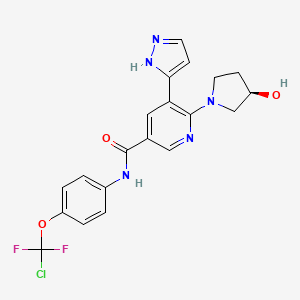
| Formula | C20H18ClF2N5O3 |
|---|---|
| Molecular weight | 449.85 g/mol |
| IUPAC name | N-[4-[chloro(difluoro)methoxy]phenyl]-6-[(3R)-3-hydroxypyrrolidin-1-yl]-5-(1H-pyrazol-5-yl)pyridine-3-carboxamide |
| CAS | 1492952-76-7 |
| PubChem CID | 72165228 |
| InChIKey | VOVZXURTCKPRDQ-CQSZACIVSA-N |
| logP | 3.46 (XLogP 3.0) |
| Polar surface area | 103.37 Ų |
| H-bond acceptors / donors | 6 / 3 |
| Drug-likeness (QED) | 0.50 |
| Lipinski violations | 0 |
SMILES
O=C(Nc1ccc(OC(F)(F)Cl)cc1)c1cnc(N2CC[C@@H](O)C2)c(-c2cc[nH]n2)c1Biology & Pharmacokinetics
Pharmacokinetics predicted
| Bioavailability | 70.0% |
|---|---|
| Half-life | 1.313 h |
| Volume of distribution | 0.593 L/kg |
| Protein binding | 91.1% |
| BBB penetrant | No |
Enzyme interactions
| Enzyme | Role | Detail |
|---|---|---|
| CYP1A2 | Inhibitor | — |
| CYP2C8 | Inhibitor | — |
Transporters
BCRP (Inhibitor)BSEP (Inhibitor)MDR1 (Inhibitor)MRP1 (Inhibitor)OATP1B1 (Inhibitor)OATP1B1 (Inhibitor)OATP1B3 (Inhibitor)OCT1 (Inhibitor)P-gp (Inhibitor)MDR1 (Substrate)P-gp (Substrate)
Registered Products (1)
| Brand | Form / strength | Pack | Agent | Citizen (JOD) |
|---|---|---|---|---|
| Scemblix Tablets | Tablet 20 mg | 60 tab | The Jordan Drugstore Co | — |