Betamethasone Dipropionate
JFDA label: Sunnymethasone
Mechanism of Action
Agonist of Glucocorticoid receptor — Glucocorticoid receptor agonist
| Target | Action | Gene / class |
|---|---|---|
| Glucocorticoid receptor efficacy | AGONIST | NR3C1 |
Indications
Approved
- Infections — infection
- Psoriasis — psoriasis
- Skin Diseases — skin disease
Off-label
- Gout
- Lichen Planus, Oral
- Periarthritis
- Sinusitis
Contraindications
Source: openFDA
- None. None ( 4 ) Absolute
Adverse Reactions
Vascular disorders (1)
Not Known Hypertension
Nervous system disorders (1)
Not Known Paraesthesia
Endocrine disorders (1)
Not Known Cushing's syndrome
Metabolism and nutrition disorders (1)
Not Known Hyperglycaemia
Skin and subcutaneous tissue disorders (11)
Not Known Dermatitis · Dermatitis acneiform · Dermatitis contact · Dry skin · Erythema · Papule · Pruritus · Rash erythematous · Rash follicular · Skin depigmentation · Urticaria
Infections and infestations (1)
Not Known Infection
General disorders and administration site conditions (12)
Not Known Atrophy · Contusion · Folliculitis · Glycosuria · Hyperaesthesia · Hypertrichosis · Leukoderma · Miliaria · Pain · Skin atrophy · Skin striae · Telangiectasia
Dosing
Source: openFDA
Warnings & Precautions
Source: openFDA
Warnings & Precautions
Hypercalcemia and Hypercalciuria: Hypercalcemia and hypercalciuria have been reported. If either occurs, discontinue until parameters of calcium metabolism normalize. ( 5.1 ) Effects on Endocrine System: Can cause reversible hypothalamic-pituitary-adrenal (HPA) axis suppression with the potential for glucocorticosteroid insufficiency during and after withdrawal of treatment. Risk factors include the use of high-potency topical corticosteroid, use over a large surface area or to areas under occlusion, prolonged use, altered skin barrier, liver failure, and use in pediatric patients. Modify use should HPA axis suppression develop. ( 5.2 , 8.4 ) Ophthalmic Adverse Reactions: May increase the risk of cataracts and glaucoma. If visual symptoms occur, consider referral to an ophthalmologist. ( 5.5 )
Hypercalcemia and Hypercalciuria Hypercalcemia and hypercalciuria have
Hypercalcemia and Hypercalciuria Hypercalcemia and hypercalciuria have been observed with use of calcipotriene and betamethasone dipropionate topical suspension. If hypercalcemia or hypercalciuria develop, discontinue treatment until parameters of calcium metabolism have normalized. The incidence of hypercalcemia and hypercalciuria following calcipotriene and betamethasone dipropionate topical suspension treatment of more than 8 weeks has not been evaluated [see Clinical Pharmacology (12.2) ].
Effects on Endocrine System Hypothalamic-Pituitary-Adrenal Axis Suppre
Effects on Endocrine System Hypothalamic-Pituitary-Adrenal Axis Suppression Calcipotriene and betamethasone dipropionate topical suspension can cause reversible hypothalamic-pituitary-adrenal (HPA) axis suppression with the potential for clinical glucocorticosteroid insufficiency. This may occur during treatment or upon withdrawal of treatment. Factors that predispose a patient to HPA axis suppression include the use of high-potency steroids, large treatment surface areas, prolonged use, use of occlusive dressings, altered skin barrier, liver failure, and young age. Evaluation for HPA axis suppression may be done by using the adrenocorticotropic hormone (ACTH) stimulation test. If HPA axis suppression is documented, gradually withdraw calcipotriene and betamethasone dipropionate topical suspension, reduce the frequency of application, or substitute with a less potent corticosteroid. The following trials evaluated the effects of calcipotriene and betamethasone dipropionate topical suspension on HPA axis suppression: In a trial evaluating the effects of calcipotriene and betamethasone dipropionate topical suspension and calcipotriene and betamethasone dipropionate ointment on the HPA axis, 32 adult subjects applied both calcipotriene and betamethasone dipropionate topical suspension on the scalp and calcipotriene and betamethasone dipropionate ointment on the body. Adrenal suppression was identified in 5 of 32 subjects (16%) after 4 weeks of treatment and in 2 of 11 subjects (18%) who continued treatment for 8 weeks. In another trial, 36 adult subjects applied calcipotriene and betamethasone dipropionate topical suspension on the body and scalp and 7 subjects applied calcipotriene and betamethasone dipropionate topical suspension on the body. Adrenal suppression occurred in 3 out of 43 subjects (7%) after 4 weeks of treatment and in none of the 36 subjects who continued treatment for 8 weeks [see Clinical Pharmacology (12.2) ]. In two trials, the effects of calcipotriene and betamethasone dipropionate topical suspension on the HPA axis were evaluated in 31 and 30 pediatric subjects aged 12 to 17 years old who applied calcipotriene and betamethasone dipropionate topical suspension on the scalp and the scalp/body, respectively. Adrenal suppression occurred in 1 of 30 evaluable subjects (3%) after 4 weeks of treatment (scalp) and 5 of 31 evaluable subjects (16%) after up to 8 weeks of treatment (scalp and body) [see Use in Specific Populations (8.4) and Clinica
Allergic Contact Dermatitis with Topical Corticosteroids Allergic cont
Allergic Contact Dermatitis with Topical Corticosteroids Allergic contact dermatitis to a topical corticosteroid is usually diagnosed by observing a failure to heal rather than a clinical exacerbation. Such an observation should be corroborated with appropriate diagnostic patch testing.
Allergic Contact Dermatitis with Topical Calcipotriene Allergic contac
Allergic Contact Dermatitis with Topical Calcipotriene Allergic contact dermatitis has been observed with use of topical calcipotriene. Such an observation should be corroborated with appropriate diagnostic patch testing.
Ophthalmic Adverse Reactions Use of topical corticosteroids, including
Ophthalmic Adverse Reactions Use of topical corticosteroids, including calcipotriene and betamethasone dipropionate topical suspension, may increase the risk of posterior subcapsular cataracts and glaucoma. Cataracts and glaucoma have been reported with the postmarketing use of topical corticosteroid products [see Adverse Reactions (6.2) ]. Avoid contact of calcipotriene and betamethasone dipropionate topical suspension with eyes. Calcipotriene and betamethasone dipropionate topical suspension may cause eye irritation. Advise patients to report any visual symptoms and consider referral to an ophthalmologist for evaluation.
Chemistry & Properties
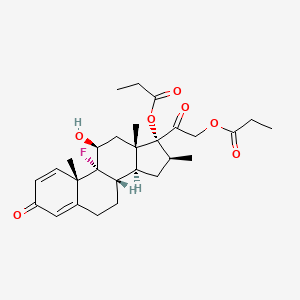
| Formula | C28H37FO7 |
|---|---|
| Molecular weight | 504.6 g/mol |
| IUPAC name | [2-[(8S,9R,10S,11S,13S,14S,16S,17R)-9-fluoro-11-hydroxy-10,13,16-trimethyl-3-oxo-17-propanoyloxy-6,7,8,11,12,14,15,16-octahydrocyclopenta[a]phenanthren-17-yl]-2-oxoethyl] propanoate |
| CAS | 5593-20-4 |
| PubChem CID | 21800 |
| InChIKey | CIWBQSYVNNPZIQ-XYWKZLDCSA-N |
| logP | 3.82 (XLogP 3.6) |
| Polar surface area | 106.97 Ų |
| H-bond acceptors / donors | 7 / 1 |
| Drug-likeness (QED) | 0.55 |
| Lipinski violations | 1 |
SMILES
CCC(=O)OCC(=O)[C@@]1(OC(=O)CC)[C@@H](C)C[C@H]2[C@@H]3CCC4=CC(=O)C=C[C@]4(C)[C@@]3(F)[C@@H](O)C[C@@]21CBiology & Pharmacokinetics
Pharmacokinetics
| BBB penetrant | Yes |
|---|
Enzyme interactions
| Enzyme | Role | Detail |
|---|---|---|
| CYP2B6 | Inhibitor | — |
| CYP2C8 | Inhibitor | — |
| CYP3A4 | Substrate | — |
Transporters
BCRP (Inhibitor)BSEP (Inhibitor)MRP1 (Inhibitor)OATP1B1 (Inhibitor)OATP1B3 (Inhibitor)P-gp (Inhibitor)P-gp (Substrate)
Registered Products (1)
| Brand | Form / strength | Pack | Agent | Citizen (JOD) |
|---|---|---|---|---|
| Sunnymethasone | Ampoule 14 mg/2 ml | 1 amp | Mohamad Zreiqat Drug Store | 2.380 |