Brinzolamide
JFDA label: Azopt Eye Drops
Mechanism of Action
Inhibitor of Carbonic anhydrase 2 — Carbonic anhydrase II inhibitor
| Target | Action | Gene / class |
|---|---|---|
| Carbonic anhydrase 2 efficacy | INHIBITOR | CA2 |
Indications
Approved
- Elevated intraocular pressure
Contraindications
Source: Lexicomp
- Additional contraindications (not in US labeling): Hypersensitivity to sulfonamide Absolute
- Hypersensitivity to brinzolamide or any component of the formulation Absolute
- severe renal impairment (CrCl Absolute
Adverse Reactions
Cardiac disorders (1)
Common Hyperemia
Nervous system disorders (2)
Common Foreign body sensation of eye · headache
Gastrointestinal disorders (1)
Common Dysgeusia
Skin and subcutaneous tissue disorders (1)
Common Dermatitis
Eye disorders (8)
Common blepharitis · Blurred vision · eye discharge · eye discomfort · eye pain · eye pruritus · keratitis · xerophthalmia
Respiratory, thoracic and mediastinal disorders (1)
Common Rhinitis
Dosing
Source: Lexicomp
Warnings & Precautions
Source: Lexicomp
Ophthalmic effects
Vision may be temporarily blurred, which may impair physical or mental abilities; patients must be cautioned about performing tasks that require mental alertness (eg, operating machinery or driving).
Sulfonamide (“sulfa”) allergy
The FDA-approved product labeling for many medications containing a sulfonamide chemical group includes a broad contraindication in patients with a prior allergic reaction to sulfonamides. There is a potential for cross-reactivity between members of a specific class (eg, two antibiotic sulfonamides). However, concerns for cross-reactivity have previously extended to all compounds containing the sulfonamide structure (SO2NH2). An expanded understanding of allergic mechanisms indicates cross-reactivity between antibiotic sulfonamides and nonantibiotic sulfonamides may not occur or at the very least this potential is extremely low (Brackett 2004; Johnson 2005; Slatore 2004; Tornero 2004). In particular, mechanisms of cross-reaction due to antibody production (anaphylaxis) are unlikely to occur with nonantibiotic sulfonamides. T-cell-mediated (type IV) reactions (eg, maculopapular rash) are less well understood and it is not possible to completely exclude this potential based on current insights. In cases where prior reactions were severe (Stevens-Johnson syndrome/TEN), some clinicians choose to avoid exposure to these classes. Disease-related concerns:
Acute angle-closure glaucoma
Use has not been studied in acute angle-closure glaucoma.
Corneal endothelium
Use with caution in patients with low endothelial cell counts; may be at increased risk of corneal edema.
Renal impairment
Use is not recommended in patients with severe renal impairment (has not been studied). Concurrent drug therapy issues:
Drug-drug interactions
Potentially significant interactions may exist, requiring dose or frequency adjustment, additional monitoring, and/or selection of alternative therapy. Consult drug interactions database for more detailed. Special populations:
Contact lens wearers
Product may contain benzalkonium chloride which may be absorbed by soft contact lenses; remove lens prior to administration and wait 15 minutes before reinserting.
Pregnancy & Lactation
Pregnancy
Adverse events have been observed in animal reproduction studies.
Lactation
Due to the potential for serious adverse reactions in the breastfeeding infant, the manufacturer recommends a decision be made whether to discontinue breastfeeding or to discontinue the drug, taking into account the importance of treatment to the mother.
Monitoring
| Clinical pearl | Ophthalmic exams and intraocular pressure |
|---|
Chemistry & Properties
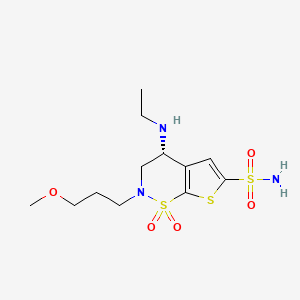
| Formula | C12H21N3O5S3 |
|---|---|
| Molecular weight | 383.52 g/mol |
| IUPAC name | (4R)-4-(ethylamino)-2-(3-methoxypropyl)-1,1-dioxo-3,4-dihydrothieno[3,2-e]thiazine-6-sulfonamide |
| CAS | 138890-62-7 |
| PubChem CID | 68844 |
| InChIKey | HCRKCZRJWPKOAR-JTQLQIEISA-N |
| logP | 0.09 (XLogP -0.3) |
| Polar surface area | 118.8 Ų |
| H-bond acceptors / donors | 7 / 2 |
| Drug-likeness (QED) | 0.64 |
| Lipinski violations | 0 |
SMILES
CCN[C@H]1CN(CCCOC)S(=O)(=O)c2sc(S(N)(=O)=O)cc21Biology & Pharmacokinetics
Pharmacokinetics
| BBB penetrant | No |
|---|
Enzyme interactions
| Enzyme | Role | Detail |
|---|---|---|
| CYP2C9 | Substrate | — |
| CYP3A4 | Substrate | — |
Receptor binding (top 4)
| Target | Action | Affinity |
|---|---|---|
| carbonic anhydrase 7 (CA7) | Inhibitor | pKi 8.6 |
| Carbonic Anhydrase Isozymes, CA II | Binding | pKi 8.5 |
| carbonic anhydrase 12 (CA12) | Inhibitor | pKi 8.5 |
| Carbonic Anhydrase Isozymes, CA IX | Binding | pKi 7.4 |
Transporters
BCRP (Inhibitor)BSEP (Inhibitor)BSEP (Inhibitor)MRP1 (Inhibitor)MRP2 (Inhibitor)MRP3 (Inhibitor)MRP4 (Inhibitor)OATP1B1 (Inhibitor)OATP1B3 (Inhibitor)P-gp (Inhibitor)P-gp (Substrate)
Registered Products (3)
| Brand | Form / strength | Pack | Agent | Citizen (JOD) |
|---|---|---|---|---|
| Azopt Eye Drops | Ophthalmic Solution 10 mg/ml | 5 ml | The Jordan Drugstore Co | 4.110 |
| Azarga | Injection 10 mg/ml, 5 mg/ml | 5 ml | The Jordan Drugstore Co | 8.830 |
| Simbrinza Eye drops, suspension | Suspension 10 mg/1 ml, 2 mg/1 mg | 5 ml | The Jordan Drugstore Co | 11.130 |