Carbetocin
JFDA label: Pabal RTS
Mechanism of Action
Agonist of Oxytocin receptor — Oxytocin receptor agonist
| Target | Action | Gene / class |
|---|---|---|
| Oxytocin receptor efficacy | AGONIST | OXTR |
Indications
Approved
- Prevention of uterine atony and postpartum hemorrhage
Contraindications
Source: Lexicomp
- Hypersensitivity to carbetocin, oxytocin, or any component of the formulation Absolute
- administration prior to delivery of infant for any reason (including elective or medical induction of labor) Absolute
- serious cardiovascular disorders Absolute
- use in children Absolute
Adverse Reactions
Cardiac disorders (4)
Very Common Flushing · hypotension
Common Chest pain · tachycardia
Nervous system disorders (4)
Very Common Headache
Common Anxiety · chills · dizziness
Blood and lymphatic system disorders (1)
Common Anemia
Gastrointestinal disorders (4)
Very Common Abdominal pain · nausea · vomiting
Common Metallic taste
Skin and subcutaneous tissue disorders (1)
Very Common Pruritus
Musculoskeletal and connective tissue disorders (2)
Very Common Tremor
Common Back pain
General disorders and administration site conditions (2)
Very Common Feeling of warmth
Common Diaphoresis
Respiratory, thoracic and mediastinal disorders (1)
Common Dyspnea
Dosing
Source: Lexicomp
Warnings & Precautions
Source: Lexicomp
Antidiuretic effect
May produce antidiuretic effect; risk of water intoxication cannot be excluded.
Bleeding
Persistent bleeding warrants further evaluation to rule out coagulopathy, genital tract trauma, or the presence of retained placental fragments. Disease-related concerns:
Asthma
Use with caution in patients with asthma.
Cardiovascular disease
Use has not been studied in patients with a history of hypertension, or known coagulopathy; use with extreme caution in patients with cardiovascular disease (contraindicated in serious cardiovascular disorders), especially coronary artery disease.
Epilepsy
Use with caution in patients with epilepsy.
Migraines
Use with caution in patients with migraines. Concurrent drug therapy issues:
Drug-drug interactions
Potentially significant interactions may exist, requiring dose or frequency adjustment, additional monitoring, and/or selection of alternative therapy. Consult drug interactions database for more detailed information. Other warnings/precautions:
Appropriate use
Carbetocin induced contractions are of a longer duration than those observed with oxytocin and are not stopped by discontinuation of therapy. Improper use during pregnancy may produce symptoms similar to those observed with oxytocin overdosage (eg, hyperstimulation of uterus with strong or prolonged contractions, tumultuous labor, uterine rupture, cervical and vaginal lacerations, postpartum hemorrhage, utero-placental hypoperfusion and variable deceleration of fetal heart, fetal hypoxia, hypercapnia, or death). Therapy should not be repeated if response to initial dose is inadequate; aggressive therapy with alternative agents (eg, oxytocin, ergonovine) should be utilized. Safety of use in patients with eclampsia and pre-eclampsia has not been evaluated; monitor blood pressure. Appropriate doses have not been established in women following labor or vaginal delivery.
Pregnancy & Lactation
Pregnancy
Use in pregnancy prior to delivery is contraindicated. Carbetocin induced contractions are of a longer duration than those observed with oxytocin and are not stopped by discontinuation of therapy. Improper use during pregnancy may produce symptoms similar to those observed with oxytocin overdosage (eg, hyperstimulation of uterus, uterine rupture).
Lactation
Carbetocin is present in breast milk. Small amounts of carbetocin were detected in the breast milk of 5 healthy nursing women approximately 7 to 14 weeks postpartum though peak levels observed were 50 times lower than in plasma (Silcox 1993). Exposure to the breastfeeding infant is expected to be minimal and not expected to pose significant health risks as carbetocin in breast milk is rapidly degraded in the GI tract of a breastfeeding infant. Milk let-down was found to occur normally in 5 breas
Monitoring
| Clinical pearl | Persistent postpartum bleeding; blood pressure |
|---|
Chemistry & Properties
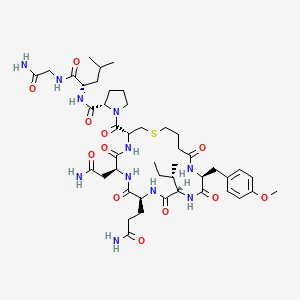
| Formula | C45H69N11O12S |
|---|---|
| Molecular weight | 988.18 g/mol |
| IUPAC name | (2S)-N-[(2S)-1-[(2-amino-2-oxoethyl)amino]-4-methyl-1-oxopentan-2-yl]-1-[(3R,6S,9S,12S,15S)-6-(2-amino-2-oxoethyl)-9-(3-amino-3-oxopropyl)-12-[(2S)-butan-2-yl]-15-[(4-methoxyphenyl)methyl]-5,8,11,14,17-pentaoxo-1-thia-4,7,10,13,16-pentazacycloicosane-3-carbonyl]pyrrolidine-2-carboxamide |
| CAS | 37025-55-1 |
| PubChem CID | 16681432 |
| InChIKey | NSTRIRCPWQHTIA-DTRKZRJBSA-N |
| logP | -2.5 (XLogP -1.1) |
| Polar surface area | 362.51 Ų |
| H-bond acceptors / donors | 13 / 10 |
| Drug-likeness (QED) | 0.07 |
| Lipinski violations | 3 |
SMILES
CC[C@H](C)[C@@H]1NC(=O)[C@H](Cc2ccc(OC)cc2)NC(=O)CCCSC[C@@H](C(=O)N2CCC[C@H]2C(=O)N[C@@H](CC(C)C)C(=O)NCC(N)=O)NC(=O)[C@H](CC(N)=O)NC(=O)[C@H](CCC(N)=O)NC1=OBiology & Pharmacokinetics
Pharmacokinetics predicted
| Bioavailability | 70.0% |
|---|---|
| Half-life | 1.37 h |
| Volume of distribution | 0.326 L/kg |
| Protein binding | 47.5% |
| BBB penetrant | No |
Enzyme interactions
| Enzyme | Role | Detail |
|---|---|---|
| CYP2C19 | Substrate | — |
Receptor binding (top 1)
| Target | Action | Affinity |
|---|---|---|
| OT receptor (OXTR) | Agonist | pEC50 8.0 |
Transporters
BCRP (Inhibitor)BSEP (Inhibitor)MRP1 (Inhibitor)OATP1B1 (Inhibitor)OATP1B3 (Inhibitor)P-gp (Inhibitor)P-gp (Substrate)
Registered Products (3)
| Brand | Form / strength | Pack | Agent | Citizen (JOD) |
|---|---|---|---|---|
| CARBETOCIN GP-PHARM 100 MICROGRAMS SOLUTION FOR INJECTION IN PREFILLED SYRINGE, 5 PFS /box | Injection 0.1 mg/1 ml | 5 SYR/1 BOX | Almutanabbe Drug Store | — |
| Datocin 100mcg/ml solution for injection | Injection 0.1 mg/1 ml | 4 vial | Al Rayah drug store | — |
| Pabal RTS | Vial 100 mcg/1 ml | 5 vial | Petra Drug Store | — |