Cilastatin
JFDA label: Tienam for IV Infusion
Mechanism of Action
Inhibitor of Dipeptidase 1 — Renal dipeptidase inhibitor
| Target | Action | Gene / class |
|---|---|---|
| Dipeptidase 1 efficacy | INHIBITOR | DPEP1 |
Indications
Off-label
- Bacterial Infections
- Hematologic Neoplasms
- Infections
- Pneumonia, Bacterial
- Pneumonia, Ventilator-Associated
- Pyelonephritis
- Urinary Tract Infections
Antimicrobial Spectrum
Expected / intrinsic spectrum (EUCAST breakpoints & labels) — not local resistance. Source: openfda-label.
Bacteria
| Organism | Activity | MIC |
|---|---|---|
| Acinetobacter calcoaceticus | Active | — |
| Bacteroides caccae | Active | — |
| Bacteroides fragilis | Active | — |
| Bacteroides ovatus | Active | — |
| Bacteroides stercoris | Active | — |
| Bacteroides thetaiotaomicron | Active | — |
| Bacteroides uniformis | Active | — |
| Bacteroides vulgatus | Active | — |
| Citrobacter freundii | Active | — |
| Citrobacter koseri | Active | — |
| Enterobacter asburiae | Active | — |
| Enterobacter cloacae | Active | — |
| Enterococcus faecalis | Active | — |
| Enterococcus faecium | Active | — |
| Escherichia coli | Active | — |
| Fusobacterium necrophorum | Active | — |
| Fusobacterium nucleatum | Active | — |
| Fusobacterium varium | Active | — |
| Haemophilus influenzae | Active | — |
| Klebsiella aerogenes | Active | — |
| Klebsiella oxytoca | Active | — |
| Klebsiella pneumoniae | Active | — |
| Peptostreptococcus anaerobius | Active | — |
| Prevotella bivia | Active | — |
| Pseudomonas aeruginosa | Active | — |
| Serratia marcescens | Active | — |
| Staphylococcus aureus | Active | — |
| Streptococcus anginosus | Active | — |
| Streptococcus constellatus | Active | — |
| Streptococcus pneumoniae | Active | — |
Class profile
| atypicalCoverage | No |
|---|---|
| moaCategory | Renal dehydropeptidase-I inhibitor (protects imipenem from hydrolysis) |
| mrsaCoverage | 0 |
Contraindications
Source: openFDA
- Imipenem and Cilastatin for Injection (I.V.) is contraindicated in patients who have shown hypersensitivity to any component of this product. Known hypersensitivity to any component of Imipenem and Cilastatin for Injection (I.V.) ( 4 ) Absolute
Adverse Reactions
Hepatobiliary disorders (4)
Not Known Aspartate Aminotransferase Ast Or Sgot · Bilirubin · Increased Alanine Aminotransferase Alt Or Sgpt · Urine Bilirubin
Renal and urinary disorders (1)
Not Known Creatinine Urinalysis Presence Of Urine Protein
Blood and lymphatic system disorders (2)
Not Known Decreased Hemoglobin And Hematocrit · Increased Platelets
Investigations (5)
Not Known And Lactate Dehydrogenase Ldh Hemic Increased Eosinophils · Increased Bun · Increased Monocyte · Increased Wbc · Urine White Blood Cells
General disorders and administration site conditions (4)
Not Known Alkaline Phosphatase · Positive Coombs Test · Urine Casts · Urine Red Blood Cells
Dosing
Source: openFDA
Warnings & Precautions
Source: openFDA
Warnings & Precautions
Hypersensitivity Reactions: Serious and occasionally fatal hypersensitivity (anaphylactic) reactions have been reported in patients receiving therapy with beta-lactams. If an allergic reaction to Imipenem and Cilastatin for Injection (I.V.) occurs, discontinue the drug immediately ( 5.1 ). Seizure Potential: Seizures and other CNS adverse reactions, such as confusional states and myoclonic activity, have been reported during treatment with Imipenem and Cilastatin for Injection (I.V.). If focal tremors, myoclonus, or seizures occur, patients should be evaluated neurologically, placed on anticonvulsant therapy if not already instituted, and the dosage of Imipenem and Cilastatin for Injection (I.V.) re-examined to determine whether it should be decreased, or the antibacterial drug discontinued ( 5.2 ). Increased Seizure Potential Due to Interaction with Valproic Acid: Co-administration of Imipenem and Cilastatin for Injection (I.V.), to patients receiving valproic acid or divalproex sodium results in a reduction in valproic acid concentrations. The valproic acid concentrations may drop below the therapeutic range as a result of this interaction, therefore increasing the risk of breakthrough seizures. The concomitant use of Imipenem and Cilastatin for Injection (I.V.) and valproic acid/divalproex sodium is generally not recommended ( 5.3 , 7.3 ). Clostridioides difficile-Associated Diarrhea (CDAD): has been reported with use of Imipenem and Cilastatin for Injection (I.V.) and may range in severity from mild diarrhea to fatal colitis. Evaluate if diarrhea occurs ( 5.4 ).
Hypersensitivity Reactions Serious and occasionally fatal hypersensiti
Hypersensitivity Reactions Serious and occasionally fatal hypersensitivity (anaphylactic) reactions have been reported in patients receiving therapy with beta-lactams. These reactions are more likely to occur in individuals with a history of sensitivity to multiple allergens. There have been reports of individuals with a history of penicillin hypersensitivity who have experienced severe hypersensitivity reactions when treated with another beta-lactam. Before initiating therapy with Imipenem and Cilastatin for Injection (I.V.), careful inquiry should be made concerning previous hypersensitivity reactions to penicillins, cephalosporins, other beta-lactams and other allergens. If an allergic reaction to Imipenem and Cilastatin for Injection (I.V.) occurs, discontinue the drug immediately. Serious anaphylactic reactions require immediate emergency treatment as clinically indicated.
Seizure Potential Seizures and other CNS adverse experiences, such as
Seizure Potential Seizures and other CNS adverse experiences, such as confusional states and myoclonic activity, have been reported during treatment with Imipenem and Cilastatin for Injection (I.V.), especially when recommended dosages were exceeded [see Adverse Reactions ( 6.1 , 6.2 )]. These experiences have occurred most commonly in patients with CNS disorders (e.g., brain lesions or history of seizures) and/or compromised renal function [see Use in Specific Populations ( 8.6 )] . However, there have been reports of CNS adverse experiences in patients who had no recognized or documented underlying CNS disorder or compromised renal function. Anticonvulsant therapy should be continued in patients with known seizure disorders. If focal tremors, myoclonus, or seizures occur, patients should be evaluated neurologically, placed on anticonvulsant therapy if not already instituted, and the dosage of Imipenem and Cilastatin for Injection (I.V.) re-examined to determine whether it should be decreased, or the antibacterial drug discontinued.
Increased Seizure Potential Due to Interaction with Valproic Acid Case
Increased Seizure Potential Due to Interaction with Valproic Acid Case reports in the literature have shown that co-administration of carbapenems, including Imipenem and Cilastatin for Injection (I.V.), to patients receiving valproic acid or divalproex sodium results in a reduction in valproic acid concentrations. The valproic acid concentrations may drop below the therapeutic range as a result of this interaction, therefore increasing the risk of breakthrough seizures. Increasing the dose of valproic acid or divalproex sodium may not be sufficient to overcome this interaction. The concomitant use of Imipenem and Cilastatin for Injection (I.V.) and valproic acid/divalproex sodium is generally not recommended. Antibacterials other than carbapenems should be considered to treat infections in patients whose seizures are well controlled on valproic acid or divalproex sodium. If administration of Imipenem and Cilastatin for Injection (I.V.) is necessary, supplemental anti-convulsant therapy should be considered [see Drug Interactions ( 7.3 )]. Close adherence to the recommended dosage and dosage schedules is urged, especially in patients with known factors that predispose to convulsive activity.
Clostridioides difficile -Associated Diarrhea (CDAD) Clostridioides di
Clostridioides difficile -Associated Diarrhea (CDAD) Clostridioides difficile associated diarrhea (CDAD) has been reported with use of nearly all antibacterial agents, including Imipenem and Cilastatin for Injection (I.V.), and may range in severity from mild diarrhea to fatal colitis. Treatment with antibacterial agents alters the normal flora of the colon leading to overgrowth of C. difficile . C. difficile produces toxins A and B which contribute to the development of CDAD. Hypertoxin producing strains of C. difficile cause increased morbidity and mortality, as these infections can be refractory to antimicrobial therapy and may require colectomy. CDAD must be considered in all patients who present with diarrhea following antibacterial drug use. Careful medical history is necessary since CDAD has been reported to occur over two months after the administration of antibacterial agents. If CDAD is suspected or confirmed, ongoing antibacterial drug use not directed against C. difficile may need to be discontinued. Appropriate fluid and electrolyte management, protein supplementation, antibacterial drug treatment of C. difficile, and surgical evaluation should be instituted as clinically indicated.
Development of Drug-Resistant Bacteria As with other antibacterial dru
Development of Drug-Resistant Bacteria As with other antibacterial drugs, prolonged use of Imipenem and Cilastatin for Injection (I.V.) may result in overgrowth of nonsusceptible organisms. Repeated evaluation of the patient's condition is essential. If superinfection occurs during therapy, appropriate measures should be taken. Prescribing Imipenem and Cilastatin for Injection (I.V.) in the absence of a proven or strongly suspected bacterial infection or a prophylactic indication is unlikely to provide benefit to the patient and increases the risk of the development of drug-resistant bacteria.
Monitoring
| Efficacy | Culture and susceptibility testing; clinical resolution (temperature, WBC, CRP, procalcitonin) |
|---|---|
| Toxicity | Renal function (dose adjustment in renal impairment); hepatic function for hepatically cleared agents; signs of C. difficile infection (diarrhoea) |
| Clinical pearl | Culture results guide de-escalation to narrower-spectrum therapy. Review antibiotic appropriateness at 48–72 h (antimicrobial stewardship). |
| Counseling | Complete the full course. Report persistent diarrhoea, rash, or lack of improvement after 48–72 h. |
Chemistry & Properties
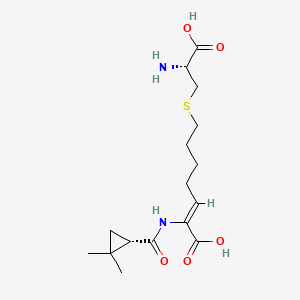
| Formula | C16H26N2O5S |
|---|---|
| Molecular weight | 358.46 g/mol |
| IUPAC name | (Z)-7-[(2R)-2-amino-2-carboxyethyl]sulfanyl-2-[[(1S)-2,2-dimethylcyclopropanecarbonyl]amino]hept-2-enoic acid |
| CAS | 82009-34-5 |
| PubChem CID | 6435415 |
| InChIKey | DHSUYTOATWAVLW-WFVMDLQDSA-N |
| logP | 1.43 (XLogP -1.0) |
| Polar surface area | 129.72 Ų |
| H-bond acceptors / donors | 5 / 4 |
| Drug-likeness (QED) | 0.32 |
| Lipinski violations | 0 |
SMILES
CC1(C)C[C@@H]1C(=O)N/C(=C\CCCCSC[C@H](N)C(=O)O)C(=O)OBiology & Pharmacokinetics
Pharmacokinetics predicted
| Bioavailability | 70.0% |
|---|---|
| Half-life | 1.04 h |
| Volume of distribution | 0.148 L/kg |
| Protein binding | 35.4% |
| BBB penetrant | No |
Transporters
BCRP (Inhibitor)BSEP (Inhibitor)MRP1 (Inhibitor)OAT1 (Inhibitor)OAT3 (Inhibitor)OATP1B1 (Inhibitor)OATP1B3 (Inhibitor)P-gp (Inhibitor)P-gp (Substrate)
Registered Products (7)
| Brand | Form / strength | Pack | Agent | Citizen (JOD) |
|---|---|---|---|---|
| Cilanem | Vial 500 mg, 500 mg | 1 vial | Reda Jardaneh Drug Store | — |
| Imista( 500mg+500mg) powder for solution for infusion | Infusion 500 mg, 500 mg | 10 vial | ORIENT DRUG STORE CO | — |
| Ivnem | Vial 500 mg, 500 mg | 10 vial | The Arab Pharmaceutical Manufactruing Co | — |
| Premax 500mg/500mg | Vial 500 mg, 500 mg | 1 vial pack varies | Al-Taqqadom Pharmaceutical Industries | — |
| Premax 500mg/500mg | Vial 500 mg, 500 mg | 50 vial pack varies | Al-Taqqadom Pharmaceutical Industries | — |
| Premax 500mg/500mg | Vial 500 mg, 500 mg | 10 vial pack varies | Al-Taqqadom Pharmaceutical Industries | — |
| Tienam for IV Infusion | Infusion 500 mg, 500 mg | 1 vial | Adatco Drug Store | — |