Colecalciferol
JFDA label: D3 Max 50000
Mechanism of Action
Agonist of Vitamin D3 receptor — Vitamin D receptor agonist
| Target | Action | Gene / class |
|---|---|---|
| Vitamin D3 receptor efficacy | AGONIST | VDR |
Indications
Approved
- Anemia — anemia (phenotype)
- Anemia, Iron-Deficiency — Iron deficiency anemia
- Osteoporosis — osteoporosis
Off-label
- Acquired Immunodeficiency Syndrome
- Adenoma
- Aging
- Arthritis, Juvenile
- Asthma
- Autistic Disorder
- Bone Diseases, Metabolic
- Breast Neoplasms
- Bronchiolitis
- Cardiovascular Diseases
- Cognitive Dysfunction
- Colitis, Ulcerative
- Colonic Neoplasms
- Colorectal Neoplasms
- Common Cold
- Conjunctivitis, Allergic
- Crohn Disease
- Depressive Disorder
- Dermatitis, Atopic
- Diabetes Mellitus
- Diabetes Mellitus, Type 1
- Diabetes Mellitus, Type 2
- Diabetes, Gestational
- Epilepsy
- Fractures, Bone
- Glucose Intolerance
- HIV Infections
- Heart Failure
- Helicobacter Infections
- Hematologic Neoplasms
- Hepatitis C
- Hereditary Breast and Ovarian Cancer Syndrome
- Hip Fractures
- Hyperparathyroidism
- Hypersensitivity
- Hypogonadism
- Infections
- Infertility, Male
- Inflammatory Bowel Diseases
- Influenza, Human
- Keratosis, Actinic
- Leukemia, Lymphocytic, Chronic, B-Cell
- Leukemia, Myeloid, Acute
- Lipid Metabolism Disorders
- Lupus Erythematosus, Systemic
- Lymphoma, Large B-Cell, Diffuse
- Malnutrition
- Melanoma
- Metabolic Syndrome
- Multiple Sclerosis
- Multiple Sclerosis, Relapsing-Remitting
- Neoplasms
- Neurofibromatosis 1
- Non-alcoholic Fatty Liver Disease
- Obesity
- Optic Neuritis
- Osteoporosis, Postmenopausal
- Ovarian Neoplasms
- Parkinson Disease
- Polycystic Ovary Syndrome
- Prediabetic State
- Pregnancy
- Prostatic Neoplasms
- Prostatic Neoplasms, Castration-Resistant
- Psoriasis
- Psychotic Disorders
- Pulmonary Disease, Chronic Obstructive
- Rectal Neoplasms
- Renal Insufficiency, Chronic
- Respiratory Insufficiency
- Schizophrenia
- Severe Acute Respiratory Syndrome
- Staphylococcal Infections
- Tuberculosis
- Tuberculosis, Pulmonary
- Urinary Tract Infections
- Urticaria
- Vitamin D Deficiency
Contraindications
Source: openFDA
- is contraindicated in patients who have: • An existing hypervitaminosis, or • A history of hypersensitivity to any vitamins or excipients contained in this formulation. • Hypersensitivity to any of vitamins or excipients ( 4 ) • Existing hypervitaminosis ( 4 ) Absolute
Dosing
Source: openFDA
Warnings & Precautions
Source: openFDA
Warnings & Precautions
• Risk of Aluminum Toxicity: For at risk patients (renal failure or those with prolonged therapy), consider periodic monitoring of aluminum levels ( 5.1 ) • Allergic Reactions: To thiamine may occur ( 5.2 ) • Hypervitaminosis A : Patients with renal failure or liver disease may be at higher risk ( 5.3 ) • Decreased Anticoagulant Effect of Warfarin: Monitor INR ( 5.4 , 7.1 ) • Interferes with Megaloblastic Anemia Diagnosis: Avoid during testing for this disorder ( 5.5 ) • Risk of Vitamin Deficiencies or Excesses: Monitor blood vitamin concentrations ( 5.6 ) • False Negative Urine Glucose Tests: Due to vitamin C ( 5.7 ) • Risk of Vitamin E Toxicity: Additional oral and parenteral vitamin E may result in elevated vitamin E blood concentrations in infants ( 5.8 ) • Low Vitamin A Levels: Monitor vitamin A levels ( 5.9 ) • Risk of E-Ferol Syndrome: Due to polysorbates ( 5.10 )
Aluminum Toxicity INFUVITE PEDIATRIC contains aluminum that may be tox
Aluminum Toxicity INFUVITE PEDIATRIC contains aluminum that may be toxic. Aluminum may reach toxic levels with prolonged parenteral administration in pediatric patients with renal impairment. Premature neonates are particularly at risk because their kidneys are immature, and they require large amounts of calcium and phosphate solution, which contain aluminum. Research indicates that patients with impaired kidney function, including premature neonates who receive parenteral levels of aluminum at greater than 4 to 5 mcg/kg/day accumulate aluminum at levels associated with central nervous system and bone toxicity. Tissue loading may occur at even lower rates of administration. To prevent aluminum toxicity periodically monitor aluminum levels with prolonged parenteral administration of INFUVITE PEDIATRIC.
Allergic Reactions to Thiamine Allergic reactions such as urticaria, s
Allergic Reactions to Thiamine Allergic reactions such as urticaria, shortness of breath, wheezing and angioedema have been reported following intravenous administration of thiamine, which is found in INFUVITE PEDIATRIC. There have been rare reports of anaphylaxis following intravenous doses of thiamine. No fatal anaphylaxis associated with INFUVITE PEDIATRIC has been reported. 5.3. Hypervitaminosis A Hypervitaminosis A, manifested by nausea, vomiting, headache, dizziness, blurred vision has been reported in patients with renal failure receiving 1.5 mg/day retinol and in patients with liver disease. Therefore, supplementation of renal failure patients and patients with liver disease with vitamin A, an ingredient found in INFUVITE PEDIATRIC, should be undertaken with caution [ see Use in Specific Populations ( 8.6 , 8.7 ) ]. Blood levels of Vitamin A should be monitored periodically.
Decreased Anticoagulant Effect of Warfarin INFUVITE PEDIATRIC contains
Decreased Anticoagulant Effect of Warfarin INFUVITE PEDIATRIC contains Vitamin K which may decrease the anticoagulant action of warfarin. In patients who are on warfarin anticoagulant therapy receiving INFUVITE PEDIATRIC monitor blood levels of prothrombin/INR to determine if dose of warfarin needs to be adjusted.
Interference with Diagnosis of Megaloblastic Anemia INFUVITE PEDIATRIC
Interference with Diagnosis of Megaloblastic Anemia INFUVITE PEDIATRIC contains folic acid and cyanocobalamin which can mask serum deficiencies of folic acid and cyanocobalamin in patients with megaloblastic anemia. Avoid the use of INFUVITE PEDIATRICS in patients with suspected or diagnosed megaloblastic anemia prior to blood sampling for the detection of the folic acid and cyanocobalamin deficiencies.
Potential to Develop Vitamin Deficiencies or Excesses In patients rece
Potential to Develop Vitamin Deficiencies or Excesses In patients receiving parenteral multivitamins such as with INFUVITE PEDIATRIC, blood vitamin concentrations should be periodically monitored to determine if vitamin deficiencies or excesses are developing. INFUVITE PEDIATRIC may not correct long-standing specific vitamin deficiencies. The administration of additional doses of specific vitamins may be required [ see Dosage and Administration ( 2.2 ) ].
Interference with Urine Glucose Testing INFUVITE PEDIATRIC contains vi
Interference with Urine Glucose Testing INFUVITE PEDIATRIC contains vitamin C which is also known as ascorbic acid. Ascorbic acid in the urine may cause false negative urine glucose results.
Vitamin E Overdose in Infants Receiving Additional Vitamin E Additiona
Vitamin E Overdose in Infants Receiving Additional Vitamin E Additional vitamin E supplementations of patients receiving INFUVITE PEDIATRIC may result in elevated blood concentrations of vitamin E and potential vitamin E toxicity in infants. Avoid additional oral or parental doses of vitamin E in infants. Daily dose of INFUVITE PEDIATRIC contains adequate concentrations of vitamin E required to achieve normal blood levels of vitamin E.
Risk of Low Vitamin A Levels Lower vitamin A concentrations may occur
Risk of Low Vitamin A Levels Lower vitamin A concentrations may occur after administration of INFUVITE PEDIATRIC due to the adherence of Vitamin A to plastic. Monitor blood vitamin A concentrations periodically. Additional administration of therapeutic doses of vitamin A may be required, especially in low-birth weight infants.
Risk of E-Ferol Syndrome in Low-Birth Weight Infants E-Ferol syndrome
Risk of E-Ferol Syndrome in Low-Birth Weight Infants E-Ferol syndrome manifested by thrombocytopenia, renal dysfunction, hepatomegaly, cholestasis, ascites, hypotension and metabolic acidosis has been reported in low-birth weight infants following administration of polysorbates which are found in INFUVITE PEDIATRIC. No E-Ferol syndrome associated with INFUVITE PEDIATRIC has been reported.
Pregnancy & Lactation
Lactation
Obese mothers may have higher requirements.
Chemistry & Properties
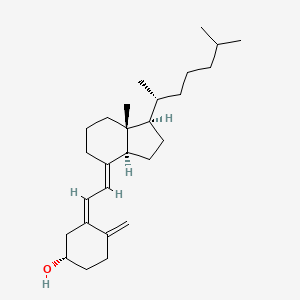
| Formula | C27H44O |
|---|---|
| Molecular weight | 384.65 g/mol |
| IUPAC name | (1S,3Z)-3-[(2E)-2-[(1R,3aS,7aR)-7a-methyl-1-[(2R)-6-methylheptan-2-yl]-2,3,3a,5,6,7-hexahydro-1H-inden-4-ylidene]ethylidene]-4-methylidenecyclohexan-1-ol |
| CAS | 67-97-0 |
| PubChem CID | 5280795 |
| InChIKey | QYSXJUFSXHHAJI-YRZJJWOYSA-N |
| logP | 7.62 (XLogP 7.9) |
| Polar surface area | 20.23 Ų |
| H-bond acceptors / donors | 1 / 1 |
| Drug-likeness (QED) | 0.50 |
| Lipinski violations | 1 |
SMILES
C=C1CC[C@H](O)C/C1=C/C=C1\CCC[C@]2(C)[C@@H]([C@H](C)CCCC(C)C)CC[C@@H]12Biology & Pharmacokinetics
Pharmacokinetics
| BBB penetrant | No |
|---|
Enzyme interactions
| Enzyme | Role | Detail |
|---|---|---|
| CYP2B6 | Inhibitor | — |
| CYP2C19 | Inhibitor | — |
| CYP2C8 | Inhibitor | — |
| CYP3A4 | Substrate | — |
Transporters
BCRP (Inhibitor)BSEP (Inhibitor)MRP1 (Inhibitor)OATP1B1 (Inhibitor)OATP1B3 (Inhibitor)P-gp (Inhibitor)P-gp (Substrate)
Registered Products (9)
| Brand | Form / strength | Pack | Agent | Citizen (JOD) |
|---|---|---|---|---|
| D-Rise Injection | Injection 300000 IU/1 ml | 1 amp pack varies | SANA PHARMACEUTICAL INDUSTRY/JORDAN | 2.490 |
| DIBASE 10,000 I.U./mL oral drops, | Oral Drops 10, 000 IU/ml | 10 ml | Al-Omawai Drug Store | 4.310 |
| DIBASE 300,000 I.U../ ml solution for injection | Injection 300.000 IU/1 ml | 2 amp | Al-Omawai Drug Store | 4.500 |
| DIBASE 100,000 I.U../ ml solution for injection | Injection 100.000 IU/1 ml | 6 amp | Al-Omawai Drug Store | 5.230 |
| D3 Max 50000 | Capsule 1.25 mg | 10 cap pack varies | Al-Taqaddom Pharmaceutical Industries | 6.110 |
| D3 Max 50000 | Capsule 1.25 mg | 20 cap pack varies | Al-Taqaddom Pharmaceutical Industries | 11.760 |
| Fosavance | Tablet 70 mg, 2800 IU | 4 tab | Adatco Drug Store | 11.860 |
| D-Rise Injection | Injection 300000 IU/1 ml | 10 amp pack varies | SANA PHARMACEUTICAL INDUSTRY/JORDAN | 22.410 |
| D3 Max 50000 | Tablet 1.25 mg | 1000 tab pack varies | Al-Taqaddom Pharmaceutical Industries | 519.350 |