Cortisone
Active form: Hydrocortisone.
JFDA label: Cortisone 25mg Tablets
Mechanism of Action
Decreases inflammation by suppression of migration of polymorphonuclear leukocytes and reversal of increased capillary permeability
Indications
Approved
- Allergic states
- Dermatologic diseases
- Endocrine disorders
- Gastrointestinal diseases
- Hematologic disorders
- Miscellaneous
- Neoplastic diseases
- Ophthalmic diseases
- Renal diseases
- Respiratory diseases
- Rheumatic disorders
Contraindications
Source: Lexicomp
- Hypersensitivity to cortisone or any component of the formulation Absolute
- administration of live virus vaccines (with immunosuppressive doses of cortisone). Documentation of allergenic cross-reactivity for glucocorticoids is limited. However, because of similarities in chemical structure and/or pharmacologic actions, the possibility of cross-sensitivity cannot be ruled out with certainty Absolute
- systemic fungal infection Absolute
Adverse Reactions
Nervous system disorders (2)
Very Common Insomnia · nervousness
Metabolism and nutrition disorders (2)
Common Diabetes mellitus · hirsutism
Gastrointestinal disorders (2)
Very Common Dyspepsia · increased appetite
Musculoskeletal and connective tissue disorders (1)
Common Arthralgia
Eye disorders (2)
Common Cataract · glaucoma
Respiratory, thoracic and mediastinal disorders (1)
Common Epistaxis
Dosing
Source: Lexicomp
Warnings & Precautions
Source: Lexicomp
Adrenal suppression
May cause hypercortisolism or suppression of hypothalamic-pituitary-adrenal (HPA) axis, particularly in younger children or in patients receiving high doses for prolonged periods. HPA axis suppression may lead to adrenal crisis. Withdrawal and discontinuation of a corticosteroid should be done slowly and carefully. Particular care is required when patients are transferred from systemic corticosteroids to inhaled products due to possible adrenal insufficiency or withdrawal from steroids, including an increase in allergic symptoms. Adult patients receiving >20 mg per day of prednisone (or equivalent) may be most susceptible. Fatalities have occurred due to adrenal insufficiency in asthmatic patients during and after transfer from systemic corticosteroids to aerosol steroids; aerosol steroids do not provide the systemic steroid needed to treat patients having trauma, surgery, or infections.
Anaphylactoid reactions
Rare cases of anaphylactoid reactions have been observed in patients receiving corticosteroids.
Immunosuppression
Prolonged use of corticosteroids may also increase the incidence of secondary infection, mask acute infection (including fungal infections), prolong or exacerbate viral infections, or limit response to inactivated vaccines. Exposure to chickenpox or measles should be avoided. Corticosteroids should not be used for cerebral malaria or viral hepatitis. Close observation is required in patients with latent tuberculosis (TB) and/or TB reactivity; restrict use in active TB (only fulminating or disseminated TB in conjunction with antituberculosis treatment). Amebiasis should be ruled out in any patient with recent travel to tropical climates or unexplained diarrhea prior to initiation of corticosteroids.
Kaposi sarcoma
Prolonged treatment with corticosteroids has been associated with the development of Kaposi sarcoma (case reports); if noted, discontinuation of therapy should be considered (Goedert 2002).
Myopathy
Acute myopathy has been reported with high-dose corticosteroids, usually in patients with neuromuscular transmission disorders; may involve ocular and/or respiratory muscles; monitor creatine kinase; recovery may be delayed.
Psychiatric disturbances
Corticosteroid use may cause psychiatric disturbances, including severe depression, euphoria, insomnia, mood swings, personality changes, to frank psychotic manifestations. Preexisting psychiatric conditions may be exacerbated by corticosteroid use. Disease-related concerns:
Cardiovascular disease
Use with caution in patients with heart failure and/or hypertension; use has been associated with electrolyte disturbances, fluid retention, and hypertension. Use with caution in patients with a recent history of myocardial infarction (MI); left ventricular free wall rupture has been reported after the use of corticosteroids.
Diabetes
Use with caution in patients with diabetes mellitus; may alter glucose production/regulation leading to hyperglycemia.
Gastrointestinal disease
Use with caution in patients with GI diseases (diverticulitis, fresh intestinal anastomoses, active or latent peptic ulcer, ulcerative colitis [nonspecific) due to perforation risk.
Head injury
Increased mortality was observed in patients receiving high-dose IV methylprednisolone; high-dose corticosteroids should not be used for the management of head injury.
Hepatic impairment
Use with caution in patients with hepatic impairment, including cirrhosis; long-term use has been associated with fluid retention.
Myasthenia gravis
Use with caution in patients with myasthenia gravis; exacerbation of symptoms has occurred especially during initial treatment with corticosteroids.
Ocular disease
Use with caution in patients with cataracts and/or glaucoma; increased intraocular pressure, open-angle glaucoma, and cataracts have occurred with prolonged use. Use with caution in patients with a history of ocular herpes simplex; corneal perforation has occurred; do not use in active ocular herpes simplex. Consider routine eye exams in chronic users.
Osteoporosis
Use with caution in patients with osteoporosis; high doses and/or long-term use of corticosteroids have been associated with increased bone loss and osteoporotic fractures.
Renal impairment
Use with caution in patients with renal impairment; fluid retention may occur.
Seizure disorders
Use with caution in patients with a history of seizure disorder; seizures have been reported with adrenal crisis.
Thyroid disease
Changes in thyroid status may necessitate dosage adjustments; metabolic clearance of corticosteroids increases in hyperthyroid patients and decreases in hypothyroid ones. Concurrent drug therapy issues:
Drug-drug interactions
Potentially significant interactions may exist, requiring dose or frequency adjustment, additional monitoring, and/or selection of alternative therapy. Consult drug interactions database for more detailed information. Special populations:
Elderly
Because of the risk of adverse effects, systemic corticosteroids should be used cautiously in the elderly in the smallest possible effective dose for the shortest duration.
Pediatric
May affect growth velocity; growth and development should be routinely monitored in pediatric patients. Other warnings/precautions:
Discontinuation of therapy
Withdraw therapy with gradual tapering of dose.
Pregnancy & Lactation
Pregnancy
Adverse events have been observed with corticosteroids in animal reproduction studies. Cortisone crosses the placenta (Migeon 1957). Some studies have shown an association between first trimester systemic corticosteroid use and oral clefts (Park-Wyllie 2000; Pradat 2003). Systemic corticosteroids may also influence fetal growth (decreased birth weight); however, information is conflicting (Lunghi 2010). Hypoadrenalism may occur in newborns following maternal use of corticosteroids in pregnancy (monitor). When systemic corticosteroids are needed in pregnancy, it is generally recommended to use the lowest effective dose for the shortest duration of time, avoiding high doses during the first trimester (Leachman 2006; Lunghi 2010; Makol 2011; Østensen 2009). Cortisone may be used (alternative agent) to treat primary adrenal insufficiency (PAI) in pregnant women. Pregnant women with PAI should be monitored at least once each trimester (Bornstein 2016).
Lactation
Corticosteroids are excreted in breast milk. The manufacturer notes that when used systemically, maternal use of corticosteroids have the potential to cause adverse events in a breast-feeding infant (eg, growth suppression, interference with endogenous corticosteroid production). Breast-feeding is not recommended by the manufacturer in women taking pharmacologic doses. If there is concern about exposure to the infant, some guidelines recommend waiting 4 hours after the maternal dose of an oral s
Monitoring
| Clinical pearl | Blood pressure; glucose (in diabetics); bone mineral density; growth in children; eye exams (with prolonged use); signs and symptoms of infection; signs and symptoms of hypercortisolism or adrenal suppression. |
|---|
Chemistry & Properties
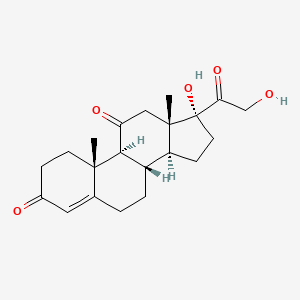
| Formula | C21H28O5 |
|---|---|
| Molecular weight | 360.45 g/mol |
| IUPAC name | (8S,9S,10R,13S,14S,17R)-17-hydroxy-17-(2-hydroxyacetyl)-10,13-dimethyl-1,2,6,7,8,9,12,14,15,16-decahydrocyclopenta[a]phenanthrene-3,11-dione |
| CAS | 53-06-5 |
| PubChem CID | 222786 |
| InChIKey | MFYSYFVPBJMHGN-ZPOLXVRWSA-N |
| logP | 1.99 (XLogP 1.5) |
| Polar surface area | 91.67 Ų |
| H-bond acceptors / donors | 5 / 2 |
| Drug-likeness (QED) | 0.79 |
| Lipinski violations | 0 |
SMILES
C[C@]12CCC(=O)C=C1CC[C@@H]1[C@@H]2C(=O)C[C@@]2(C)[C@H]1CC[C@]2(O)C(=O)COBiology & Pharmacokinetics
Pharmacokinetics predicted
| Bioavailability | 70.0% |
|---|---|
| Half-life | 1.733 h |
| Volume of distribution | 0.444 L/kg |
| Protein binding | 83.8% |
| BBB penetrant | No |
Enzyme interactions
| Enzyme | Role | Detail |
|---|---|---|
| CYP2C19 | Substrate | — |
| CYP2C8 | Inhibitor | — |
| CYP3A4 | Substrate | — |
Transporters
BCRP (Inhibitor)BSEP (Inhibitor)BSEP (Inhibitor)MATE1 (Inhibitor)MRP1 (Inhibitor)OATP1A2 (Inhibitor)OATP1B1 (Inhibitor)OATP1B3 (Inhibitor)OATP1B3 (Inhibitor)OATP2B1 (Inhibitor)OCT1 (Inhibitor)P-gp (Inhibitor)MDR1 (Substrate)P-gp (Substrate)
Registered Products (1)
| Brand | Form / strength | Pack | Agent | Citizen (JOD) |
|---|---|---|---|---|
| Cortisone | Tablet 25 mg | 100 tab | Hikma Pharmaceuticals Co.Ltd/Jordan | 15.000 |