Dinoprostone
JFDA label: PROSTIN E2 AMPOULE
- Appropriate use:
- Experienced physician:
Mechanism of Action
Agonist of Prostaglandin E2 receptor — Prostaglandin E2 receptor agonist
| Target | Action | Gene / class |
|---|---|---|
| Prostaglandin E2 receptor efficacy | AGONIST |
Indications
Approved
- Cervical ripening and labor induction
- Endocervical gel (Prepidil)
- Tablet (oral) (Prostin E2; [Canadian product])
- Termination of intrauterine pregnancy
- Vaginal gel (Prostin E2; [Canadian product])
- Vaginal insert (Cervidil)
Contraindications
Source: Lexicomp
- Additional contraindications (not in US labeling): History of epilepsy Absolute
- Additional contraindications (not in US labeling): Placenta previa Absolute
- Generally, labor induction is contraindicated whenever spontaneous labor or vaginal delivery is contraindicated (ACOG 2009) Absolute
- active cardiac, pulmonary, renal, or hepatic disease Tablet (oral) [Canadian product]: Patients in whom oxytocic drugs are generally contraindicated or where prolonged contractions of the uterus are considered inappropriate. Active cardiac, pulmonary, renal or hepatic disease Absolute
- concurrent use with other oxytocics Suppository: Acute pelvic inflammatory disease Absolute
- engagement of head not taken place Absolute
- fetal distress when delivery is not imminent Absolute
- fetal malpresentation Absolute
- gynecological, obstetrical or medical conditions that preclude vaginal delivery Absolute
- history of cesarean section or major uterine surgery Absolute
- history of difficult labor and/or traumatic delivery Absolute
- history of or existing pelvic inflammatory disease unless adequately treated Vaginal gel [Canadian product]: Simultaneous use with other oxytocics Absolute
- history of uncontrolled epilepsy Absolute
- hyperactive or hypertonic uterine patterns Absolute
- manufacturer specific contraindications are listed by dosage form. All dosage forms: Hypersensitivity to prostaglandins or any component of the formulation Endocervical gel: Patients in whom oxytocic drugs are contraindicated including: History of cesarean section or major uterine surgery Absolute
- obstetric emergencies when surgical intervention would be favorable. Use is also contraindicated with placenta previa or when vaginal delivery is not indicated (eg, vasa previa, active herpes genitalia) Absolute
- overdistention of the uterus (multiple pregnancies, polyhydramnios) Absolute
- overdistention of the uterus (multiple pregnancy, polyhydramnios) Absolute
- patients already receiving IV oxytocic drugs Absolute
- preexisting uterine hypertonus Absolute
- pregnancy complicated by abnormal position of the placenta or umbilical cord Absolute
- presence of cephalopelvic disproportion Absolute
- ruptured amniotic membranes or suspected chorioamnionitis Absolute
- ruptured amniotic membranes or suspected chorioamnionitis Vaginal insert: Patients in whom oxytocic drugs are contraindicated Absolute
- simultaneous use with other oxytocics Absolute
- situations where a responsible physician is unavailable Absolute
- suspected or clinically evident preexisting fetal distress Absolute
- unexplained vaginal bleeding during this pregnancy Absolute
- ≥6 pregnancies Absolute
- ≥6 previous term pregnancies Absolute
- ≥6 previous term pregnancies with nonvertex presentation Absolute
- ≥6 term pregnancies Absolute
Adverse Reactions
Cardiac disorders (7)
Not Known Amniotic fluid embolism (pulmonary) · cardiac arrest · Cardiac arrhythmia · chest pain · chest tightness · hypotension · syncope
Nervous system disorders (9)
Common Localized warm feeling
Not Known Chills · dizziness · headache · Localized warm feeling (vagina) · Malaise (transient vasovagal symptoms) · paresthesia · shivering · tension
Renal and urinary disorders (12)
Common Uterine contractions
Not Known Breast tenderness · cervical dilation (rapid) · Hypertonic uterine contractions · placental abruption · urinary retention · uterine contractions (abnormal) · uterine rupture · vaginal pain · vaginismus · vaginitis · vulvitis
Immune system disorders (1)
Not Known Hypersensitivity reaction (including anaphylaxis, anaphylactic shock, and nonimmunologic anaphylaxis [formerly known as anaphylactoid reaction])
Metabolism and nutrition disorders (2)
Not Known Dehydration · hot flash
Gastrointestinal disorders (5)
Common Gastrointestinal distress
Not Known Diarrhea · endometritis · nausea · vomiting
Skin and subcutaneous tissue disorders (3)
Not Known Diaphoresis · skin discoloration · skin rash
Musculoskeletal and connective tissue disorders (9)
Common Back pain
Not Known Arthralgia · arthritis (new or exacerbated) · leg cramps (nocturnal) · muscle cramps · myalgia · neck stiffness · tremor · weakness
Eye disorders (2)
Not Known Blurred vision · eye pain
Ear and labyrinth disorders (1)
Not Known Auditory impairment
General disorders and administration site conditions (1)
Not Known Fever
Respiratory, thoracic and mediastinal disorders (6)
Not Known Asthma · Cough · dyspnea · laryngitis · pharyngitis · wheezing
Dosing
Source: Lexicomp
Warnings & Precautions
Source: Lexicomp
Anaphylactoid syndrome of pregnancy
Intracervical placement of endocervical gel, vaginal gel or vaginal insert may lead to anaphylactoid syndrome of pregnancy (rare).
Disseminated intravascular coagulation (DIC)
Postpartum DIC has been reported following dinoprostone for labor induction. Risk may be increased in women ≥30 years of age, gestation age >40 weeks, or women with pregnancy complications.
Hypersensitivity reactions
Serious life-threatening hypersensitivity reactions, including anaphylaxis and angioedema, have been noted. Onset of reactions may occur within minutes to hours following initiation of therapy. Disease related concerns:
Cardiovascular disease
Use caution in patients with cardiovascular disease; manufacturer labeling for some dosage forms contraindicate use in active cardiovascular disease (refer to contraindications field).
Epilepsy
Use with caution in patients with epilepsy.
Glaucoma
Use caution in patients with glaucoma.
Hepatic impairment
Use caution in patients with hepatic impairment; manufacturer labeling for some dosage forms (eg, suppository, tablet, vaginal gel) contraindicate use in active hepatic disease.
Pulmonary disease
Use caution in patients with a history of asthma; manufacturer labeling for some dosage forms (eg, suppository, tablet, vaginal gel) contraindicate use with active pulmonary disease.
Renal impairment
Use caution in patients with renal impairment; manufacturer labeling for some dosage forms (eg, suppository, tablet, vaginal gel) contraindicate use in active renal disease. Dosage form specific issues:
Endocervical gel
Use caution with ruptured membranes.
Suppository
When used for termination of pregnancy, dinoprostone is not considered feticidal, but is used to terminate pregnancy due to its ability to stimulate uterine contractions; do not use if fetus has reached the stage of viability. Transient pyrexia and decreased blood pressure may be observed with treatment. Use caution with history of hypotension or hypertension; cardiovascular disease; anemia; jaundice; diabetes; compromised uteri; cervicitis, endocervical infections or acute vaginitis. Measures should be taken to ensure complete abortion. Commercially available suppositories should not be used for extemporaneous preparation of any other dosage form of drug. Do not use for cervical ripening or other indications in patients with term pregnancy.
Vaginal gel [Canadian product]
For intravaginal use only; not for intracervical use.
Vaginal insert
Use caution with ruptured membranes; nonvertex or nonsingleton pregnancy or previous uterine hypertony. Must be removed prior to administration of oxytocin, in case of hyperstimulation or if labor begins, fetal distress, maternal distress (eg, hypotension, nausea, tachycardia, vomiting), and prior to amniotomy. Other warnings/precautions:
Experienced personnel
Dinoprostone should be used only by medically-trained personnel in a hospital with strict adherence to recommended doses.
Pregnancy & Lactation
Pregnancy
Adverse events have been observed in animal reproduction studies. Although these effects would not be expected in humans when administered after the period of organogenesis, a sustained increase in uterine tone may have increased risks of adverse events to the fetus. Fetal distress without corresponding maternal uterine hyperstimulation was observed in 3% to 4% of infants exposed to Cervidil in utero. No adverse effects on physical or psychomotor function were observed in a 3 year follow-up study of exposed infants. Abnormal fetal heart rates were observed in 17% of infants exposed to Prepidil gel in utero. Deceleration, intrauterine fetal sepsis, fetal depression and fetal acidosis have also been reported with administration of the endocervical gel. Still births, abnormal fetal heart rate and fetal distress have been reported with administration of Prostin E2 vaginal gel and oral tablets [Canadian product]. When used for termination of pregnancy, dinoprostone is not considered fet
Lactation
Endogenous PGE2 is present in breast milk (Shimizu 1992).
Monitoring
| Clinical pearl | Gel, insert: Fetal heart rate, uterine activity, progression of cervical dilation and effacement Tablet: Uterine activity; excessive uterine activity is contractions > 5 per 10 minutes and/or the internal tonus consistently > 15 mmHg. Suppository: Confirmation of fetal death |
|---|
Chemistry & Properties
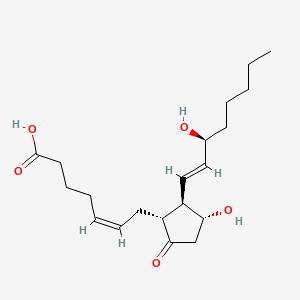
| Formula | C20H32O5 |
|---|---|
| Molecular weight | 352.47 g/mol |
| IUPAC name | (Z)-7-[(1R,2R,3R)-3-hydroxy-2-[(E,3S)-3-hydroxyoct-1-enyl]-5-oxocyclopentyl]hept-5-enoic acid |
| CAS | 363-24-6 |
| PubChem CID | 5280360 |
| InChIKey | XEYBRNLFEZDVAW-ARSRFYASSA-N |
| logP | 3.25 (XLogP 2.8) |
| Polar surface area | 94.83 Ų |
| H-bond acceptors / donors | 4 / 3 |
| Drug-likeness (QED) | 0.37 |
| Lipinski violations | 0 |
SMILES
CCCCC[C@H](O)/C=C/[C@H]1[C@H](O)CC(=O)[C@@H]1C/C=C\CCCC(=O)OBiology & Pharmacokinetics
Pharmacokinetics
| BBB penetrant | No |
|---|
Enzyme interactions
| Enzyme | Role | Detail |
|---|---|---|
| CYP2B6 | Inhibitor | — |
Receptor binding (top 14)
| Target | Action | Affinity |
|---|---|---|
| Prostaglandin E3 (PTGER3) | Binding | pKi 9.5 |
| EP3 receptor (PTGER3) | Agonist | pKi 9.5 |
| Prostaglandin E4 (PTGER4) | Binding | pKi 9.1 |
| EP3 receptor (PTGER3) | Agonist | pKd 8.7 |
| Prostaglandin E2 (PTGER2) | Binding | pKi 8.3 |
| Prostaglandin E1 (PTGER1) | Binding | pKi 8.0 |
| Prostaglandin F (PTGFR) | Binding | pKi 6.9 |
| Prostaglandin D (PTGDR) | Binding | pKi 6.5 |
| CatSper1 (CATSPER1) | Activator | pEC50 6.3 |
| CatSper2 (CATSPER2) | Activator | pEC50 6.3 |
| CatSper3 (CATSPER3) | Activator | pEC50 6.3 |
| CatSper4 (CATSPER4) | Activator | pEC50 6.3 |
| EP4 receptor (PTGER4) | Agonist | pEC50 6.0 |
| DP2 receptor (PTGDR2) | Agonist | pKi 5.3 |
Transporters
BCRP (Inhibitor)BSEP (Inhibitor)MDR1 (Inhibitor)MRP1 (Inhibitor)OAT1 (Inhibitor)OAT2 (Inhibitor)OAT3 (Inhibitor)OAT4 (Inhibitor)OATP1B1 (Inhibitor)OATP1B3 (Inhibitor)OATP1B3 (Inhibitor)OATP2B1 (Inhibitor)OATP3A1 (Inhibitor)OATP4A1 (Inhibitor)OATP4C1 (Inhibitor)OATP5A1 (Inhibitor)OCT1 (Inhibitor)OCT2 (Inhibitor)P-gp (Inhibitor)MRP4 (Substrate)OAT1 (Substrate)OAT2 (Substrate)OAT3 (Substrate)OAT4 (Substrate)OATP1A2 (Substrate)OATP1B1 (Substrate)OATP1B2 (Substrate)OATP1B3 (Substrate)OATP1C1 (Substrate)OATP2B1 (Substrate)OATP3A1 (Substrate)OCT1 (Substrate)OCT2 (Substrate)P-gp (Substrate)
Registered Products (6)
| Brand | Form / strength | Pack | Agent | Citizen (JOD) |
|---|---|---|---|---|
| PREPIDIL GEL | Gel 0.5 mg/3 g | 3 g tube | Khoury Drug Store | — |
| PROSTIN E2 AMPOULE | Ampoule 10 mg/ml | 0.5 ml | Khoury Drug Store | — |
| PROSTIN E2 VAG GEL | Gel 2 mg/3gm | 3 gm syr | Khoury Drug Store | — |
| PROSTIN E2 VAG GEL | Gel 1 mg/3GM | 3 gm syr | Khoury Drug Store | — |
| PROSTIN E2 VAGINAL TABS | Tablet 3 mg | 4 tab | Khoury Drug Store | — |
| Propess 10 mg Vaginal Delivery System | Vaginal 10 mg | 1 | Petra Drug Store | — |