Finerenone
JFDA label: Kerendia film-coated tablet
Mechanism of Action
Antagonist of Mineralocorticoid receptor — Mineralocorticoid receptor antagonist
| Target | Action | Gene / class |
|---|---|---|
| Mineralocorticoid receptor efficacy | ANTAGONIST | NR3C2 |
Indications
Approved
- Cardiovascular Diseases — cardiovascular disease
- Diabetes Mellitus, Type 2 — type 2 diabetes mellitus
- Renal Insufficiency, Chronic — chronic kidney disease
Off-label
- Diabetes Mellitus
- Diabetic Nephropathies
- Heart Failure
Contraindications
Source: openFDA
- Kerendia is contraindicated in patients: Who are hypersensitive to any component of this product [see Adverse Reactions (6.2) ] . Who are receiving concomitant treatment with strong CYP3A4 inhibitors [see Drug Interactions (7.1) ]. With adrenal insufficiency. Concomitant use with strong CYP3A4 inhibitors. ( 4 , 7.1 ) Patients with adrenal insufficiency. ( 4 ) Hypersensitivity to any component of this product. ( 4 ) Absolute
Dosing
Source: openFDA
Warnings & Precautions
Source: openFDA
Warnings & Precautions
Hyperkalemia. Patients with decreased kidney function and higher baseline potassium levels are at increased risk. Monitor serum potassium levels and adjust dose as needed. ( 2.1 , 2.2 , 2.3 , 5.1 ) Worsening of Renal Function in Patients with Heart Failure. Measure eGFR and adjust dose as needed. ( 2.1 , 2.3 , 6.1 )
Hyperkalemia Kerendia can cause hyperkalemia [see Adverse Reactions (6
Hyperkalemia Kerendia can cause hyperkalemia [see Adverse Reactions (6.1) ] . The risk for developing hyperkalemia increases with decreasing kidney function and is greater in patients with higher baseline potassium levels or other risk factors for hyperkalemia. Measure serum potassium and eGFR in all patients before initiation of treatment with Kerendia and dose accordingly [see Dosage and Administration (2.1) ] . Do not initiate Kerendia if serum potassium is > 5.0 mEq/L. Measure serum potassium periodically during treatment with Kerendia and adjust dose accordingly [see Dosage and Administration (2.3) ] . More frequent monitoring may be necessary for patients at risk for hyperkalemia, including those on concomitant medications that impair potassium excretion or increase serum potassium [see Drug Interactions (7.1 , 7.2) ] .
Worsening of Renal Function in Patients with Heart Failure Kerendia ca
Worsening of Renal Function in Patients with Heart Failure Kerendia can cause worsening of renal function in patients with heart failure. Rarely, severe events associated with worsening renal function, including events requiring hospitalization, have been observed [see Adverse Reactions (6.1) ] . Measure eGFR in all patients before initiation of treatment or with dose titration of Kerendia and dose accordingly [see Dosage and Administration (2.1 , 2.3) ]. Initiation of Kerendia in patients with heart failure and an eGFR <25 mL/min/1.73m 2 is not recommended. Measure eGFR periodically during maintenance treatment with Kerendia in patients with heart failure. Consider delaying up-titration or interrupting treatment with Kerendia in patients who develop clinically significant worsening of renal function.
Pregnancy & Lactation
Lactation
However, the manufacturer recommends avoiding breastfeeding during treatment and for 1 day after treatment.
Chemistry & Properties
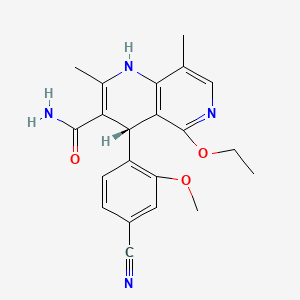
| Formula | C21H22N4O3 |
|---|---|
| Molecular weight | 378.43 g/mol |
| IUPAC name | (4S)-4-(4-cyano-2-methoxyphenyl)-5-ethoxy-2,8-dimethyl-1,4-dihydro-1,6-naphthyridine-3-carboxamide |
| CAS | 1050477-31-0 |
| PubChem CID | 60150535 |
| InChIKey | BTBHLEZXCOBLCY-QGZVFWFLSA-N |
| logP | 2.99 (XLogP 2.4) |
| Polar surface area | 110.26 Ų |
| H-bond acceptors / donors | 6 / 2 |
| Drug-likeness (QED) | 0.83 |
| Lipinski violations | 0 |
SMILES
CCOc1ncc(C)c2c1[C@H](c1ccc(C#N)cc1OC)C(C(N)=O)=C(C)N2Biology & Pharmacokinetics
Pharmacokinetics predicted
| Bioavailability | 10.0% |
|---|---|
| Half-life | 1.318 h |
| Volume of distribution | 3.619 L/kg |
| Protein binding | 97.4% |
| BBB penetrant | No |
Enzyme interactions
| Enzyme | Role | Detail |
|---|---|---|
| CYP1A2 | Substrate | — |
| CYP2B6 | Inhibitor | — |
| CYP2C8 | Inhibitor | — |
| CYP2C9 | Inhibitor | — |
| CYP3A4 | Substrate | — |
Receptor binding (top 1)
| Target | Action | Affinity |
|---|---|---|
| Mineralocorticoid receptor (NR3C2) | Antagonist | pIC50 7.7 |
Transporters
BCRP (Inhibitor)BSEP (Inhibitor)MRP1 (Inhibitor)OATP1B1 (Inhibitor)OATP1B3 (Inhibitor)P-gp (Inhibitor)P-gp (Substrate)
Registered Products (2)
| Brand | Form / strength | Pack | Agent | Citizen (JOD) |
|---|---|---|---|---|
| Kerendia film-coated tablet | Film-Coated Tablet 20 mg | 28 tab | Khoury Drug Store | 52.190 |
| Kerendia film-coated tablet | Film-Coated Tablet 10 mg | 28 tab | Khoury Drug Store | 52.190 |