Flunarizine
JFDA label: Sibelium 5mg Tab
Mechanism of Action
Flunarizine is a selective calcium channel blocker that prevents cellular calcium overload by reducing excessive transmembrane calcium influx; also has antihistamine properties. Has greater effect on decreasing the frequency of migraine attacks than on decreasing the severity or duration of attacks.
Indications
Approved
- Migraine
Contraindications
Source: Lexicomp
- Hypersensitivity to flunarizine or any component of the formulation Absolute
- history of depression Absolute
- preexisting symptoms of Parkinson disease, or other extrapyramidal disorders Absolute
Adverse Reactions
Nervous system disorders (11)
Not Known anxiety · depression · dizziness · Drowsiness · extrapyramidal reaction · fatigue · insomnia · motor dysfunction · sedation · sleep disorder · vertigo
Metabolism and nutrition disorders (4)
Not Known galactorrhea · increased serum prolactin · menstrual disease · Weight gain
Gastrointestinal disorders (6)
Not Known Heartburn · increased appetite · nausea · stomach pain · vomiting · xerostomia
Skin and subcutaneous tissue disorders (1)
Not Known Skin rash
Musculoskeletal and connective tissue disorders (2)
Not Known Myalgia · weakness
Dosing
Source: Lexicomp
Warnings & Precautions
Source: Lexicomp
CNS effects
May cause CNS depression, which may impair physical or mental abilities; patients must be cautioned about performing tasks that require mental alertness (eg, operating machinery, driving). Rarely, progressive fatigue may occur during therapy; monitor for fatigue symptoms. Discontinue therapy with progressively worsening fatigue.
Depression
May precipitate depression; greater risk in younger patients. Monitor for depressive symptoms and discontinue use if depressive symptoms occur. Use is contraindicated in patients with a history of depressive illness.
Endocrine effects
Galactorrhea (rare) has been reported in female patients during the first 2 months of therapy; usually resolves with discontinuation of therapy. Mild but significant increase in serum prolactin levels and menstrual irregularities have been observed with use.
Extrapyramidal symptoms
May produce extrapyramidal symptoms in individuals with no prior history of neurological deficits; monitor for symptoms (may require discontinuation); effects are usually reversible upon discontinuation of therapy. Risk is increased in elderly patients. Use is contraindicated in patients with preexisting Parkinson disease or other extrapyramidal disorders. Disease-related concerns:
Hepatic impairment
Undergoes hepatic metabolism; use with caution. Concurrent drug therapy issues:
Drug-drug interactions
Potentially significant interactions may exist, requiring dose or frequency adjustment, additional monitoring, and/or selection of alternative therapy. Consult drug interactions database for more detailed information. Other warnings/precautions:
Appropriate use
Discontinue use if inadequate response after 3 months of therapy. Closely monitor for adverse effects (eg, CNS effects) in patients treated for >6 months; discontinue therapy with onset of adverse effects. Risk for adverse effects may be decreased by allowing 2 consecutive medication-free days each week. Not indicated for treatment of acute migraine attacks.
Pregnancy & Lactation
Pregnancy
Adverse events have been observed in animal reproduction studies.
Lactation
It is not known if flunarizine is excreted into breast milk. Breast-feeding is not recommended by the manufacturer.
Monitoring
| Clinical pearl | Monitor (at regular intervals) for extrapyramidal, depressive, and/or fatigue symptoms. |
|---|
Chemistry & Properties
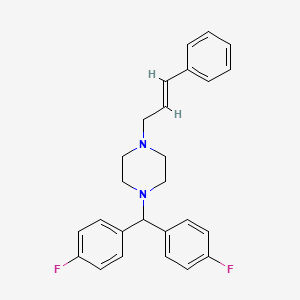
| Formula | C26H26F2N2 |
|---|---|
| Molecular weight | 404.5 g/mol |
| IUPAC name | 1-[bis(4-fluorophenyl)methyl]-4-[(E)-3-phenylprop-2-enyl]piperazine |
| CAS | 52468-60-7 |
| PubChem CID | 941361 |
| InChIKey | SMANXXCATUTDDT-QPJJXVBHSA-N |
| logP | 5.39 (XLogP 6.0) |
| Polar surface area | 6.48 Ų |
| H-bond acceptors / donors | 2 / 0 |
| Drug-likeness (QED) | 0.54 |
| Lipinski violations | 1 |
SMILES
Fc1ccc(C(c2ccc(F)cc2)N2CCN(C/C=C/c3ccccc3)CC2)cc1Biology & Pharmacokinetics
Pharmacokinetics
| BBB penetrant | Yes |
|---|
Enzyme interactions
| Enzyme | Role | Detail |
|---|---|---|
| CYP1A2 | Substrate | — |
| CYP2B6 | Substrate | — |
| CYP2C19 | Substrate | — |
| CYP2C8 | Inhibitor | — |
| CYP2C9 | Inhibitor | — |
| CYP2C9 | Substrate | — |
| CYP2D6 | Inhibitor | IC₅₀ 7.889999999999998 µM |
| CYP2D6 | Substrate | — |
Receptor binding (top 3)
| Target | Action | Affinity |
|---|---|---|
| Cav3.1 (CACNA1G) | Channel blocker | pIC50 6.3 |
| Cav3.3 (CACNA1I) | Channel blocker | pIC50 6.1 |
| Cav3.2 (CACNA1H) | Channel blocker | pIC50 5.4 |
Transporters
BCRP (Inhibitor)BSEP (Inhibitor)BSEP (Inhibitor)MRP1 (Inhibitor)OATP1B1 (Inhibitor)OATP1B1 (Inhibitor)OATP1B3 (Inhibitor)OATP1B3 (Inhibitor)OCT1 (Inhibitor)P-gp (Inhibitor)P-gp (Substrate)
Registered Products (1)
| Brand | Form / strength | Pack | Agent | Citizen (JOD) |
|---|---|---|---|---|
| Sibelium | Tablet 5 mg | 20 tab | Telegraph Drug Store | 2.910 |