Fluocinonide
JFDA label: Topsym FAPG
Mechanism of Action
Agonist of Glucocorticoid receptor — Glucocorticoid receptor agonist
| Target | Action | Gene / class |
|---|---|---|
| Glucocorticoid receptor efficacy | AGONIST | NR3C1 |
Indications
Approved
- Inflammatory and pruritic dermatologic conditions
Contraindications
Source: Lexicomp
- Hypersensitivity to fluocinonide or any component of the formulation Absolute
Adverse Reactions
Nervous system disorders (2)
Not Known Intracranial hypertension · localized burning
Metabolism and nutrition disorders (5)
Not Known Cushing's syndrome · glycosuria · growth suppression · HPA-axis suppression · hyperglycemia
Skin and subcutaneous tissue disorders (14)
Not Known Acne vulgaris · allergic dermatitis · atrophic striae · contact dermatitis · folliculitis · hypertrichosis · hypopigmentation · maceration of the skin · miliaria · perioral dermatitis · pruritus · skin atrophy · telangiectasia · xeroderma
Infections and infestations (1)
Not Known Secondary infection
General disorders and administration site conditions (1)
Not Known Local irritation
Dosing
Source: Lexicomp
Warnings & Precautions
Source: Lexicomp
Adrenal suppression
May cause hypercortisolism or suppression of hypothalamic-pituitary-adrenal (HPA) axis, particularly in younger children or in patients receiving high doses for prolonged periods. HPA axis suppression may lead to adrenal crisis.
Contact dermatitis
Allergic contact dermatitis can occur, it is usually diagnosed by failure to heal rather than clinical exacerbation.
Kaposi sarcoma
Prolonged treatment with corticosteroids has been associated with the development of Kaposi sarcoma (case reports); if noted, discontinuation of therapy should be considered (Goedert, 2002).
Local effects
Local adverse reactions may occur (eg, skin atrophy, striae, telangiectasias, burning, itching, irritation, dryness, folliculitis, acneiform eruptions, hypopigmentation, perioral dermatitis, allergic contact dermatitis, secondary infection miliaria); may be irreversible. Local adverse reactions are more likely to occur with occlusive and/or prolonged use. If irritation develops, discontinued use and institute appropriate therapy.
Skin infections
Concomitant skin infections may be present or develop during therapy; discontinue if dermatological infection persists despite appropriate antimicrobial therapy.
Systemic effects
Topical corticosteroids may be absorbed percutaneously. Absorption of topical corticosteroids may cause manifestations of Cushing syndrome, hyperglycemia, or glycosuria. Absorption is increased by the use of occlusive dressings, application to denuded skin, or application to large surface areas. Special populations:
Pediatric
Children may absorb proportionally larger amounts after topical application and may be more prone to systemic effects. HPA axis suppression, intracranial hypertension, and Cushing syndrome have been reported in children receiving topical corticosteroids. Prolonged use may affect growth velocity; growth should be routinely monitored in pediatric patients. Other warnings/precautions:
Application site
Lower-strength formulations (0.05%) may be used cautiously on face or opposing skin surfaces that may rub or touch (eg, skin folds of the groin, axilla, and breasts); higher-strength (0.1%) should not be used on the face, groin, or axillae.
Appropriate use
0.1% cream: Treatment beyond 2 consecutive weeks is not recommended and the total dosage should not exceed 60 g per week. Therapy should be discontinued when control of the disease is achieved. If no improvement is seen within 2 weeks, reassess diagnosis. Do not use more than half of the 120 g tube per week. Should not be used in the treatment of rosacea or perioral dermatitis.
Pregnancy & Lactation
Pregnancy
Adverse events have been observed with corticosteroids in animal reproduction studies. Topical corticosteroids are preferred over systemic for treating conditions, such as psoriasis or atopic dermatitis in pregnant women; high-potency corticosteroids are not recommended during the first trimester. Topical products are not recommended for extensive use, in large quantities, or for long periods of time in pregnant women (Bae 2011; Koutroulis 2011; Leachman 2006). Information specific to the use of fluocinonide during pregnancy is limited (Valkova 2006).
Lactation
Systemic corticosteroids are excreted in human milk. It is not known if sufficient quantities of fluocinonide are absorbed following topical administration to produce detectable amounts in breast milk. Do not apply topical corticosteroids to nipples; hypertension was noted in a breast-feeding infant exposed to a topical corticosteroid while breast-feeding (Leachman 2006). The manufacturer recommends that caution be exercised when administering fluocinonide 0.05% to nursing women. Because mater
Monitoring
| Clinical pearl | HPA axis suppression (ACTH stimulation test, AM plasma cortisol test, urinary free cortisol test); signs of bacterial or fungal infections. |
|---|
Chemistry & Properties
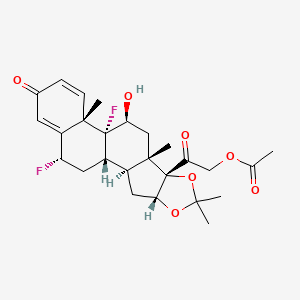
| Formula | C26H32F2O7 |
|---|---|
| Molecular weight | 494.53 g/mol |
| IUPAC name | [2-[(1S,2S,4R,8S,9S,11S,12R,13S,19S)-12,19-difluoro-11-hydroxy-6,6,9,13-tetramethyl-16-oxo-5,7-dioxapentacyclo[10.8.0.02,9.04,8.013,18]icosa-14,17-dien-8-yl]-2-oxoethyl] acetate |
| CAS | 356-12-7 |
| PubChem CID | 9642 |
| InChIKey | WJOHZNCJWYWUJD-IUGZLZTKSA-N |
| logP | 2.94 (XLogP 3.2) |
| Polar surface area | 99.13 Ų |
| H-bond acceptors / donors | 7 / 1 |
| Drug-likeness (QED) | 0.60 |
| Lipinski violations | 0 |
SMILES
CC(=O)OCC(=O)[C@@]12OC(C)(C)O[C@@H]1C[C@H]1[C@@H]3C[C@H](F)C4=CC(=O)C=C[C@]4(C)[C@@]3(F)[C@@H](O)C[C@@]12CBiology & Pharmacokinetics
Pharmacokinetics
| BBB penetrant | Yes |
|---|
Enzyme interactions
| Enzyme | Role | Detail |
|---|---|---|
| CYP2C8 | Inhibitor | — |
| CYP3A4 | Substrate | — |
Receptor binding (top 1)
| Target | Action | Affinity |
|---|---|---|
| Glucocorticoid receptor (NR3C1) | Agonist | pIC50 8.3 |
Transporters
BCRP (Inhibitor)BSEP (Inhibitor)MRP1 (Inhibitor)OATP1B1 (Inhibitor)OATP1B1 (Inhibitor)OATP1B3 (Inhibitor)OATP1B3 (Inhibitor)P-gp (Inhibitor)P-gp (Substrate)
Registered Products (1)
| Brand | Form / strength | Pack | Agent | Citizen (JOD) |
|---|---|---|---|---|
| Topsym FAPG | Cream 0.05 % | 15 g tube | Nabulsi Drug Store | 4.350 |