Fluorescein
JFDA label: Minims Lidocaine 4% & Fluorescein 0.25%
Mechanism of Action
Fluorescein sodium, a fluoresce dye, responds to wavelengths between 465-490 nm of electromagnetic radiation and light, and fluoresces at wavelengths of 520-530 nm.
Indications
Approved
- Ophthalmic angiography/angioscopy (injection)
- Ophthalmic diagnostic staining (strips)
Contraindications
Source: Lexicomp
- Hypersensitivity to fluorescein or any other component of the formulation Absolute
Adverse Reactions
Cardiac disorders (4)
Not Known Arterial ischemia (basilar; rare) · hypotension · shock · syncope
Nervous system disorders (5)
Not Known Convulsions (rare) · dizziness (Kwan 2006) · headache · nerve palsy (localized; [Kwan 2006]) · seizure (rare; [Kwan 2006])
Renal and urinary disorders (1)
Not Known Urine discoloration (bright yellow)
Blood and lymphatic system disorders (2)
Not Known Hemolytic anemia (Kwan 2006) · sickle cell disease (Kwan 2006, Acheson 1985)
Immune system disorders (2)
Not Known Anaphylaxis · hypersensitivity reaction
Gastrointestinal disorders (4)
Not Known Dysgeusia · gastrointestinal distress · nausea (common) · vomiting
Skin and subcutaneous tissue disorders (4)
Not Known Pruritus · rash at injection site · skin discoloration (yellow) · urticaria
General disorders and administration site conditions (2)
Not Known Extravasation · inflammation at injection site
Respiratory, thoracic and mediastinal disorders (2)
Not Known Bronchospasm · pulmonary edema (acute; [Kwan 2006])
Dosing
Source: Lexicomp
Warnings & Precautions
Source: Lexicomp
Anaphylaxis/hypersensitivity reactions
Hypersensitivity and anaphylactic reactions may occur (death has been reported rarely); immediate treatment (including epinephrine) should be available. Serious intolerance reactions may be induced; history of adverse reaction to fluorescein or allergic reaction to foods or drugs, such as urticaria, asthma, eczema, or allergic rhinitis, may increase risk. Premedicating some patients (eg, antihistamines, corticosteroids) may be advisable. An intradermal skin test may be performed prior to use when allergy is suspected; however, a negative skin test does not rule out the potential for a reaction to occur.
Gastrointestinal effects
Nausea and/or vomiting and gastrointestinal distress occur commonly within the first few minutes following injection; these reactions usually subside within 10 minutes.
Skin/urine discoloration
Following use of the injection, skin may temporarily turn a yellow color within a few minutes of administration and usually fades in 6 to 12 hours. Urine may appear bright yellow for 24 to 36 hours. Disease-related concerns:
Allergies/asthma
Respiratory reactions may occur, especially in patients with a history of allergies or bronchial asthma; use with caution. Special populations:
Contact lens wearers
Ophthalmic products should not be used in patients with soft contact lenses, will cause them to discolor. Flush eyes with saline following use and wait at least 1hour prior to replacing contact lenses. Dosage form specific issues:
Injection
For administration via antecubital vein only; not for intrathecal or arterial injection. Avoid extravasation; severe local tissue damage may result, including skin sloughing, superficial phlebitis, subcutaneous granuloma, and toxic neuritis along the median curve in the antecubital area. Following extravasation, severe pain may last up to several hours. Discontinue immediately if extravasation occurs.
Pregnancy & Lactation
Pregnancy
Animal reproduction studies have not been conducted. Pregnancy outcome information is available following fluorescein use in pregnant women (Halperin 1990; Olk 1991).
Lactation
Fluorescein is excreted into breast milk when administered by injection (Maquire 1988) and ophthalmic drops (Mattern 1990). Measurable concentrations can be detected for at least 4 days following injection; pumping and discarding milk during this time period is recommended by the manufacturer.
Monitoring
| Clinical pearl | Injection: Hypersensitivity reactions (during procedure and after) |
|---|
Chemistry & Properties
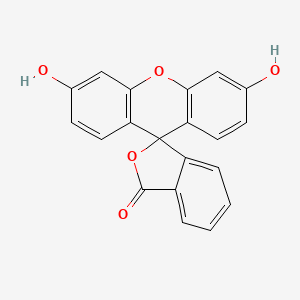
| Formula | C20H12O5 |
|---|---|
| Molecular weight | 332.31 g/mol |
| IUPAC name | 3',6'-dihydroxyspiro[2-benzofuran-3,9'-xanthene]-1-one |
| CAS | 2321-07-5 |
| PubChem CID | 16850 |
| InChIKey | GNBHRKFJIUUOQI-UHFFFAOYSA-N |
| logP | 3.67 (XLogP 3.4) |
| Polar surface area | 75.99 Ų |
| H-bond acceptors / donors | 5 / 2 |
| Drug-likeness (QED) | 0.61 |
| Lipinski violations | 0 |
SMILES
O=C1OC2(c3ccc(O)cc3Oc3cc(O)ccc32)c2ccccc21Biology & Pharmacokinetics
Pharmacokinetics
| BBB penetrant | No |
|---|
Enzyme interactions
| Enzyme | Role | Detail |
|---|---|---|
| CYP1A2 | Inhibitor | — |
| CYP1A2 | Substrate | — |
| CYP2B6 | Inhibitor | — |
| CYP2B6 | Substrate | — |
| CYP2C19 | Inhibitor | IC₅₀ 0.9074 µM |
| CYP2C19 | Substrate | — |
| CYP2C8 | Inhibitor | — |
| CYP2C9 | Inhibitor | — |
| CYP2C9 | Substrate | — |
| CYP2D6 | Substrate | — |
| CYP3A4 | Inhibitor | — |
| CYP3A4 | Substrate | — |
Transporters
BCRP (Inhibitor)BSEP (Inhibitor)BSEP (Inhibitor)MRP1 (Inhibitor)MRP2 (Inhibitor)MRP3 (Inhibitor)OAT1 (Inhibitor)OATP1B1 (Inhibitor)OATP1B3 (Inhibitor)P-gp (Inhibitor)BSEP (Substrate)MRP1 (Substrate)OAT1 (Substrate)OATP1A2 (Substrate)OATP1B1 (Substrate)OATP1B3 (Substrate)OATP1C1 (Substrate)OATP2A1 (Substrate)OATP2B1 (Substrate)OATP3A1 (Substrate)OATP4A1 (Substrate)OATP4C1 (Substrate)OATP5A1 (Substrate)OATP6A1 (Substrate)P-gp (Substrate)
Registered Products (5)
| Brand | Form / strength | Pack | Agent | Citizen (JOD) |
|---|---|---|---|---|
| Fluorescein Sodium USP IV | Ampoule 10 g/100 ml | 100 amp | JAWEDA INT. DRUD STORE | — |
| Minims Fluorescein Sod.B.P 1% e/d | Ophthalmic Solution 1 % | 0.5 ml | Petra Drug Store | — |
| Minims Fluorescein Sod.B.P 2% e/d | Ophthalmic Solution 2 % | 20 S.D.U | Petra Drug Store | — |
| Minims Lidocaine 4% & Fluorescein | Solution 0.25 %, 4 % | 0.5 ml | Petra Drug Store | — |
| SunnyFloresin | Ampoule 500 mg/5 ml | 5 amp | Sahar Drug Store | — |