Flupentixol
JFDA label: FLUANXOL DEPOT
Mechanism of Action
Flupentixol is a thioxanthene-derivative antipsychotic which blocks postsynaptic dopamine receptors in the CNS, resulting in inhibition of dopamine-mediated effects.
Indications
Approved
- Schizophrenia
Contraindications
Source: Lexicomp
- CNS depression due to any cause Absolute
- Hypersensitivity to flupentixol, thioxanthenes, or any component of the formulation Absolute
- acute intoxication (ethanol, barbiturate, or opioid) Absolute
- cerebrovascular or renal insufficiency Absolute
- concomitant use with large doses of hypnotics Due to similarities in chemical structure and/or pharmacologic actions the possibility of cross-sensitivity between thioxanthenes and phenothiazine derivatives should be considered Absolute
- liver damage Absolute
- severe cardiovascular disease/circulatory collapse Absolute
- severely-agitated psychotic patients, psychoneurotic patients, or geriatric patients with confusion and/or agitation Absolute
- suspected or established subcortical brain damage Absolute
Adverse Reactions
Cardiac disorders (2)
Not Known Palpitations · syncope
Nervous system disorders (14)
Not Known depression · dizziness · drowsiness · Extrapyramidal reaction · fatigue · headache · hyperreflexia · hypertonia · hypomania · insomnia · opisthotonos · psychomotor agitation · restlessness · seizure
Hepatobiliary disorders (4)
Not Known Increased serum alkaline phosphatase · increased serum ALT · increased serum AST · jaundice
Renal and urinary disorders (2)
Not Known Impotence · urination disorder
Blood and lymphatic system disorders (1)
Not Known Eosinophilia
Metabolism and nutrition disorders (7)
Not Known Amenorrhea · decreased libido · galactorrhea · gynecomastia · hyperprolactinemia · increased libido · weight changes
Gastrointestinal disorders (5)
Not Known Constipation · nausea · paralytic ileus · sialorrhea · xerostomia
Skin and subcutaneous tissue disorders (9)
Not Known Contact dermatitis · diaphoresis · eczema · erythema · exfoliative dermatitis · pruritus · seborrhea · skin rash · urticaria
Musculoskeletal and connective tissue disorders (1)
Not Known Tremor
Eye disorders (3)
Not Known Blurred vision · cataract · oculogyric crisis
Dosing
Source: Lexicomp
Warnings & Precautions
Source: Lexicomp
Altered cardiac conduction
May alter cardiac conduction; life-threatening arrhythmias have occurred with therapeutic doses of antipsychotics (Haddad 2002; Stollberger 2005). Use with caution in susceptible patients (eg, significant bradycardia, recent MI, decompensated HF, arrhythmias). Correct electrolyte abnormalities (eg, hypokalemia, hypomagnesemia prior to use. Avoid use in patients with underlying QT prolongation, in those taking medicines that prolong the QT interval, or cause polymorphic ventricular tachycardia; monitor ECG closely for dose-related QT effects. Adverse effects of decanoate may be prolonged.
Anticholinergic effects
May cause anticholinergic effects (constipation, xerostomia, blurred vision, urinary retention); use with caution in patients with decreased gastrointestinal motility, paralytic ileus, urinary retention, BPH, xerostomia, or visual problems. Relative to other neuroleptics, flupentixol has a low potency of cholinergic blockade.
Blood dyscrasias
Antipsychotic use has been associated with agranulocytosis, neutropenia, leukopenia, and granulocytopenia; monitoring of CBC is recommended.
CNS effects
May be sedating in some patients (flupentixol is associated with less sedative effects compared to other antipsychotics), use with caution in disorders where CNS depression is a feature; patients must be cautioned about performing tasks which require mental alertness (eg, operating machinery or driving).
Diabetic ketoacidosis (DKA)
DKA has been observed in patients with no prior history of hyperglycemia; monitoring of blood glucose and body weight is recommended.
Esophageal dysmotility/aspiration
Antipsychotic use has been associated with esophageal dysmotility and aspiration; use with caution in patients at risk of pneumonia (ie, Alzheimer's disease) (Maddalena 2004).
Extrapyramidal symptoms (EPS)
May cause extrapyramidal symptoms, including pseudoparkinsonism, acute dystonic reactions, akathisia, and tardive dyskinesia. Risk of dystonia (and possibly other EPS) may be greater with increased doses, use of conventional antipsychotics, males, and younger patients. Factors associated with greater vulnerability to tardive dyskinesia include older in age, female gender combined with postmenopausal status, Parkinson disease, pseudoparkinsonism symptoms, affective disorders (particularly major depressive disorder), concurrent medical diseases such as diabetes, previous brain damage, alcoholism, poor treatment response, and use of high doses of antipsychotics (APA [Lehman 2004]; Soares-Weiser 2007). Consider therapy discontinuation with signs/symptoms of tardive dyskinesia.
Neuroleptic malignant syndrome (NMS)
[Canadian Boxed Warning]: NMS has been associated with use of antipsychotic agents, including flupentixol; monitor for mental status changes, fever, muscle rigidity, and/or autonomic instability, elevated creatine phosphokinase (CPK), myoglobinuria,, and/or acute renal failure (risk may be increased in patients with Parkinson disease or Lewy body dementia). Discontinue treatment immediately with onset of NMS; recurrence has been reported in patients rechallenged with antipsychotic therapy.
Ocular
Lens opacity has been reported rarely with use. Similar drugs have been associated with pigmentary retinopathy, corneal and lenticular deposits, and photosensitivity.
Orthostatic hypotension
May cause orthostatic hypotension; use with caution in patients at risk of this effect or in those who would not tolerate transient hypotensive episodes (cerebrovascular disease, cardiovascular disease, hypovolemia, or concurrent medication use which may predispose to hypotension/bradycardia).
Temperature regulation
Impaired core body temperature regulation may occur; caution with strenuous exercise, heat exposure, dehydration, and concomitant medication possessing anticholinergic effects.
Venous thromboembolism (VTE)
VTE has been reported with antipsychotics; evaluate VTE risk prior to and during therapy. Disease-related concerns:
Cardiovascular disease
Use is contraindicated in patients with severe cardiovascular disease. Use with caution in patients with a history of or at risk for cerebrovascular accident.
Dementia
Elderly patients with dementia-related psychosis who are treated with antipsychotics are at an increased risk of death compared to placebo. Most deaths appeared to be either cardiovascular (eg, heart failure, sudden death) or infectious (eg, pneumonia) in nature. An increased incidence of cerebrovascular adverse events (including fatalities) has been reported in elderly patients with dementia-related psychosis. Flupentixol is not approved for use in elderly patients with dementia or dementia-related psychosis.
Glaucoma
Use with caution in patients with known or suspected glaucoma (avoid use in patients with known or suspected narrow-angle glaucoma); condition may be exacerbated by cholinergic blockade (flupentixol has weak anticholinergic properties compared to other antipsychotics).
Hepatic impairment
Use is contraindicated in patients with liver damage.
Parkinson disease
Use with caution in patients with Parkinson disease; they may be more sensitive to adverse effects.
Prolactin-dependent tumors
Use is associated with increased prolactin levels; clinical significance of hyperprolactinemia in patients with breast cancer or other prolactin-dependent tumors is unknown.
Renal impairment
Use is contraindicated in patients with renal insufficiency.
Seizure disorder
Use with caution in patients at risk of seizures, including those with a history of seizures, head trauma, brain damage, alcoholism, or concurrent therapy with medications which may lower seizure threshold. Concurrent drug therapy issues:
Drug-drug interactions
Potentially significant interactions may exist, requiring dose or frequency adjustment, additional monitoring, and/or selection of alternative therapy. Consult drug interactions database for more detailed information. Special populations:
Surgical patients
Surgical patients receiving high-dose flupentixol should be monitored closely for hypotension; dose reduction of anesthetic or CNS depressants may be necessary. Other warnings/precautions:
Antiemetic effects
May mask toxicity of other drugs or conditions (eg, intestinal obstruction, brain tumor) due to antiemetic effects.
Appropriate use
Not recommended for use in excitable, overactive, or manic patients.
Therapy discontinuation
Avoid abrupt withdrawal in patients receiving maintenance therapy; withdrawal symptoms (eg, n/v, insomnia, restlessness, agitation) may appear 1 to 4 days after discontinuing therapy and subside within 7 to 14 days.
Pregnancy & Lactation
Pregnancy
There are no adequate and well-controlled studies in pregnant women. Antipsychotic use during the third trimester of pregnancy has a risk for abnormal muscle movements (extrapyramidal symptoms [EPS]) and withdrawal symptoms in newborns following delivery. Symptoms in the newborn may include agitation, feeding disorder, hypertonia, hypotonia, respiratory distress, somnolence, and tremor; these effects may be self-limiting or require hospitalization. Amenorrhea, decreased libido, erectile dysfunction, and ejaculation failure have been observed; dose reduction or therapy discontinuation may be needed for severe effects.
Lactation
At therapeutic doses, flupentixol is found at low concentrations in human breast milk. Adverse effects are not likely in a nursing infant when used within the therapeutic dosing range.
Monitoring
| Clinical pearl | Vital signs; hepatic function tests (particularly during first few months of therapy), lipid profile, CBC (baseline then periodically during therapy), fasting blood glucose/HbA1c (baseline then periodically during therapy); BMI; mental status, abnormal involuntary movement scale (AIMS), extrapyramidal symptoms (EPS) |
|---|
Chemistry & Properties
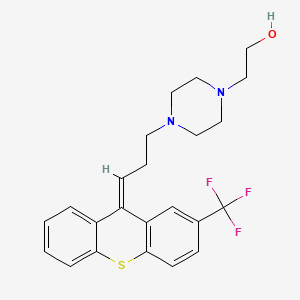
| Formula | C23H25F3N2OS |
|---|---|
| Molecular weight | 434.5 g/mol |
| IUPAC name | 2-[4-[(3Z)-3-[2-(trifluoromethyl)thioxanthen-9-ylidene]propyl]piperazin-1-yl]ethanol |
| CAS | 2709-56-0 |
| PubChem CID | 5281881 |
| InChIKey | NJMYODHXAKYRHW-DVZOWYKESA-N |
| logP | 4.5 (XLogP 4.5) |
| Polar surface area | 52.0 Ų |
| H-bond acceptors / donors | 7 / 1 |
SMILES
C1CN(CCN1CCC=C2C3=CC=CC=C3SC4=C2C=C(C=C4)C(F)(F)F)CCOBiology & Pharmacokinetics
Pharmacokinetics
| BBB penetrant | Yes |
|---|
Enzyme interactions
| Enzyme | Role | Detail |
|---|---|---|
| CYP1A2 | Inhibitor | — |
| CYP1A2 | Substrate | — |
| CYP2C19 | Substrate | — |
| CYP2D6 | Inhibitor | — |
| CYP3A4 | Inhibitor | — |
| CYP3A4 | Substrate | — |
Receptor binding (top 3)
| Target | Action | Affinity |
|---|---|---|
| D3 receptor (DRD3) | Antagonist | pKi 9.0 |
| D2 receptor (DRD2) | Antagonist | pKi 8.8 |
| D5 receptor (DRD5) | Antagonist | pKi 8.1 |
Transporters
BCRP (Inhibitor)BCRP (Inhibitor)BSEP (Inhibitor)MDR1 (Inhibitor)MRP1 (Inhibitor)MRP2 (Inhibitor)OATP1B1 (Inhibitor)OATP1B3 (Inhibitor)OATP1B3 (Inhibitor)OATP2B1 (Inhibitor)OCT1 (Inhibitor)P-gp (Inhibitor)MDR1 (Substrate)P-gp (Substrate)
Registered Products (6)
| Brand | Form / strength | Pack | Agent | Citizen (JOD) |
|---|---|---|---|---|
| FLUANXOL DEPOT | Ampoule 40 mg/2 ml | 1 amp pack varies | Abu Sharef Medical Stores | 3.590 |
| Sernil | Tablet 0.5 mg, 10 mg | 100 tab | Ibn Majah Drugstore | 4.920 |
| Deanxit Tablets | Tablet 0.5 mg, 10 mg | 100 tab | Abu Sharef Medical Stores | 7.490 |
| FLUANXOL DEPOT | Ampoule 100 mg/ml | 1 amp pack varies | Abu Sharef Medical Stores | 7.520 |
| FLUANXOL DEPOT | Ampoule 40 mg/2 ml | 10 amp pack varies | Abu Sharef Medical Stores | 32.680 |
| FLUANXOL DEPOT | Ampoule 100 mg/ml | 10 amp pack varies | Abu Sharef Medical Stores | 68.400 |