Folinic Acid
JFDA label: CALCIUM FOLINAT "EBEWE"
Mechanism of Action
Leucovorin calcium is a reduced form of folic acid, leucovorin supplies the necessary cofactor blocked by methotrexate. Leucovorin actively competes with methotrexate for transport sites, displaces methotrexate from intracellular binding sites, and restores active folate stores required for DNA/RNA synthesis. Stabilizes the binding of 5-dUMP and thymidylate synthetase, enhancing the activity of fluorouracil. When administered with pyrimethamine for the treatment of opportunistic infections, leucovorin reduces the risk for hematologic toxicity (HHS [OI adult 2015]). Methanol toxicity treatment: Formic acid (methanol’s toxic metabolite) is normally metabolized to carbon dioxide and water by 10-formyltetrahydrofolate dehydrogenase after being bound to tetrahydrofolate. Administering a sourc
Indications
Approved
- Colorectal cancer, advanced
- Injection
- Megaloblastic anemia
- Methotrexate toxicity
- Oral
Off-label
- Adjunctive cofactor therapy in methanol toxicity
- Bladder cancer (neoadjuvant treatment)
- Esophageal cancer (advanced or metastatic)
- Gastric cancer (advanced or metastatic)
- Pancreatic cancer (metastatic)
- Prevention of pyrimethamine hematologic toxicity in HIV-exposed/-positive patients (children)
- Prevention of pyrimethamine hematologic toxicity in HIV-infected patients (adolescents and adults)
Contraindications
Source: Lexicomp
- Pernicious anemia and other megaloblastic anemias secondary to vitamin B12-deficiency Absolute
Adverse Reactions
Blood and lymphatic system disorders (1)
Not Known Thrombocythemia
Immune system disorders (2)
Not Known Anaphylactoid reaction · hypersensitivity reaction
Skin and subcutaneous tissue disorders (4)
Not Known Erythema · pruritus · skin rash · urticaria
Respiratory, thoracic and mediastinal disorders (1)
Not Known Wheezing
Dosing
Source: Lexicomp
Warnings & Precautions
Source: Lexicomp
Hypersensitivity
Hypersensitivity, including allergic reactions, anaphylactoid reactions, and urticaria have been reported with leucovorin. Because leucovorin is typically administered in combination with other chemotherapy agents, it may be difficult to determine the causative agent for hypersensitivity reactions. In a series of 44 patients with hypersensitivity to leucovorin-containing regimens, hypersensitivity/infusion reaction to leucovorin was confirmed in 5 patients; reactions also occurred with subsequent rechallenge with LEVOleucovorin (Ureña-Tavera 2015).
Seizures
Seizures or syncope have been reported (rarely) in patients with cancer receiving leucovorin, usually in association with fluoropyrimidine administration, and most commonly in patients with CNS metastases or other predisposing factors; a causal relationship has not been established. Disease-related concerns:
Anemias
Leucovorin is inappropriate treatment for pernicious anemia and other megaloblastic anemias secondary to a lack of vitamin B12; a hematologic remission may occur while neurologic manifestations progress.
Renal impairment
Leucovorin is excreted renally; the risk for toxicities may be increased in patients with renal impairment. Concurrent drug therapy issues:
Drug-drug interactions
Potentially significant interactions may exist, requiring dose or frequency adjustment, additional monitoring, and/or selection of alternative therapy. Consult drug interactions database for more detailed information.
Fluorouracil
Leucovorin may increase the toxicity of 5-fluorouracil; deaths from severe enterocolitis, diarrhea, and dehydration have been reported (in elderly patients); granulocytopenia and fever have also been reported.
Sulfamethoxazole-trimethoprim
Combination of leucovorin and sulfamethoxazole-trimethoprim for the acute treatment of PCP in patients with HIV infection has been reported to cause increased rates of treatment failure. Dosage form specific issues:
Administration route
Parenteral administration may be preferred to oral if vomiting or malabsorption is likely. Because oral absorption is saturable at doses above 25 mg, administering oral doses greater than 25 mg is not recommended (convert to parenteral therapy).
Benzyl alcohol and derivatives
When doses >10 mg/m2 are required using the powder for injection, reconstitute using sterile water for injection, not a solution containing benzyl alcohol; large amounts of benzyl alcohol (≥99 mg/kg/day) have been associated with a potentially fatal toxicity (“gasping syndrome”) in neonates; the “gasping syndrome” consists of metabolic acidosis, respiratory distress, gasping respirations, CNS dysfunction (including convulsions, intracranial hemorrhage), hypotension, and cardiovascular collapse (AAP ["Inactive" 1997]; CDC 1982); some data suggests that benzoate displaces bilirubin from protein binding sites (Ahlfors 2001); avoid or use dosage forms containing benzyl alcohol with caution in neonates. See manufacturer’s labeling.
Injection
Due to calcium content, do not administer IV solutions at a rate >160 mg/minute. Not intended for intrathecal use. Other warnings and precautions:
Folic acid antagonist overdose
When used for the treatment of accidental folic acid antagonist overdose, administer as soon as possible.
Methotrexate overdose
When used for the treatment of a methotrexate overdose, administer IV leucovorin as soon as possible. Monitoring of the serum methotrexate concentration is essential to determine the optimal dose/duration of leucovorin; however, do not wait for the results of a methotrexate level before initiating leucovorin. It is important to adjust the leucovorin dose once a methotrexate level is known. The dose may need to be increased or administration prolonged in situations in which methotrexate excretion may be delayed (eg, ascites, pleural effusion, renal insufficiency, inadequate hydration). Never administer leucovorin intrathecally.
Methotrexate rescue therapy
Methotrexate serum concentrations should be monitored to determine dose and duration of leucovorin therapy. Dose may need increased or administration prolonged in situations where methotrexate excretion may be delayed (eg, ascites, pleural effusion, renal insufficiency, inadequate hydration). Never administer leucovorin intrathecally.
Pregnancy & Lactation
Pregnancy
Animal reproduction studies have not been conducted. Leucovorin is a biologically active form of folic acid. Adequate amounts of folic acid are recommended during pregnancy. Refer to Folic Acid monograph.
Lactation
Leucovorin is a biologically active form of folic acid. Adequate amounts of folic acid are recommended in breast-feeding women. Refer to Folic Acid monograph.
Monitoring
| Clinical pearl | High-dose methotrexate therapy: Plasma methotrexate concentration; leucovorin is continued until the plasma methotrexate level Fluorouracil therapy: CBC with differential and platelets, liver function tests, electrolytes |
|---|
Chemistry & Properties
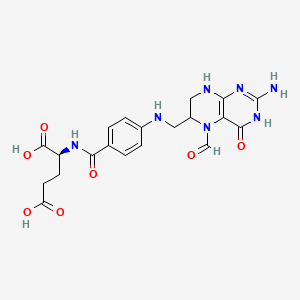
| Formula | C20H23N7O7 |
|---|---|
| Molecular weight | 473.45 g/mol |
| CAS | 58-05-9 |
| PubChem CID | 135403648 |
| InChIKey | VVIAGPKUTFNRDU-OLZOCXBDSA-N |
| logP | -0.73 |
| Polar surface area | 219.84 Ų |
| H-bond acceptors / donors | 9 / 7 |
| Drug-likeness (QED) | 0.21 |
| Lipinski violations | 1 |
SMILES
Nc1nc(=O)c2c([nH]1)NC[C@@H](CNc1ccc(C(=O)N[C@@H](CCC(=O)O)C(=O)O)cc1)N2C=OBiology & Pharmacokinetics
Pharmacokinetics predicted
| Bioavailability | 10.0% |
|---|---|
| Half-life | 1.122 h |
| Volume of distribution | 0.225 L/kg |
| Protein binding | 69.3% |
| BBB penetrant | No |
Transporters
BCRP (Inhibitor)BSEP (Inhibitor)MRP1 (Inhibitor)OATP1B1 (Inhibitor)OATP1B3 (Inhibitor)P-gp (Inhibitor)P-gp (Substrate)
Registered Products (1)
| Brand | Form / strength | Pack | Agent | Citizen (JOD) |
|---|---|---|---|---|
| CALCIUM FOLINAT "EBEWE" | Ampoule (as Calcium Folinate) 10 mg/ml | 5 amp | Sabbagh Drug Store | — |