Fulvestrant
JFDA label: Faslodex 250mg/5ml PFS
Mechanism of Action
Antagonist of Estrogen receptor — Estrogen receptor alpha antagonist; Degrader of Estrogen receptor — Estrogen receptor degrader
| Target | Action | Gene / class |
|---|---|---|
| Estrogen receptor efficacy | ANTAGONIST | ESR1 |
Indications
Approved
- Breast cancer, advanced
- Breast cancer, advanced or metastatic (second-line endocrine-based combination therapy)
Contraindications
Source: Lexicomp
- Additional contraindications (not in the US labeling): Pregnant or lactating women Absolute
- Known hypersensitivity to fulvestrant or any component of the formulation Absolute
Adverse Reactions
Nervous system disorders (2)
Very Common Fatigue · headache
Hepatobiliary disorders (3)
Very Common Increased liver enzymes
Common Increased serum ALT · increased serum AST
Blood and lymphatic system disorders (5)
Very Common Anemia
Common Decreased platelet count · febrile neutropenia · leukopenia · neutropenia
Metabolism and nutrition disorders (1)
Very Common Hot flash
Gastrointestinal disorders (8)
Very Common constipation · Nausea · stomatitis
Common anorexia · Decreased appetite · diarrhea · dysgeusia · vomiting
Skin and subcutaneous tissue disorders (3)
Common Alopecia · skin rash · xeroderma
Musculoskeletal and connective tissue disorders (7)
Very Common Arthralgia
Common back pain · limb pain · musculoskeletal pain · myalgia · Ostealgia · weakness
Eye disorders (3)
Common Blurred vision · dry eye syndrome · increased lacrimation
Infections and infestations (1)
Very Common Infection
General disorders and administration site conditions (1)
Very Common Pain at injection site
Respiratory, thoracic and mediastinal disorders (3)
Common Cough · dyspnea · epistaxis
Dosing
Source: Lexicomp
Warnings & Precautions
Source: Lexicomp
Hypersensitivity
Hypersensitivity reactions, including urticaria and angioedema, have been reported.
Injection-site related events
Events related to injection site, including sciatica, neuralgia, neuropathic pain, and peripheral neuropathy, have been reported with fulvestrant administration. Due to the proximity of underlying sciatic nerve, use caution if administering at the dorsogluteal site. Disease-related concerns:
Bleeding disorders
Use with caution in patients with a history of bleeding disorders (including thrombocytopenia) and/or patients on anticoagulant therapy; bleeding/hematoma may occur from IM administration.
Hepatic impairment
Exposure is increased and dosage adjustment is recommended in patients with moderate impairment. Safety and efficacy have not been established in severe impairment. Dosage form specific issues:
Benzyl alcohol and derivatives
Some dosage forms may contain benzyl alcohol; large amounts of benzyl alcohol (≥99 mg/kg/day) have been associated with a potentially fatal toxicity ("gasping syndrome") in neonates; the "gasping syndrome" consists of metabolic acidosis, respiratory distress, gasping respirations, CNS dysfunction (including convulsions, intracranial hemorrhage), hypotension and cardiovascular collapse (AAP ["Inactive" 1997]; CDC 1982); some data suggest that benzoate displaces bilirubin from protein binding sites (Ahlfors 2001); avoid or use dosage forms containing benzyl alcohol with caution in neonates. See manufacturer's labeling.
Pregnancy & Lactation
Pregnancy
Adverse events were observed in animal reproduction studies. Based on the mechanism of action, fulvestrant may cause fetal harm if administered during pregnancy. For females of reproductive potential, pregnancy testing is recommended within 7 days prior to initiation of fulvestrant and effective contraception should be used during treatment and for 1 year after the last fulvestrant dose. Animal data suggest that fulvestrant may affect female and male fertility (although not approved for use in men).
Lactation
It is not known if fulvestrant is present in breast milk. Because of the potential for serious adverse reactions in the breastfed infant, lactating women should not breastfeed during treatment and for 1 year after the final fulvestrant dose.
Monitoring
| Clinical pearl | Liver function tests; pregnancy testing is recommended within 7 days prior to fulvestrant initiation (for females of reproductive potential); monitor for signs/symptoms of bleeding |
|---|
Chemistry & Properties
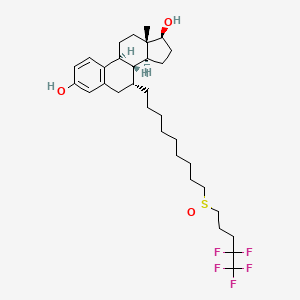
| Formula | C32H47F5O3S |
|---|---|
| Molecular weight | 606.78 g/mol |
| IUPAC name | (7R,8R,9S,13S,14S,17S)-13-methyl-7-[9-(4,4,5,5,5-pentafluoropentylsulfinyl)nonyl]-6,7,8,9,11,12,14,15,16,17-decahydrocyclopenta[a]phenanthrene-3,17-diol |
| CAS | 129453-61-8 |
| PubChem CID | 104741 |
| InChIKey | VWUXBMIQPBEWFH-WCCTWKNTSA-N |
| logP | 8.68 (XLogP 9.2) |
| Polar surface area | 63.52 Ų |
| H-bond acceptors / donors | 3 / 2 |
| Drug-likeness (QED) | 0.13 |
| Lipinski violations | 2 |
SMILES
C[C@]12CC[C@@H]3c4ccc(O)cc4C[C@@H](CCCCCCCCC[S+]([O-])CCCC(F)(F)C(F)(F)F)[C@H]3[C@@H]1CC[C@@H]2OBiology & Pharmacokinetics
Pharmacokinetics predicted
| Bioavailability | 70.0% |
|---|---|
| Half-life | 0.791 h |
| Volume of distribution | 1.027 L/kg |
| Protein binding | 98.8% |
| BBB penetrant | Yes |
Enzyme interactions
| Enzyme | Role | Detail |
|---|---|---|
| CYP1A2 | Substrate | — |
| CYP2B6 | Inhibitor | — |
| CYP2C19 | Inhibitor | — |
| CYP2C19 | Substrate | — |
| CYP2C8 | Inhibitor | — |
Receptor binding (top 3)
| Target | Action | Affinity |
|---|---|---|
| Estrogen receptor-α (ESR1) | Antagonist | pKi 9.0 |
| Estrogen receptor-β (ESR2) | Antagonist | pKi 8.9 |
| GPER (GPER1) | Agonist | pKi 7.0 |
Transporters
BCRP (Inhibitor)BSEP (Inhibitor)MRP1 (Inhibitor)MRP2 (Inhibitor)MRP3 (Inhibitor)MRP4 (Inhibitor)OATP1B1 (Inhibitor)OATP1B3 (Inhibitor)P-gp (Inhibitor)P-gp (Substrate)
Drug–drug interactions (1, DDInter)
| Interacting drug | Severity | Management |
|---|---|---|
| Omacetaxine mepesuccinate | moderate |
Registered Products (3)
| Brand | Form / strength | Pack | Agent | Citizen (JOD) |
|---|---|---|---|---|
| Fulvestrant EVER Pharma | Pre-filled Syringe 250 mg/5 ml | 2 PFS | Sabbagh Drug Store | 125.740 |
| Estroquin | Pre-filled Syringe 250 mg/5 ml | 2 PFS | Hikma Pharmaceuticals Co.Ltd/Jordan | — |
| Faslodex 250mg/5ml PFS | Pre-filled Syringe 50 mg/ml | 2 PFS | Shawi & Rushedat Drug Store | — |