Ibandronic Acid
JFDA label: Bondronat F.C Tab
Mechanism of Action
A bisphosphonate which inhibits bone resorption via actions on osteoclasts or on osteoclast precursors; decreases the rate of bone resorption, leading to an indirect increase in bone mineral density.
Indications
Approved
- Postmenopausal osteoporosis
Off-label
- Hypercalcemia of malignancy
- Metastatic bone disease due to breast cancer
Contraindications
Source: Lexicomp
- Known hypersensitivity to ibandronate or any component of the formulation Absolute
- hypocalcemia Absolute
- oral tablets are also contraindicated in patients unable to stand or sit upright for at least 60 minutes and in patients with abnormalities of the esophagus which delay esophageal emptying, such as stricture or achalasia. Documentation of allergenic cross-reactivity for bisphosphonates is limited. However, because of similarities in chemical structure and/or pharmacologic actions, the possibility of cross-sensitivity cannot be ruled out with certainty Absolute
Adverse Reactions
Cardiac disorders (1)
Common Hypertension
Nervous system disorders (5)
Common depression · dizziness · fatigue · Headache · insomnia
Renal and urinary disorders (2)
Common cystitis · Urinary tract infection
Immune system disorders (2)
Common Acute phase reaction-like symptoms · hypersensitivity reaction
Gastrointestinal disorders (9)
Very Common Dyspepsia
Common Abdominal pain · constipation · dental disease · diarrhea · gastritis · gastroenteritis · nausea · vomiting
Skin and subcutaneous tissue disorders (1)
Common Skin rash
Musculoskeletal and connective tissue disorders (1)
Very Common Back pain
Infections and infestations (1)
Common Influenza
General disorders and administration site conditions (1)
Common Injection site reaction, arthralgia, myalgia, arthropathy, weakness, localized osteoarthritis, muscle cramps
Respiratory, thoracic and mediastinal disorders (6)
Very Common Upper respiratory tract infection
Common Bronchitis · flu-like symptoms · nasopharyngitis · pharyngitis · pneumonia
Other (19)
Not Known Acute renal failure · anaphylactic shock · anaphylaxis · angioedema · bronchospasm · bullous dermatitis · erythema multiforme · exacerbation of asthma · femur fracture (diaphyseal or subtrochanteric) · hypocalcemia · iritis · musculoskeletal pain (bone, joint, or muscle; incapacitating) · ophthalmic inflammation · osteonecrosis (oro-facial sites including the external auditory canal) · osteonecrosis of the jaw · prolonged Q-T interval on ECG (Bonilla 2014) · scleritis · Stevens-Johnson syndrome · uveitis
Dosing
Source: Lexicomp
Warnings & Precautions
Source: Lexicomp
Bone fractures
Atypical femur fractures have been reported in patients receiving bisphosphonates for treatment/prevention of osteoporosis. The fractures include subtrochanteric femur (bone just below the hip joint) and diaphyseal femur (long segment of the thigh bone). Some patients experience prodromal pain weeks or months before the fracture occurs. It is unclear if bisphosphonate therapy is the cause for these fractures, although the majority of cases have been reported in patients taking bisphosphonates. Patients receiving long-term (>3-5 years) therapy may be at an increased risk. Discontinue bisphosphonate therapy in patients who develop a femoral shaft fracture.
Bone/joint/muscle pain
Infrequently, severe (and occasionally debilitating) bone, joint, and/or muscle pain have been reported during bisphosphonate treatment. The onset of pain ranged from a single day to several months. Discontinue intravenous ibandronate therapy in patients who experience severe symptoms; symptoms usually resolve upon discontinuation. Some patients experienced recurrence when rechallenged with same drug or another bisphosphonate; avoid use in patients with a history of these symptoms in association with bisphosphonate therapy.
Gastrointestinal mucosa irritation
May cause irritation to upper gastrointestinal mucosa. Esophagitis, dysphagia, esophageal ulcers, esophageal erosions, and esophageal stricture (rare) have been reported with oral bisphosphonates; risk increases in patients unable to comply with dosing instructions. Use with caution in patients with dysphagia, esophageal disease, gastritis, duodenitis, or ulcers (may worsen underlying condition). Discontinue if new or worsening symptoms develop.
Hypersensitivity
Allergic reactions, including anaphylactic reaction/shock (some fatal), angioedema, bronchospasm, exacerbation of asthma, rash, Stevens-Johnson syndrome, erythema multiforme, and dermatitis bullous have been reported; discontinue immediately if anaphylactic or other severe hypersensitivity/allergic reactions occur.
Hypocalcemia
Hypocalcemia has been reported with the use of bisphosphonates. Prior to therapy initiation, hypocalcemia must be corrected; ensure adequate calcium and vitamin D intake.
Osteonecrosis of the jaw
Osteonecrosis of the jaw (ONJ), also referred to as medication-related osteonecrosis of the jaw (MRONJ), has been reported in patients receiving bisphosphonates. Known risk factors for MRONJ include invasive dental procedures (eg, tooth extraction, dental implants, boney surgery), cancer diagnosis, concomitant therapy (eg, chemotherapy, corticosteroids, angiogenesis inhibitors), poor oral hygiene, ill-fitting dentures, and comorbid disorders (anemia, coagulopathy, infection, preexisting dental or periodontal disease). Risk may increase with increased duration of bisphosphonate use. According to a position paper by the American Association of Maxillofacial Surgeons (AAOMS), MRONJ has been associated with bisphosphonates and other antiresorptive agents (denosumab), and antiangiogenic agents (eg, bevacizumab, sunitinib) used for the treatment of osteoporosis or malignancy; risk is significantly higher in cancer patients receiving antiresorptive therapy compared to patients receiving osteoporosis treatment (regardless of medication used or dosing schedule). MRONJ risk is also increased with monthly IV antiresorptive therapy compared to the minimal risk associated with oral bisphosphonate use, although risk appears to increase with oral bisphosphonates when duration of therapy exceeds 4 years (AAOMS [Ruggiero 2014]). The manufacturer’s labeling states that discontinuing bisphosphonates in patients requiring invasive dental procedures may reduce the risk of ONJ and clinical judgmen
Renal impairment
Use not recommended with severe renal impairment (CrCl Dosage form specific issues:
Injection
Intravenous bisphosphonates may cause transient decreases in serum calcium and have also been associated with renal toxicity. Concurrent drug therapy issues:
Drug-drug interactions
Potentially significant interactions may exist, requiring dose or frequency adjustment, additional monitoring, and/or selection of alternative therapy. Consult drug interactions database for more detailed information. Other warnings/precautions:
Duration of therapy
In the management of osteoporosis, re-evaluate the need for continued therapy periodically; the optimal duration of treatment has not yet been determined. Consider discontinuing after 3-5 years of use in patients at low-risk for fracture; following discontinuation, re-evaluate fracture risk periodically.
Pregnancy & Lactation
Pregnancy
Adverse effects were observed in animal reproduction studies. It is not known if bisphosphonates cross the placenta, but fetal exposure is expected (Djokanovic, 2008; Stathopoulos, 2011). Bisphosphonates are incorporated into the bone matrix and gradually released over time. The amount available in the systemic circulation varies by dose and duration of therapy. Theoretically, there may be a risk of fetal harm when pregnancy follows the completion of therapy; however, available data have not shown that exposure to bisphosphonates during pregnancy significantly increases the risk of adverse fetal events (Djokanovic, 2008; Levy, 2009; Stathopoulos, 2011). Until additional data is available, most sources recommend discontinuing bisphosphonate therapy in women of reproductive potential as early as possible prior to a planned pregnancy; use in premenopausal women should be reserved for special circumstances when rapid bone loss is occurring (Bhalla, 2010; Pereira, 2012; Stathopoulos, 2011).
Lactation
It is not known if ibandronate is excreted into breast milk.
Monitoring
| Clinical pearl | Osteoporosis: Bone mineral density (BMD) should be evaluated 1 to 2 years after initiating therapy and every 2 years thereafter (NOF [Cosman 2014]); annual measurements of height and weight, assessment of chronic back pain; serum calcium and 25(OH)D; may consider measuring biochemical markers of bone turnover Serum creatinine prior to each IV dose |
|---|
Chemistry & Properties
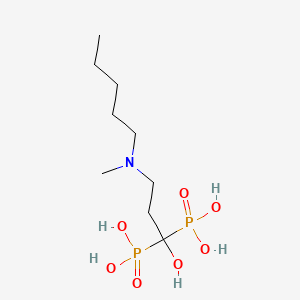
| Formula | C9H23NO7P2 |
|---|---|
| Molecular weight | 319.23 g/mol |
| IUPAC name | [1-hydroxy-3-[methyl(pentyl)amino]-1-phosphonopropyl]phosphonic acid |
| CAS | 114084-78-5 |
| PubChem CID | 60852 |
| InChIKey | MPBVHIBUJCELCL-UHFFFAOYSA-N |
| logP | 0.5 (XLogP -4.1) |
| Polar surface area | 138.53 Ų |
| H-bond acceptors / donors | 4 / 5 |
| Drug-likeness (QED) | 0.31 |
| Lipinski violations | 0 |
SMILES
CCCCCN(C)CCC(O)(P(=O)(O)O)P(=O)(O)OBiology & Pharmacokinetics
Pharmacokinetics
| BBB penetrant | No |
|---|
Enzyme interactions
| Enzyme | Role | Detail |
|---|---|---|
| CYP2C9 | Substrate | — |
Receptor binding (top 1)
| Target | Action | Affinity |
|---|---|---|
| farnesyl diphosphate synthase (FDPS) | Inhibitor | pKi 6.7 |
Transporters
BCRP (Inhibitor)BSEP (Inhibitor)MRP1 (Inhibitor)OATP1B1 (Inhibitor)OATP1B3 (Inhibitor)P-gp (Inhibitor)P-gp (Substrate)
Registered Products (3)
| Brand | Form / strength | Pack | Agent | Citizen (JOD) |
|---|---|---|---|---|
| Bonviva F.C.Tablet | Film-Coated Tablet 150 mg | 1 F.C Tab | Shawi & Rushedat Drug Store | 12.440 |
| Bondronat F.C Tab | Film-Coated Tablet 50 mg | 28 tab | Shawi & Rushedat Drug Store | — |
| Bondronat Vial | Vial 6 mg/6 ml | 1 vial | Shawi & Rushedat Drug Store | — |