Imiquimod
JFDA label: Jedara Cream 5%
Mechanism of Action
Agonist of Toll-like receptor 7 — Toll-like receptor 7 agonist
| Target | Action | Gene / class |
|---|---|---|
| Toll-like receptor 7 efficacy | AGONIST | TLR7 |
Indications
Approved
- Actinic keratosis (2.5%, 3.75% and 5% cream)
- Genital and perianal warts (3.75% and 5% cream)
- Superficial basal cell carcinoma (Aldara 5% cream)
Off-label
- Cutaneous flat wart
- Herpes simplex virus (HSV) infection, acyclovir-resistant
Contraindications
Source: Lexicomp
- Hypersensitivity to imiquimod or any component of the formulation Absolute
- There are no contraindications listed in the manufacturer's US labeling Absolute
Adverse Reactions
Cardiac disorders (2)
Common Chest pain · localized blanching
Nervous system disorders (3)
Common dizziness, skin hypertrophy, skin infection, eczema, cheilitis, alopecia, dermal hemorrhage (local), localized rash, papule (local), seborrhoeic keratosis, skin tenderness (local), stinging of the ski · fatigue · Headache
Renal and urinary disorders (2)
Common Bacterial vaginosis · urinary tract infection
Blood and lymphatic system disorders (2)
Common lymphadenopathy · Squamous cell carcinoma
Metabolism and nutrition disorders (1)
Common Increased serum glucose
Gastrointestinal disorders (5)
Common anorexia · diarrhea · dyspepsia · Nausea · vomiting
Skin and subcutaneous tissue disorders (7)
Very Common crusted skin · dermal ulcer · excoriation · Localized erythema · localized vesiculation · skin sclerosis · xeroderma
Musculoskeletal and connective tissue disorders (3)
Common Arthralgia · back pain · myalgia
Infections and infestations (2)
Very Common Fungal infection
Common Herpes simplex
General disorders and administration site conditions (5)
Very Common application site discharge · local pruritus · localized burning · Localized edema
Common Local irritation
Other (56)
Not Known Abdominal pain · acute exacerbations of multiple sclerosis · agitation · and individual sensitivity · anemia · angioedema · atrial fibrillation · capillary leak syndrome · cardiac failure · cardiomyopathy · cellulitis (local) · cerebrovascular accident · chills · depression · dermatitis · dyspnea · dysuria · erythema (scrotal) · erythema multiforme · exacerbation of psoriasis · exacerbation of ulcerative colitis · exfoliative dermatitis · febrile seizures · Frequency of reactions vary and are related to the degree of inflammation associated with the treated disease · Henoch-Schönlein purpura (IgA vasculitis) · hepatic insufficiency · herpes zoster · hyperpigmentation · immune thrombocytopenia (ITP) · insomnia · ischemia · lethargy · leukopenia · malignant lymphoma · myocardial infarction · number of weekly applications · pain (scrotal) · palpitations · pancytopenia · paresis · product formulation · proteinuria · psoriasis · pulmonary edema · scrotal edema · seizure · supraventricular tachycardia · syncope · tachycardia · thrombocytopenia · thyroiditis · ulcer (scrotal) · ulcerative colitis · urinary retention · urticaria · vertebral disk disease (spondylitis onset or exacerbated)
Respiratory, thoracic and mediastinal disorders (3)
Very Common Upper respiratory tract infection
Common flu-like symptoms · Sinusitis
Dosing
Source: Lexicomp
Warnings & Precautions
Source: Lexicomp
Local inflammatory reactions
Intense local inflammatory reactions (including skin weeping or erosion) may occur after a few applications; may require treatment interruption and may be accompanied by systemic symptoms (fever, malaise, myalgia); reactions may extend beyond the application site. Imiquimod has the potential to exacerbate inflammatory conditions of the skin (including chronic graft-versus-host disease).
Photosensitivity
Due to the potential for increased sensitivity to sunlight, avoid or minimize sunlight exposure (including sunlamps or other artificial sunlight exposure) during treatment. Advise patients to wear protective clothing (eg, a hat) during treatment. Patients with sunburn should not to use imiquimod until full recovery form sunburn. Patients with a potential for considerable sun exposure (eg, due to their occupations) or inherent sensitivity to sunlight should use caution during imiquimod treatment.
Systemic reactions
Flu-like symptoms (arthralgias, chills, fatigue, fever, malaise, myalgias, nausea, rigors) may accompany or precede local inflammatory reactions; may require treatment interruption.
Vulvar swelling
Severe local inflammation of female external genitalia following topical application may lead to severe vulvar swelling and urinary retention; interrupt or discontinue treatment for severe symptoms. Disease related concerns:
Actinic keratosis
Safety and efficacy have not been established in the treatment of actinic keratosis with repeat use (more than 1 treatment course) in the same area. Safety of imiquimod 5% applied to areas of skin larger than 25 cm2 has not been established. Lymphadenopathy has occurred in patients being treated for actinic keratosis; lymphadenopathy resolved within 4 weeks after completion of treatment.
Autoimmune disorders
Safety and efficacy in immunosuppressed patients have not been established. Use with caution in patients with preexisting autoimmune disorders (onset or exacerbation of disease has been reported).
Basal cell carcinoma
Use should be limited to superficial carcinomas with a maximum diameter of 2 cm. Safety and efficacy in treatment of other types of basal cell carcinoma (BCC) lesions of the face, head, and anogenital area, or other subtypes of BCC (including nodular and morpheaform), have not been established. Patients with superficial BCC treated with imiquimod should have regular follow up of the treatment site.
Human papilloma viral disease
Imiquimod has not been evaluated for the treatment of urethral, intravaginal, cervical, rectal, or intra-anal human papilloma viral disease and is not recommended for these conditions. Concurrent drug therapy issues:
Drug-drug interactions
Potentially significant interactions may exist, requiring dose or frequency adjustment, additional monitoring, and/or selection of alternative therapy. Consult drug interactions database for more detailed information. Dosage forms specific issues:
Benzyl alcohol and derivatives
Some dosage forms may contain benzyl alcohol; large amounts of benzyl alcohol (≥99 mg/kg/day) have been associated with a potentially fatal toxicity (“gasping syndrome”) in neonates; the “gasping syndrome” consists of metabolic acidosis, respiratory distress, gasping respirations, CNS dysfunction (including convulsions, intracranial hemorrhage), hypotension and cardiovascular collapse (AAP 1997; CDC 1982); some data suggests that benzoate displaces bilirubin from protein binding sites (Ahlfors 2001); avoid or use dosage forms containing benzyl alcohol with caution in neonates. See manufacturer's labeling. Other warnings/precautions:
Appropriate use
Not intended for oral, nasal, intravaginal, or ophthalmic use. Administration is not recommended until tissue is healed from any previous drug or surgical treatment. Treatment should not be prolonged beyond recommended period due to missed doses or rest periods. Safety and efficacy have not been established for basal cell nevus syndrome, in immunocompromised patients, or for xeroderma pigmentosum. Safety and efficacy of the 2.5% cream in the treatment of external genital warts have not been established.
Pregnancy & Lactation
Pregnancy
Adverse events were observed in some animal reproduction studies following oral administration. Imiquimod may weaken condoms and vaginal diaphragms. Imiquimod appears to pose a low risk, but use in pregnant women should be avoided until additional data are available (CDC [Workowski 2015]).
Lactation
It is not known if imiquimod is present in breast milk. The manufacturer recommends that caution be exercised when administering imiquimod to breastfeeding women.
Monitoring
| Clinical pearl | Assess response to therapy periodically (reduction in lesion size is indicative of a therapeutic response); monitor for local skin reactions and for signs and symptoms of hypersensitivity to imiquimod. |
|---|
Chemistry & Properties
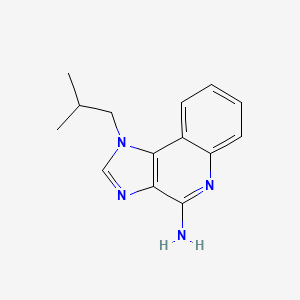
| Formula | C14H16N4 |
|---|---|
| Molecular weight | 240.31 g/mol |
| IUPAC name | 1-(2-methylpropyl)imidazo[4,5-c]quinolin-4-amine |
| CAS | 99011-02-6 |
| PubChem CID | 57469 |
| InChIKey | DOUYETYNHWVLEO-UHFFFAOYSA-N |
| logP | 2.82 (XLogP 2.6) |
| Polar surface area | 56.73 Ų |
| H-bond acceptors / donors | 4 / 1 |
| Drug-likeness (QED) | 0.75 |
| Lipinski violations | 0 |
SMILES
CC(C)Cn1cnc2c(N)nc3ccccc3c21Biology & Pharmacokinetics
Pharmacokinetics
| BBB penetrant | No |
|---|
Enzyme interactions
| Enzyme | Role | Detail |
|---|---|---|
| CYP1A2 | Substrate | — |
| CYP2B6 | Inhibitor | — |
| CYP2C19 | Substrate | — |
| CYP2C8 | Inhibitor | — |
| CYP2C9 | Inhibitor | — |
| CYP2D6 | Inhibitor | — |
| CYP3A4 | Substrate | — |
Transporters
BCRP (Inhibitor)BSEP (Inhibitor)BSEP (Inhibitor)MATE2 (Inhibitor)MRP1 (Inhibitor)MRP2 (Inhibitor)MRP3 (Inhibitor)MRP4 (Inhibitor)OATP1B1 (Inhibitor)OATP1B3 (Inhibitor)P-gp (Inhibitor)P-gp (Substrate)
Registered Products (2)
| Brand | Form / strength | Pack | Agent | Citizen (JOD) |
|---|---|---|---|---|
| Jedara Cream | Cream 5 % | 12 sachet | JERASH PHARMACEUTICALS LTD.CO/JORDAN | 38.470 |
| Aldara | Sachet 5 % | 12 sachet | Khoury Drug Store | 55.520 |