Loteprednol Etabonate
JFDA label: Lotemax
Mechanism of Action
Agonist of Glucocorticoid receptor — Glucocorticoid receptor agonist
| Target | Action | Gene / class |
|---|---|---|
| Glucocorticoid receptor efficacy | AGONIST | NR3C1 |
Indications
Approved
- Ophthalmic inflammatory conditions (0.5% suspension)
- Postoperative inflammation/pain (0.5% suspension/ointment/gel)
- Seasonal allergic conjunctivitis (0.2% suspension)
Contraindications
Source: Lexicomp
- Hypersensitivity to loteprednol, other corticosteroids, and any component of the formulation Absolute
- fungal diseases of ocular structures Absolute
- mycobacterial infection of the eye Absolute
- viral diseases of the cornea and conjunctiva (including epithelial herpes simplex keratitis, vaccinia, and varicella) Absolute
Adverse Reactions
Nervous system disorders (2)
Very Common Foreign body sensation · headache
Metabolism and nutrition disorders (1)
Very Common Chemosis
Eye disorders (11)
Very Common Anterior chamber inflammation · blepharitis (Miscellaneous: Papilla ( · blurred vision · Conjunctival hyperemia · corneal edema · epiphora · eye discharge · eye pain · photophobia · visual disturbance · xerophthalmia
General disorders and administration site conditions (1)
Very Common Application site burning
Respiratory, thoracic and mediastinal disorders (1)
Very Common Pharyngitis (1% to 10%:
Dosing
Source: Lexicomp
Warnings & Precautions
Source: Lexicomp
Cataracts
Use of corticosteroids may result in posterior subcapsular cataract formation. Use following cataract surgery may delay healing and increase the incidence of bleb formation.
Corneal thinning
Various ophthalmic disorders, as well as prolonged use of corticosteroids, may result in corneal and scleral thinning. Continued use in a patient with thinning may result in perforation.
Glaucoma
Prolonged use of corticosteroids may result in elevated intraocular pressure (IOP) and/or glaucoma; damage to the optic nerve; and defects in visual acuity and fields of vision. Use with caution in patients with glaucoma; monitor IOP in any patient receiving treatment for ≥10 days.
Immunosuppression
Prolonged use of corticosteroids (including ophthalmic preparations) may increase the incidence of secondary ocular infections (including fungal infections). Acute purulent ocular infections may be masked or exacerbated with use. Fungal infection should be suspected in any patient with persistent corneal ulceration who has received corticosteroids. Disease-related concerns:
Herpes simplex
Corticosteroids should not be used to treat ocular herpes simplex; may exacerbate the severity of the infection. Use extreme caution in patients with history of herpes simplex. Special populations:
Contact lens wearers
Some preparations may contain benzalkonium chloride which may be absorbed by contact lenses. When used for the treatment of seasonal allergic conjunctivitis, wait ≥10 minutes after instilling eye drops before inserting contact lenses; do not wear contacts if eyes are red. Contact lenses should not be worn during treatment with loteprednol ophthalmic gel.
Pediatric
Do not use ointment in children following ocular surgery; may interfere with amblyopia treatment. Other warnings/precautions:
Acute anterior uveitis
More potent steroids may be required for this indication.
Appropriate use
For ophthalmic use only; patients should be re-evaluated if symptoms fail to improve after 2 days. Initial prescription and renewal of medication after 14 days should be made by healthcare provider only after examination with the aid of magnification such as slit lamp biomicroscopy or fluorescein staining (if appropriate). Avoid contamination; do not touch tip of applicator or let tip of applicator touch eye.
Pregnancy & Lactation
Pregnancy
Adverse events have been observed in animal reproduction studies following oral administration. The amount of loteprednol absorbed systemically following ophthalmic administration is not known but expected to be
Lactation
Systemic corticosteroids are present in breast milk. The extent of systemic absorption following topical application of the ophthalmic drops is not known. The manufacturer recommends that caution be exercised when administering loteprednol to breastfeeding women.
Monitoring
| Clinical pearl | Intraocular pressure (if >10 days of treatment); signs and symptoms of infection |
|---|
Chemistry & Properties
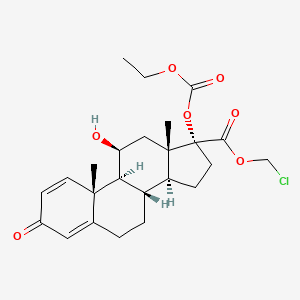
| Formula | C24H31ClO7 |
|---|---|
| Molecular weight | 466.96 g/mol |
| IUPAC name | chloromethyl (8S,9S,10R,11S,13S,14S,17R)-17-ethoxycarbonyloxy-11-hydroxy-10,13-dimethyl-3-oxo-7,8,9,11,12,14,15,16-octahydro-6H-cyclopenta[a]phenanthrene-17-carboxylate |
| CAS | 82034-46-6 |
| PubChem CID | 444025 |
| InChIKey | DMKSVUSAATWOCU-HROMYWEYSA-N |
| logP | 3.92 (XLogP 3.9) |
| Polar surface area | 99.13 Ų |
| H-bond acceptors / donors | 7 / 1 |
| Drug-likeness (QED) | 0.49 |
| Lipinski violations | 0 |
SMILES
CCOC(=O)O[C@]1(C(=O)OCCl)CC[C@H]2[C@@H]3CCC4=CC(=O)C=C[C@]4(C)[C@H]3[C@@H](O)C[C@@]21CBiology & Pharmacokinetics
Pharmacokinetics
| BBB penetrant | Yes |
|---|
Enzyme interactions
| Enzyme | Role | Detail |
|---|---|---|
| CYP2B6 | Inhibitor | — |
| CYP2C8 | Inhibitor | — |
| CYP3A4 | Inhibitor | — |
| CYP3A4 | Substrate | — |
Transporters
BCRP (Inhibitor)BSEP (Inhibitor)BSEP (Inhibitor)MRP1 (Inhibitor)MRP2 (Inhibitor)MRP4 (Inhibitor)OATP1B1 (Inhibitor)OATP1B3 (Inhibitor)P-gp (Inhibitor)P-gp (Substrate)
Registered Products (3)
| Brand | Form / strength | Pack | Agent | Citizen (JOD) |
|---|---|---|---|---|
| Lotemax | Solution 0.5 % | 5 ml pack varies | Petra Drug Store | 9.430 |
| Lotemax | Cream 0.5 % | 5 g tube pack varies | Petra Drug Store | 10.530 |
| Zylet | Solution 0.3 %, 0.5 % | 5 ml | Petra Drug Store | 11.280 |