Mesna
JFDA label: UROMITEXAN 400MG Amp
Mechanism of Action
— Unknown
Indications
Approved
- Prevention of ifosfamide-induced hemorrhagic cystitis
Off-label
- Prevention of cyclophosphamide-induced hemorrhagic cystitis (with high-dose cyclophosphamide)
Contraindications
Source: Lexicomp
- Hypersensitivity to mesna or any component of the formulation Absolute
Adverse Reactions
Cardiac disorders (1)
Not Known Flushing
Nervous system disorders (5)
Not Known Dizziness · drowsiness · headache · hyperesthesia · rigors
Gastrointestinal disorders (8)
Not Known Anorexia · constipation · diarrhea · dysgeusia (with oral administration) · flatulence · nausea · unpleasant taste (with oral administration) · vomiting
Skin and subcutaneous tissue disorders (1)
Not Known Skin rash
Musculoskeletal and connective tissue disorders (2)
Not Known Arthralgia · back pain
Eye disorders (1)
Not Known Conjunctivitis
General disorders and administration site conditions (2)
Not Known Fever · Injection site reaction
Respiratory, thoracic and mediastinal disorders (4)
Not Known Cough · flu-like symptoms · pharyngitis · rhinitis
Dosing
Source: Lexicomp
Warnings & Precautions
Source: Lexicomp
Anaphylaxis/hypersensitivity reactions
Hypersensitivity reactions have been reported; symptoms ranged from mild hypersensitivity to systemic anaphylactic reactions and may include fever, hypotension, tachycardia, acute renal impairment, hypoxia, respiratory distress, urticaria, angioedema, signs of disseminated intravascular coagulation, hematologic abnormalities, increased liver enzymes, nausea, vomiting, arthralgia, and myalgia. Reactions may occur with the first exposure, or after several months of treatment. Monitor for signs/symptoms of reactions. May require discontinuation. Patients with autoimmune disorders receiving cyclophosphamide and mesna may be at increased risk. Mesna is a thiol compound; it is unknown if the risk for reaction is increased in patients who have had a reaction to other thiol compounds (eg, amifostine).
Dermatologic toxicity
Drug rash with eosinophilia and systemic symptoms and bullous/ulcerative skin, and mucosal reactions consistent with Stevens-Johnson syndrome (SJS) or toxic epidermal necrolysis (TEN) have been reported. The skin and mucosal reactions may be characterized by rash, pruritus, urticaria, erythema, burning sensation, angioedema, periorbital edema, flushing, and stomatitis. Reactions may occur with the first exposure, or after several months of treatment. May require discontinuation.
Hematuria
Monitor urine for hematuria. Severe hematuria despite utilization of mesna may require ifosfamide dose reduction or discontinuation. Examine morning urine specimen for hematuria prior to ifosfamide or cyclophosphamide treatment; if hematuria (>50 RBC/HPF) develops, reduce the ifosfamide/cyclophosphamide dose or discontinue the drug; will not prevent hemorrhagic cystitis in all patients. Mesna will not reduce the risk of hematuria related to thrombocytopenia. Patients should receive adequate hydration during treatment.
Ifosfamide/cyclophosphamide toxicities
Mesna is intended for the prevention of hemorrhagic cystitis and will not prevent or alleviate other toxicities associated with ifosfamide or cyclophosphamide. Dosage form specific issues:
Benzyl alcohol and derivatives
Some dosage forms may contain benzyl alcohol; large amounts of benzyl alcohol (≥99 mg/kg/day) have been associated with a potentially fatal toxicity (“gasping syndrome”) in neonates; the “gasping syndrome” consists of metabolic acidosis, respiratory distress, gasping respirations, CNS dysfunction (including convulsions, intracranial hemorrhage), hypotension, and cardiovascular collapse (AAP ["Inactive" 1997]; CDC, 1982); some data suggests that benzoate displaces bilirubin from protein binding sites (Ahlfors, 2001); avoid or use dosage forms containing benzyl alcohol with caution in neonates. See manufacturer’s labeling.
Pregnancy & Lactation
Pregnancy
Adverse effects were not observed in animal reproduction studies. Use during pregnancy only if clearly needed.
Lactation
It is not known if mesna is excreted in breast milk. Benzyl alcohol, a component in some formulations, does enter breast milk and may be absorbed by a nursing infant. Due to the potential for adverse reactions in the nursing infant, a decision should be made to discontinue breast-feeding or to discontinue mesna, taking into account the importance of treatment to the mother.
Monitoring
| Clinical pearl | Monitor urine for hematuria; urine output and hydration status; monitor for signs/symptoms of hypersensitivity or dermatologic toxicity |
|---|
Chemistry & Properties
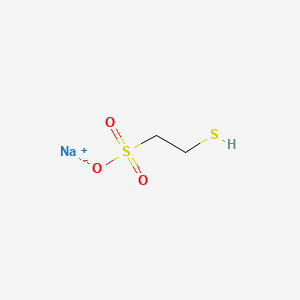
| Formula | C2H5NaO3S2 |
|---|---|
| Molecular weight | 164.18 g/mol |
| IUPAC name | sodium 2-sulfanylethanesulfonate |
| CAS | 19767-45-4 |
| PubChem CID | 23662354 |
| InChIKey | XOGTZOOQQBDUSI-UHFFFAOYSA-M |
| logP | -0.2 |
| Polar surface area | 54.37 Ų |
| H-bond acceptors / donors | 3 / 2 |
| Drug-likeness (QED) | 0.41 |
| Lipinski violations | 0 |
SMILES
O=S(=O)([O-])CCS.[Na+]Biology & Pharmacokinetics
Pharmacokinetics predicted
| Bioavailability | 10.0% |
|---|---|
| Half-life | 1.657 h |
| Volume of distribution | 0.943 L/kg |
| Protein binding | 26.8% |
| BBB penetrant | No |
Transporters
BCRP (Inhibitor)BSEP (Inhibitor)BSEP (Inhibitor)MRP1 (Inhibitor)MRP2 (Inhibitor)MRP3 (Inhibitor)MRP4 (Inhibitor)OATP1B1 (Inhibitor)OATP1B3 (Inhibitor)OATP1B3 (Inhibitor)P-gp (Inhibitor)P-gp (Substrate)
Registered Products (2)
| Brand | Form / strength | Pack | Agent | Citizen (JOD) |
|---|---|---|---|---|
| Mecen | Vial 100 mg/1 ml | 15 vial | MS PHARMA/JORDAN | — |
| UROMITEXAN | Ampoule 400 mg/4 ml | 15 amp | Khoury Drug Store | — |