Naloxone
JFDA label: Naxone 0.4mg/1ml Injection
Mechanism of Action
Pure opioid antagonist that competes and displaces opioids at opioid receptor sites
Indications
Approved
- Evzio (IM, SubQ) intranasal
- Opioid overdose
Off-label
- Opioid-induced pruritus
Contraindications
Source: Lexicomp
- Hypersensitivity to naloxone or any component of the formulation Absolute
Adverse Reactions
Cardiac disorders (6)
Not Known Flushing (parenteral) · hypertension · hypotension · tachycardia · ventricular fibrillation · ventricular tachycardia
Nervous system disorders (21)
Not Known Agitation · body pain · brain disease · coma · confusion (parenteral) · disorientation (parenteral) · dizziness (parenteral) · excessive crying (neonates) · hallucination (parenteral) · headache (nasal) · hyperreflexia (neonates) · irritability · nervousness · outbursts of anger (parenteral) · paresthesia (parenteral) · restlessness · seizure (neonates) · shivering · tonic-clonic seizures (parenteral) · withdrawal syndrome · yawning
Metabolism and nutrition disorders (1)
Not Known Hot flash (parenteral)
Gastrointestinal disorders (6)
Not Known Abdominal cramps · constipation (nasal) · diarrhea · nausea · toothache (nasal) · vomiting
Skin and subcutaneous tissue disorders (3)
Not Known Diaphoresis · piloerection · xeroderma (nasal)
Musculoskeletal and connective tissue disorders (4)
Not Known Muscle spasm (nasal) · musculoskeletal pain (nasal) · tremor · weakness
General disorders and administration site conditions (3)
Not Known Erythema at injection site (parenteral) · Fever · injection site reaction
Respiratory, thoracic and mediastinal disorders (11)
Not Known Dry nose (nasal) · dyspnea · hypoxia (parenteral) · nasal congestion (nasal) · nasal discomfort (pain; nasal) · nasal mucosa swelling (nasal) · pulmonary edema · respiratory depression (parenteral) · rhinitis (nasal) · rhinorrhea · sneezing
Dosing
Source: Lexicomp
Warnings & Precautions
Source: Lexicomp
Acute opioid withdrawal
Administration of naloxone causes the release of catecholamines, which may precipitate acute withdrawal or unmask pain in those who regularly take opioids. Symptoms of acute withdrawal in opioid-dependent patients may include pain, tachycardia, hypertension, fever, sweating, abdominal cramps, diarrhea, nausea, vomiting, agitation, and irritability. In neonates born to mothers with opioid dependence, opioid withdrawal may be life-threatening and symptoms may include excessive crying, shrill cry, failure to feed, seizures, and hyperactive reflexes. In settings other than acute opioid overdose (eg, postoperative patients), carefully titrate the dose to reverse hypoventilation; do not fully awaken patient or reverse analgesic effect. The 2 mg nasal dose (off-label) is less likely to precipitate severe opioid withdrawal compared to the 4 mg dose; however, the 2 mg dose may not provide an adequate and timely reversal in patients who have been exposed to an overdose of a potent or very high dose of opioids. Disease-related concerns:
Cardiovascular disease
Use with caution in patients with cardiovascular disease or in patients receiving medications with potential adverse cardiovascular effects (eg, hypotension, pulmonary edema or arrhythmias); pulmonary edema and cardiovascular instability, including ventricular fibrillation, have been reported in association with abrupt reversal when using opioid antagonists.
Seizures
Use caution in patients with history of seizures; avoid use in the treatment of meperidine-induced seizures. Dosage form specific issues:
Auto-injector
When administered to infants Other warnings/precautions:
Addiction involving opioid use
To prevent overdose deaths, there are initiatives to dispense naloxone for self- or buddy-administration to patients at risk of opioid overdose (eg, recipients of high-dose opioids, suspected or confirmed history of illicit opioid use) and individuals likely to be present in an overdose situation (eg, family members of illicit drug users) (Albert 2011; Bennett 2011). Clinical practice guidelines recommend patients being treated for opioid use disorder should be given prescriptions for naloxone. Patients and family members/significant others should be trained in the use of naloxone in overdose (Kampman [ASAM 2015]). Evzio is indicated for emergency treatment. Needleless administration via nebulization and the intranasal route using the injectable solution (with a mucosal atomization device) by first responders and bystanders has also been described (Doe-Simkins 2009; Weber 2012). Needleless administration provides an alternative route of administration in patients with venous scarring due to illicit drug use (eg, heroin). There is a low incidence of death following naloxone reversal of opioid toxicity in patients who refuse transport to a healthcare facility (Wampler 2011). Nevertheless, patients who received naloxone in the out-of-hospital setting should seek immediate emergency medical assistance after the first dose due to the likelihood that respiratory and/or central nervous system depression will return.
Opioid overdose
Recurrence of respiratory and/or CNS depression is possible if the opioid involved is long-acting; continuously observe patients until there is no further risk of recurrent respiratory or CNS depression.
Partial opioid agonist and mixed opioid agonist/antagonist overdose
Reversal of partial opioid agonists or mixed opioid agonist/antagonists (eg, buprenorphine, pentazocine) may be incomplete and larger or repeat doses of naloxone may be required.
Postoperative reversal
Appropriate use: Excessive dosages should be avoided after use of opioids in surgery. Abrupt postoperative reversal may result in nausea, vomiting, sweating, tachycardia, hypertension, seizures, and other cardiovascular events (including pulmonary edema and arrhythmias).
Pregnancy & Lactation
Pregnancy
Adverse events were not observed in animal reproduction studies. Naloxone crosses the placenta and may precipitate opioid withdrawal in the fetus. Naloxone is not recommended for use in pregnant women with opioid use disorder except in situations of life threatening overdose (Kampman [ASAM 2015]). Use to diagnose opioid dependence during pregnancy is contraindicated (ACOG 2012). In general, medications used as antidotes should take into consideration the health and prognosis of the mother; antidotes should be administered to pregnant women if there is a clear indication for use and should not be withheld because of fears of teratogenicity (Bailey 2003). Use caution in pregnant women with mild-to-moderate hypertension during labor; severe hypertension may occur.
Lactation
It is not known if naloxone is present in breast milk, however, systemic absorption following oral administration is low (Smith 2012) and any exposure of naloxone to a breastfeeding infant would therefore be limited. Since naloxone is used for opioid reversal, the opioid concentrations in the milk of a breastfeeding mother and potential transfer of the opioid to the infant should be considered. According to the manufacturer, the decision to continue or discontinue breastfeeding during therapy sh
Monitoring
| Clinical pearl | Respiratory rate, heart rate, blood pressure, temperature, level of consciousness, ABGs or pulse oximetry |
|---|
Chemistry & Properties
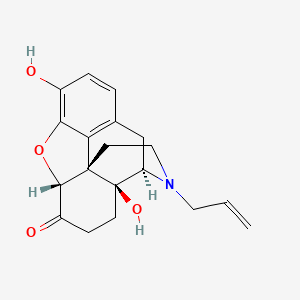
| Formula | C19H21NO4 |
|---|---|
| Molecular weight | 327.38 g/mol |
| IUPAC name | (4R,4aS,7aR,12bS)-4a,9-dihydroxy-3-prop-2-enyl-2,4,5,6,7a,13-hexahydro-1H-4,12-methanobenzofuro[3,2-e]isoquinolin-7-one |
| CAS | 465-65-6 |
| PubChem CID | 5284596 |
| InChIKey | UZHSEJADLWPNLE-GRGSLBFTSA-N |
| logP | 1.3 (XLogP 2.1) |
| Polar surface area | 70.0 Ų |
| H-bond acceptors / donors | 5 / 2 |
| Drug-likeness (QED) | 0.80 |
| Lipinski violations | 0 |
SMILES
C=CCN1CC[C@]23c4c5ccc(O)c4O[C@H]2C(=O)CC[C@@]3(O)[C@H]1C5Biology & Pharmacokinetics
Pharmacokinetics predicted
| Bioavailability | 70.0% |
|---|---|
| Half-life | 3.351 h |
| Volume of distribution | 1.681 L/kg |
| Protein binding | 65.6% |
| BBB penetrant | Yes |
Enzyme interactions
| Enzyme | Role | Detail |
|---|---|---|
| CYP1A2 | Substrate | — |
| CYP2C9 | Substrate | — |
| CYP2D6 | Inhibitor | IC₅₀ 2.0000000000000004 µM |
| CYP2D6 | Substrate | — |
| CYP3A4 | Substrate | — |
Receptor binding (top 10)
| Target | Action | Affinity |
|---|---|---|
| μ receptor (OPRM1) | Antagonist | pKi 8.9 |
| OPIATE Mu (OPRM1) | Binding | pKi 8.3 |
| OPIATE Kappa (OPRK1) | Binding | pKi 8.3 |
| MOR | Binding | pKi 7.5 |
| δ receptor (OPRD1) | Antagonist | pKi 7.2 |
| OPIATE Delta (OPRD1) | Binding | pKi 7.0 |
| OPIATE Kappa 3 | Binding | pKi 6.9 |
| DOR | Binding | pKi 6.6 |
| KOR | Binding | pKi 6.6 |
| GPR7 | Binding | pKi 5.5 |
Transporters
BCRP (Inhibitor)BSEP (Inhibitor)BSEP (Inhibitor)MATE1 (Inhibitor)MRP1 (Inhibitor)MRP2 (Inhibitor)MRP4 (Inhibitor)OATP1A2 (Inhibitor)OATP1B1 (Inhibitor)OATP1B3 (Inhibitor)OATP1B3 (Inhibitor)OCT2 (Inhibitor)P-gp (Inhibitor)MDR1 (Substrate)P-gp (Substrate)
Drug–drug interactions (32, DDInter)
| Interacting drug | Severity | Management |
|---|---|---|
| Droperidol | major | |
| Alfentanil | moderate | |
| Benzhydrocodone | moderate | |
| Binimetinib | moderate | |
| Butorphanol | moderate | |
| Codeine | moderate | |
| Dezocine | moderate | |
| Diamorphine | moderate | |
| Dihydrocodeine | moderate | |
| Fentanyl | moderate | |
| Hydrocodone | moderate | |
| Hydromorphone | moderate | |
| Levacetylmethadol | moderate | |
| Levorphanol | moderate | |
| Meperidine | moderate | |
| Methadone | moderate | |
| Methylnaltrexone | moderate | |
| Morphine | moderate | |
| Nalbuphine | moderate | |
| Naldemedine | moderate | |
| Naloxegol | moderate | |
| Oliceridine | moderate | |
| Opium | moderate | |
| Oxycodone | moderate | |
| Oxymorphone | moderate | |
| Pentazocine | moderate | |
| Remifentanil | moderate | |
| Sufentanil | moderate | |
| Tapentadol | moderate | |
| Tramadol | moderate | |
| Fenfluramine | minor | |
| Hydrocortisone | minor |
Registered Products (2)
| Brand | Form / strength | Pack | Agent | Citizen (JOD) |
|---|---|---|---|---|
| Naxone | Injection 0.4 mg/1 ml | 6 vial | Hikma Pharmaceuticals Co.Ltd/Jordan | 19.200 |
| Naxone | Injection 0.4 mg/ml | 10 vial | Hikma Pharmaceuticals Co.Ltd/Jordan | 32.000 |