Nepafenac
Active form: Amfenac.
JFDA label: Nevanac Eye Drops,Suspension 1.0mg/ml
Mechanism of Action
Inhibitor of Cyclooxygenase — Cyclooxygenase inhibitor
| Target | Action | Gene / class |
|---|---|---|
| Cyclooxygenase efficacy | INHIBITOR |
Indications
Approved
- Ocular pain and inflammation associated with cataract surgery
Contraindications
Source: Lexicomp
- Additional contraindications (not in US labeling): Asthma, urticarial, or acute rhinitis precipitated by acetylsalicylic acid or other NSAIDs Absolute
- Hypersensitivity to nepafenac, other NSAIDs, or any component of the formulation Absolute
Adverse Reactions
Cardiac disorders (1)
Common Hypertension
Nervous system disorders (2)
Common Foreign body sensation of eye · headache
Gastrointestinal disorders (2)
Common Nausea · vomiting
Eye disorders (14)
Common conjunctival edema · corneal edema · crusting of eyelid · Decreased visual acuity · eye discomfort · eye pain · eye pruritus · increased intraocular pressure · lacrimation · ocular hyperemia · photophobia · sticky sensation of eye · vitreous detachment · xerophthalmia
Respiratory, thoracic and mediastinal disorders (1)
Common Sinusitis
Dosing
Source: Lexicomp
Warnings & Precautions
Source: Lexicomp
Aspirin/NSAID sensitivity
Use with caution in patients with previous sensitivity to acetylsalicylic acid and phenylacetic acid derivatives, including patients who experience bronchospasm, asthma, rhinitis, or urticaria following NSAID or aspirin.
Keratitis
May cause keratitis; continued use in a patient with keratitis may cause severe corneal adverse reactions, potentially resulting in loss of vision. Immediately discontinue use in patients with evidence of corneal epithelial damage. Disease-related concerns:
Bleeding disorders
Use with caution in patients with a predisposition to bleeding (bleeding tendencies or medications which interfere with coagulation).
Diabetes
Use with caution in patients with diabetes mellitus; may be at risk of corneal adverse events, potentially resulting in loss of vision.
Ocular disease
Use with caution in patients with complicated ocular surgeries, corneal denervation, corneal epithelial defects, ocular surface disease, or repeat ocular surgeries (within a short timeframe); may be at risk of corneal adverse events, potentially resulting in loss of vision.
Rheumatoid arthritis
Use with caution in patients with rheumatoid arthritis; may be at risk of corneal adverse events, potentially resulting in loss of vision. Special populations:
Surgery patients
May slow/delay healing or prolong bleeding time following surgery. Increased intraocular bleeding (including hyphema) has been reported. To minimize the risk of infection following surgery of both eyes, two separate bottles of eye drops (one for each eye) should be used; instruct patients not to use the same bottle for both eyes. Other warnings/precautions:
Contact lenses
May contain benzalkonium chloride which may be absorbed by soft contact lenses; contact lenses should not be worn during treatment.
Duration of therapy
Use for more than 1 day prior to surgery or for 14 days beyond surgery may increase risk and severity of corneal adverse events.
Pregnancy & Lactation
Pregnancy
Teratogenic events were not observed in animal reproduction studies. Exposure to nonsteroidal anti-inflammatory drugs late in pregnancy may lead to premature closure of the ductus arteriosus.
Lactation
It is not known if nepafenac is excreted in breast milk; the manufacturer recommends that caution be exercised when administering to nursing women.
Chemistry & Properties
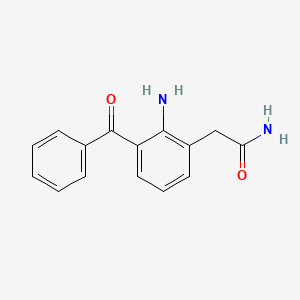
| Formula | C15H14N2O2 |
|---|---|
| Molecular weight | 254.29 g/mol |
| IUPAC name | 2-(2-amino-3-benzoylphenyl)acetamide |
| CAS | 78281-72-8 |
| PubChem CID | 151075 |
| InChIKey | QEFAQIPZVLVERP-UHFFFAOYSA-N |
| logP | 1.53 (XLogP 1.9) |
| Polar surface area | 86.18 Ų |
| H-bond acceptors / donors | 3 / 2 |
| Drug-likeness (QED) | 0.64 |
| Lipinski violations | 0 |
SMILES
NC(=O)Cc1cccc(C(=O)c2ccccc2)c1NBiology & Pharmacokinetics
Pharmacokinetics predicted
| Bioavailability | 10.0% |
|---|---|
| Half-life | 1.672 h |
| Volume of distribution | 0.483 L/kg |
| Protein binding | 99.0% |
| BBB penetrant | Yes |
Enzyme interactions
| Enzyme | Role | Detail |
|---|---|---|
| CYP1A2 | Inhibitor | — |
| CYP2C19 | Inhibitor | — |
| CYP2C8 | Inhibitor | — |
| CYP2C9 | Inhibitor | — |
| CYP3A4 | Inhibitor | — |
Transporters
BCRP (Inhibitor)BSEP (Inhibitor)MRP1 (Inhibitor)OATP1B1 (Inhibitor)OATP1B3 (Inhibitor)P-gp (Inhibitor)P-gp (Substrate)
Registered Products (1)
| Brand | Form / strength | Pack | Agent | Citizen (JOD) |
|---|---|---|---|---|
| Nevanac Eye Drops,Suspension | Suspension 1 mg/ml | 5 ml | The Jordan Drugstore Co | 5.100 |