Nitroglycerine
JFDA label: Deponit NT Transdermal
Indications
Approved
- Intra-anal administration (Rectiv ointment)
- Intravenous (IV) administration
Off-label
- Esophageal spastic disorders
- Gastroesophageal variceal hemorrhage
- Short-term management of pulmonary hypertension (IV)
- Sympathomimetic vasopressor extravasation injury (alternative to phentolamine)
- Uterine relaxation
Contraindications
Source: Lexicomp
- Additional contraindications for transdermal patch (not in US labeling): Acute circulatory failure associated with marked hypotension (shock and states of collapse) Absolute
- Additional contraindications for translingual product (not in US labeling): Closed angle glaucoma Absolute
- Hypersensitivity to nitroglycerin, other nitrates or nitrites, or any component of the formulation (includes adhesives for transdermal product) Absolute
- acute circulatory failure or shock (Nitrolingual only) Absolute
- concurrent use with phosphodiesterase-5 (PDE-5) inhibitors (avanafil, sildenafil, tadalafil, or vardenafil) Absolute
- concurrent use with soluble guanylate cyclase (sGC) stimulators (eg, riociguat). Additional contraindications for IV product: Hypersensitivity to corn or corn products (solutions containing dextrose) Absolute
- constrictive pericarditis Absolute
- early myocardial infarction (sublingual tablet only Absolute
- heart failure (aortic or mitral stenosis, constrictive pericarditis or hypertrophic obstructive cardiomyopathy) Absolute
- increased intracranial pressure Absolute
- increased intraocular pressure Absolute
- myocardial infarction Absolute
- myocardial insufficiency due to obstruction (eg, presence of aortic or mitral stenosis or of constrictive pericarditis) Absolute
- orthostatic hypotension Absolute
- pericardial tamponade Absolute
- restrictive cardiomyopathy Absolute
- severe anemia Absolute
- severe anemia Additional contraindications for translingual product: Increased intracranial pressure Absolute
- severe anemia. Note: According to the American College of Cardiology Foundation/American Heart Association (ACCF/AHA) guidelines of the management of ST-elevation myocardial infarction (STEMI) and the ACC/AHA guidelines for the management of patients with non-ST-elevation acute coronary syndromes (NSTE-ACS), avoid nitrates in the following conditions: Hypotension (SBP Absolute
- uncorrected hypovolemia Additional contraindications for sublingual product and rectal ointment: Acute circulatory failure or shock (sublingual tablets and powder) Absolute
Adverse Reactions
Cardiac disorders (7)
Common Hypotension · peripheral edema · syncope
Not Known Bradycardia · exacerbation of angina pectoris · flushing · orthostatic hypotension
Nervous system disorders (2)
Common Dizziness · paresthesia
Gastrointestinal disorders (2)
Common Abdominal pain
Not Known Vomiting
Skin and subcutaneous tissue disorders (1)
Not Known Diaphoresis
Musculoskeletal and connective tissue disorders (1)
Common Weakness
General disorders and administration site conditions (1)
Not Known Drug tolerance
Other (1)
Very Common Central nervous system: Headache
Respiratory, thoracic and mediastinal disorders (3)
Common Dyspnea · pharyngitis · rhinitis
Dosing
Source: Lexicomp
Warnings & Precautions
Source: Lexicomp
Headache
Dose-related headaches may occur, especially during initial dosing.
Hypotension/bradycardia
Severe hypotension and shock may occur (even with small doses); paradoxical bradycardia and increased angina pectoris may accompany hypotension. Orthostatic hypotension may also occur; ethanol may accentuate this. Use with caution in volume depletion, preexisting hypotension, constrictive pericarditis, aortic or mitral stenosis, and extreme caution with inferior wall MI and suspected right ventricular involvement. According to the ACCF/AHA, avoid use in patients with severe hypotension (SBP • Increased intracranial pressure: Nitroglycerin may precipitate or aggravate increased intracranial pressure and subsequently may worsen clinical outcomes in patients with neurologic injury (eg, intracranial hemorrhage, traumatic brain injury) (Rangel-Castilla 2008). Some products are contraindicated in patients with increased intracranial pressure. Disease-related concerns:
Hypertrophic cardiomyopathy (HCM)
Avoid use in patients with HCM with outflow tract obstruction; nitrates may reduce preload, exacerbating obstruction and cause hypotension or syncope and/or worsening of heart failure (ACCF/AHA [Gersh, 2011]). Concurrent drug therapy issues:
Drug-drug interactions
Potentially significant interactions may exist, requiring dose or frequency adjustment, additional monitoring, and/or selection of alternative therapy. Consult drug interactions database for more detailed information. Dosage form specific issues:
Intra-anal ointment
Use caution when treating rectal anal fissures with nitroglycerin in patients with suspected or known significant cardiovascular disorders (eg, cardiomyopathies, heart failure, acute MI); intra-anal nitroglycerin administration may decrease systolic blood pressure and decrease arterial vascular resistance.
Long-acting agents
Avoid use of long-acting agents in acute MI or acute HF; cannot easily reverse effects if adverse events develop.
Propylene glycol
Some dosage forms may contain propylene glycol; large amounts are potentially toxic and have been associated hyperosmolality, lactic acidosis, seizures and respiratory depression; use caution (AAP 1997; Zar 2007).
Transdermal patches
May contain conducting metal (eg, aluminum); remove patch prior to MRI. Other warnings/precautions:
Tolerance
May occur; cross tolerance to other nitro compounds have been reported. Appropriate dosing is needed to minimize tolerance development.
Pregnancy & Lactation
Pregnancy
Animal reproduction studies have not been conducted with all products; adverse events were not observed in animal reproduction studies conducted using the ointment. Nitroglycerin crosses the placenta (David 2000). Concentrations following application of a transdermal patch 0.4 mg/hour were low but detectable in the fetal serum (fetal/maternal ratio: 0.23) (Bustard 2003). Nitroglycerin may be used in pregnancy when immediate relaxation of the uterus is needed (ACOG 183 2017; Axemo 1998; Chandraharan 2005). Intravenous nitroglycerin may be used to treat pre-eclampsia with pulmonary edema (ESG 2011).
Lactation
It is not known if nitroglycerin is present in breast milk. According to the manufacturer, the decision to continue or discontinue breastfeeding during therapy should take into account the risk of infant exposure, the benefits of breastfeeding to the infant, and benefits of treatment to the mother. Information related to the use of nitroglycerin and breastfeeding is limited (Böttiger 2010; O’Sullivan 2011).
Monitoring
| Clinical pearl | Blood pressure, heart rate; consult individual institutional policies and procedures |
|---|
Chemistry & Properties
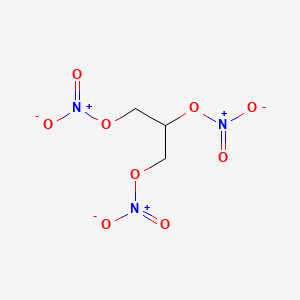
| Formula | C3H5N3O9 |
|---|---|
| Molecular weight | 227.09 g/mol |
| IUPAC name | 1,3-dinitrooxypropan-2-yl nitrate |
| CAS | 55-63-0 |
| PubChem CID | 4510 |
| InChIKey | SNIOPGDIGTZGOP-UHFFFAOYSA-N |
| logP | 1.6 (XLogP 1.6) |
| Polar surface area | 165.0 Ų |
| H-bond acceptors / donors | 9 / 0 |
SMILES
C(C(CO[N+](=O)[O-])O[N+](=O)[O-])O[N+](=O)[O-]Biology & Pharmacokinetics
Pharmacokinetics
| BBB penetrant | No |
|---|
Enzyme interactions
| Enzyme | Role | Detail |
|---|---|---|
| CYP1A2 | Substrate | — |
| CYP2C19 | Inhibitor | — |
| CYP2C19 | Substrate | — |
| CYP2C8 | Inhibitor | — |
| CYP2C9 | Inhibitor | — |
| CYP3A4 | Substrate | — |
Transporters
BCRP (Inhibitor)BSEP (Inhibitor)MRP1 (Inhibitor)OATP1B1 (Inhibitor)OATP1B3 (Inhibitor)P-gp (Inhibitor)P-gp (Substrate)
Registered Products (5)
| Brand | Form / strength | Pack | Agent | Citizen (JOD) |
|---|---|---|---|---|
| Nitroderm TTS-5 | Patch 25 mg per 10 cm2 | 10 patch pack varies | Nabulsi Drug Store | 2.590 |
| Nitroderm TTS-10 | Patch 50 mg per 20 cm2 | 10 patch | Nabulsi Drug Store | 4.560 |
| Deponit NT Transdermal | Patch 5 mg | 10 | Suleiman Tannous & Sons Co. Ltd | 5.930 |
| Nitroderm TTS-5 | Patch 25 mg per 10 cm2 | 30 patch pack varies | Nabulsi Drug Store | 7.310 |
| Deponit NT Transdermal | Patch 10 mg | 10 | Suleiman Tannous & Sons Co. Ltd | 8.950 |