Oxybuprocaine
JFDA label: Minims Oxybuprocaine Hcl 0.4% e/d
Mechanism of Action
Prevents initiation and transmission of impulse at the nerve cell membrane by decreasing ion permeability through stabilizing
Indications
Approved
- Anesthesia, ocular
Contraindications
Source: Lexicomp
- Hypersensitivity to proparacaine or any component of the formulation Absolute
Adverse Reactions
Immune system disorders (1)
Not Known Hypersensitivity reaction (corneal; characterized by acute, intense, and diffuse epithelial keratitis; gray, ground glass appearance; exfoliation of skin; corneal filaments; and can include iritis wit
Skin and subcutaneous tissue disorders (1)
Not Known Allergic contact dermatitis
Eye disorders (8)
Not Known Burning sensation of eyes · conjunctival hemorrhage · conjunctival hyperemia · corneal erosion · cycloplegia · eye redness · mydriasis · stinging of eyes
Dosing
Source: Lexicomp
Warnings & Precautions
Source: Lexicomp
Appropriate use
For topical ophthalmic use only; prolonged use may result in permanent corneal opacification and visual loss and is not recommended.
Pregnancy & Lactation
Pregnancy
Animal reproduction studies have not been conducted.
Lactation
It is not known if proparacaine is excreted in breast milk. The manufacturer recommends that caution be exercised when administering proparacaine to nursing women.
Chemistry & Properties
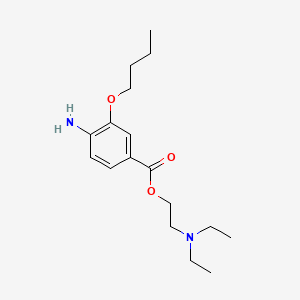
| Formula | C17H28N2O3 |
|---|---|
| Molecular weight | 308.42 g/mol |
| IUPAC name | 2-(diethylamino)ethyl 4-amino-3-butoxybenzoate |
| CAS | 99-43-4 |
| PubChem CID | 4633 |
| InChIKey | CMHHMUWAYWTMGS-UHFFFAOYSA-N |
| logP | 2.95 (XLogP 3.1) |
| Polar surface area | 64.79 Ų |
| H-bond acceptors / donors | 5 / 1 |
| Drug-likeness (QED) | 0.41 |
| Lipinski violations | 0 |
SMILES
CCCCOc1cc(C(=O)OCCN(CC)CC)ccc1NBiology & Pharmacokinetics
Pharmacokinetics
| BBB penetrant | No |
|---|
Enzyme interactions
| Enzyme | Role | Detail |
|---|---|---|
| CYP1A2 | Inhibitor | — |
| CYP2B6 | Inhibitor | — |
| CYP2D6 | Inhibitor | — |
Transporters
BCRP (Inhibitor)BSEP (Inhibitor)BSEP (Inhibitor)MRP1 (Inhibitor)OATP1B1 (Inhibitor)OATP1B3 (Inhibitor)P-gp (Inhibitor)P-gp (Substrate)
Registered Products (1)
| Brand | Form / strength | Pack | Agent | Citizen (JOD) |
|---|---|---|---|---|
| Minims Oxybuprocaine Hcl 0.4% e/d | Ophthalmic Solution 0.4 % | 0.5 ml | Petra Drug Store | — |