Permethrin
JFDA label: Prescab 5% Cream
Mechanism of Action
Blocker of Voltage-sensitive sodium channel — Voltage-sensitive sodium channel blocker
| Target | Action | Gene / class |
|---|---|---|
| Voltage-sensitive sodium channel efficacy | BLOCKER | vssc |
Indications
Approved
- Head lice (lotion/cream rinse)
- Scabies (cream)
Off-label
- Pubic lice (Pediculosis pubis)
- Scabies, crusted (Norwegian scabies)
Contraindications
Source: Lexicomp
- Hypersensitivity to any pyrethroid or pyrethrin, or to any component of the formulation. OTC labeling (cream rinse/lotion): When used for self-medication, do not use on infants Absolute
Adverse Reactions
Nervous system disorders (4)
Common Local discomfort (scalp) · localized burning · localized numbness · tingling of skin
Skin and subcutaneous tissue disorders (4)
Common erythema · Pruritus · skin rash (scalp) · stinging of the skin
General disorders and administration site conditions (1)
Common Localized edema
Dosing
Source: Lexicomp
Warnings & Precautions
Source: Lexicomp
Skin irritation
Treatment may temporarily exacerbate the symptoms of itching, redness, and swelling. Discontinue use if hypersensitivity occurs. Other warnings/precautions:
Appropriate use
For external use only. Avoid contact with eyes.
Ragweed allergy (cream rinse/lotion)
May cause difficulty in breathing or an asthmatic attack.
Pregnancy & Lactation
Pregnancy
Adverse events have not been observed in oral animal reproduction studies. The amount of permethrin available systemically following topical application is ≤2%. The CDC considers the use of permethrin or pyrethrins with piperonyl butoxide the drugs of choice for the treatment of pubic lice during pregnancy; permethrin is the preferred treatment of scabies during pregnancy (CDC [Workowski 2015]).
Lactation
It is not known if permethrin is excreted in breast milk. Due to the potential for serious adverse reactions in the nursing infant, the manufacturer recommends a decision be made whether to discontinue nursing or to discontinue the drug, taking into account the importance of treatment to the mother. Lactating women may be treated with permethrin (CDC [Workowski 2015]).
Chemistry & Properties
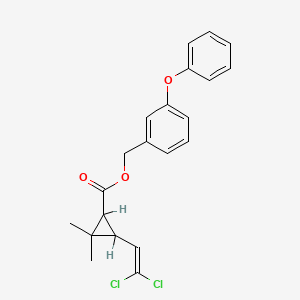
| Formula | C21H20Cl2O3 |
|---|---|
| Molecular weight | 391.29 g/mol |
| IUPAC name | (3-phenoxyphenyl)methyl 3-(2,2-dichloroethenyl)-2,2-dimethylcyclopropane-1-carboxylate |
| CAS | 52645-53-1 |
| PubChem CID | 40326 |
| InChIKey | RLLPVAHGXHCWKJ-UHFFFAOYSA-N |
| logP | 6.11 (XLogP 6.5) |
| Polar surface area | 35.53 Ų |
| H-bond acceptors / donors | 3 / 0 |
| Drug-likeness (QED) | 0.56 |
| Lipinski violations | 1 |
SMILES
CC1(C)C(C=C(Cl)Cl)C1C(=O)OCc1cccc(Oc2ccccc2)c1Biology & Pharmacokinetics
Pharmacokinetics
| BBB penetrant | No |
|---|
Enzyme interactions
| Enzyme | Role | Detail |
|---|---|---|
| CYP1A2 | Inhibitor | — |
| CYP2B6 | Inhibitor | — |
| CYP2B6 | Substrate | — |
| CYP2C19 | Inhibitor | — |
| CYP2C19 | Substrate | — |
| CYP2C8 | Inhibitor | — |
| CYP2C9 | Inhibitor | — |
| CYP2C9 | Substrate | — |
| CYP2D6 | Inhibitor | — |
| CYP3A4 | Inhibitor | — |
| CYP3A4 | Substrate | — |
Transporters
BCRP (Inhibitor)BCRP (Inhibitor)BSEP (Inhibitor)MDR1 (Inhibitor)MRP1 (Inhibitor)OATP1B1 (Inhibitor)OATP1B3 (Inhibitor)P-gp (Inhibitor)P-gp (Substrate)
Registered Products (2)
| Brand | Form / strength | Pack | Agent | Citizen (JOD) |
|---|---|---|---|---|
| Prescab Cream | Cream 2 % | 60 g tube | Arab Center for Pharmaceuticals & Chemicals | 2.390 |
| Prescab | Cream 50 mg/g | 60 g tube | Arab Center for Pharmaceuticals & Chemicals | 3.290 |