Phytomenadione
JFDA label: Phytomenadione Memphis
- immune system toxicity — ChEMBL drug_warning (Black Box Warning) | United States
- vascular toxicity — ChEMBL drug_warning (Black Box Warning) | United States
- respiratory toxicity — ChEMBL drug_warning (Black Box Warning) | United States
- nephrotoxicity — ChEMBL drug_warning (Black Box Warning) | United States
- Fatal hypersensitivity reactions, including anaphylaxis, have occurred during and immediately after intravenous and intramuscular injection of phytonadione injectable emulsion. Reactions have occurred
Indications
Approved
- Celiac Disease — celiac disease
- Colitis, Ulcerative — ulcerative colitis
- Cystic Fibrosis — cystic fibrosis
- Fibrosis — fibrosis
- Hemorrhage — hemorrhage
- Vitamin K Deficiency — vitamin deficiency disorder
Off-label
- Cardiovascular Diseases
- Glioblastoma
- Osteoporosis
- Osteoporosis, Postmenopausal
- Renal Insufficiency, Chronic
Contraindications
Source: openFDA
- Hypersensitivity to phytonadione or any other component of this medication [see Warnings and Precautions ( 5.1 )] . Hypersensitivity to any component of this medication. ( 4 ) Absolute
Dosing
Source: openFDA
Warnings & Precautions
Source: openFDA
Boxed Warning
Fatal hypersensitivity reactions, including anaphylaxis, have occurred during and immediately after intravenous and intramuscular injection of phytonadione injectable emulsion. Reactions have occurred despite dilution to avoid rapid intravenous infusion and upon first dose. Avoid the intravenous and intramuscular routes of administration unless the subcutaneous route is not feasible and the serious risk is justified [see Warnings and Precautions ( 5.1 )] . WARNING-HYPERSENSITIVITY REACTIONS WITH INTRAVENOUS AND INTRAMUSCULAR USE See full prescribing information for complete boxed warning. Fatal hypersensitivity reactions, including anaphylaxis, have occurred during and immediately after INTRAVENOUS and INTRAMUSCULAR injection of phytonadione injectable emulsion. Reactions have occurred despite dilution to avoid rapid infusion and upon first and subsequent doses. Avoid the intravenous and intramuscular routes of administration unless the subcutaneous route is not feasible and the serious risk is justified. ( 5.1 )
Warnings & Precautions
Risk of Serious Adverse Reactions in Infants due to Benzyl Alcohol Preservative: Use benzyl alcohol-free formulations in neonates and infants, if available. ( 5.1 ) Cutaneous Reactions: May occur with parenteral use. Discontinue drug and manage medically. ( 5.3 )
Hypersensitivity Reactions Fatal and severe hypersensitivity reactions
Hypersensitivity Reactions Fatal and severe hypersensitivity reactions, including anaphylaxis, have occurred with intravenous or intramuscular administration of phytonadione injectable emulsion. Reactions have occurred despite dilution to avoid rapid intravenous infusion and upon first dose. These reactions have included shock, cardiorespiratory arrest, flushing, diaphoresis, chest pain, tachycardia, cyanosis, weakness, and dyspnea. Administer phytonadione injectable emulsion subcutaneously whenever feasible. Avoid the intravenous and intramuscular routes of administration unless the subcutaneous route is not feasible and the serious risk is justified [see Dosage and Administration ( 2.1 )] .
Risk of Serious Adverse Reaction in Infants due to Benzyl Alcohol Pres
Risk of Serious Adverse Reaction in Infants due to Benzyl Alcohol Preservative Use benzyl alcohol-free formulations in neonates and infants, if available. Serious and fatal adverse reactions including "gasping syndrome" can occur in neonates and infants treated with benzyl alcohol-preserved drugs, including phytonadione injectable emulsion. The "gasping syndrome" is characterized by central nervous system depression, metabolic acidosis, and gasping respirations. When prescribing phytonadione injectable emulsion in infants, consider the combined daily metabolic load of benzyl alcohol from all sources including phytonadione injectable emulsion (contains 9 mg of benzyl alcohol per mL) and other drugs containing benzyl alcohol. The minimum amount of benzyl alcohol at which serious adverse reactions may occur is not known [see Use in Specific Populations ( 8.1 , 8.2 and 8.4 )] .
Cutaneous Reactions Parenteral administration of vitamin K replacement
Cutaneous Reactions Parenteral administration of vitamin K replacements (including phytonadione injectable emulsion) may cause cutaneous reactions. Reactions have included eczematous reactions, scleroderma-like patches, urticaria, and delayed-type hypersensitivity reactions. Time of onset ranged from 1 day to a year after parenteral administration. Discontinue phytonadione injectable emulsion for skin reactions and institute medical management.
Pregnancy & Lactation
Lactation
Vitamin K is naturally found in human milk.
Chemistry & Properties
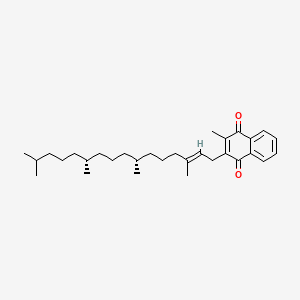
| Formula | C31H46O2 |
|---|---|
| Molecular weight | 450.71 g/mol |
| IUPAC name | 2-methyl-3-[(E,7R,11R)-3,7,11,15-tetramethylhexadec-2-enyl]naphthalene-1,4-dione |
| CAS | 84-80-0 |
| PubChem CID | 5284607 |
| InChIKey | MBWXNTAXLNYFJB-NKFFZRIASA-N |
| logP | 9.16 (XLogP 10.9) |
| Polar surface area | 34.14 Ų |
| H-bond acceptors / donors | 2 / 0 |
| Drug-likeness (QED) | 0.26 |
| Lipinski violations | 1 |
SMILES
CC1=C(C/C=C(\C)CCC[C@H](C)CCC[C@H](C)CCCC(C)C)C(=O)c2ccccc2C1=OBiology & Pharmacokinetics
Pharmacokinetics predicted
| Bioavailability | 70.0% |
|---|---|
| Half-life | 0.341 h |
| Volume of distribution | 2.265 L/kg |
| Protein binding | 97.8% |
| BBB penetrant | No |
Enzyme interactions
| Enzyme | Role | Detail |
|---|---|---|
| CYP1A2 | Inhibitor | — |
| CYP2B6 | Inhibitor | — |
| CYP2C19 | Inhibitor | — |
| CYP2C19 | Substrate | — |
| CYP2C8 | Inhibitor | — |
| CYP2C9 | Inhibitor | — |
| CYP2D6 | Inhibitor | — |
| CYP3A4 | Inhibitor | — |
| CYP3A4 | Substrate | — |
Transporters
BCRP (Inhibitor)BSEP (Inhibitor)BSEP (Inhibitor)MRP1 (Inhibitor)OATP1B1 (Inhibitor)OATP1B3 (Inhibitor)P-gp (Inhibitor)BCRP (Substrate)P-gp (Substrate)
Registered Products (5)
| Brand | Form / strength | Pack | Agent | Citizen (JOD) |
|---|---|---|---|---|
| K-Lot | Ampoule 10 mg | 1 ml | ٠ستÙدع أدÙÙØ© اÙÙÙÙÙÙÙ | 0.760 |
| K-Lot | Ampoule 2 mg | 1 ml | ٠ستÙدع أدÙÙØ© اÙÙÙÙÙÙÙ | 0.760 |
| Phytomenadione Memphis | Ampoule 10 mg | 6 amp | Petra Drug Store | 1.480 |
| Konakion MM Pediatric Amp | Ampoule 2 mg/0.2 ml | 5 amp | Shawi & Rushedat Drug Store | 5.750 |
| Konakion MM Amp | Ampoule 10 mg/1 ml | 5 | Shawi & Rushedat Drug Store | 6.000 |