Ribavirin
Active form: Rtp.
JFDA label: Ribavin Cap
- hematological toxicity — ChEMBL drug_warning (Black Box Warning) | United States
- teratogenicity — ChEMBL drug_warning (Black Box Warning) | United States
- respiratory toxicity — ChEMBL drug_warning (Black Box Warning) | United States
- carcinogenicity — ChEMBL drug_warning (Black Box Warning) | United States
- dermatological toxicity — ChEMBL drug_warning (Black Box Warning) | United States
- EMBRYO-FETAL TOXICITY, HEMOLYTIC ANEMIA, and MONOTHERAPY NOT RECOMMENDED Significant teratogenic and embryocidal effects have been demonstrated in all animal species exposed to ribavirin. In addition,
Mechanism of Action
Inhibitor of Inosine-5'-monophosphate dehydrogenase 1 — Inosine-5'-monophosphate dehydrogenase 1 inhibitor; Inhibitor of RNA-directed RNA polymerase — RNA-directed RNA polymerase inhibitor; Inhibitor of RNA — RNA inhibitor
| Target | Action | Gene / class |
|---|---|---|
| Inosine-5'-monophosphate dehydrogenase 1 efficacy | INHIBITOR | IMPDH1 |
| RNA efficacy | INHIBITOR | |
| RNA-directed RNA polymerase efficacy | INHIBITOR | NS5b |
Indications
Approved
- Fibrosis — fibrosis
- Hepatitis C, Chronic — chronic hepatitis C virus infection
- Liver Cirrhosis — cirrhosis of liver
- Virus Diseases — viral disease
Off-label
- Depressive Disorder
- Diabetes Mellitus, Type 1
- Encephalitis, Japanese
- HIV Infections
- Hemorrhagic Fever with Renal Syndrome
- Hepatitis
- Hepatitis B, Chronic
- Hepatitis C
- Hepatitis D
- Infections
- Influenza, Human
- Lassa Fever
- Leukemia, Myeloid, Acute
- Respiratory Syncytial Virus Infections
- Severe Acute Respiratory Syndrome
- Thrombocytopenia
Antimicrobial Spectrum
Expected / intrinsic spectrum (EUCAST breakpoints & labels) — not local resistance. Source: openfda-label.
Viruses
| Organism | Activity | MIC |
|---|---|---|
| Hepatitis C | Active | — |
Class profile
| targetVirus | HCV/RSV/Hantavirus |
|---|---|
| viralClass | Multiple RNA viruses |
| targetStep | Multiple: inosine monophosphate dehydrogenase inhibition + mutagenesis |
| resistanceBarrier | Low (resistance not well-characterized; often used as backbone in combination) |
| crossResistance | No class cross-resistance; broad mechanism |
| source | DHHS/AASLD/manufacturer-PIL |
Contraindications
Source: openFDA
- Ribavirin capsules combination therapy is contraindicated in: pregnancy. Ribavirin capsules may cause fetal harm when administered to a pregnant woman. Ribavirin capsules are contraindicated in women who are pregnant or planning to become pregnant. If a patient becomes pregnant while taking ribavirin capsules, the patient should be apprised of the potential hazard to the fetus [see Warnings and Precautions (5.1) , and Use in Specific Populations (8.1, 8.3) ]. men whose female partners are pregnant [see Use in Specific Populations (8.3) ] patients with known hypersensitivity reactions such as Stevens-Johnson syndrome, toxic, epidermal necrolysis, and erythema multiforme to ribavirin or any component of the product patients with autoimmune hepatitis patients with hemoglobinopathies (e.g., thalassemia major, sickle-cell anemia) patients with creatinine clearance less than 50 mL/min [see Clinical Pharmacology (12.3) ] when coadministered with didanosine because exposure to the active metabolite of didanosine (dideoxyadenosine 5’-triphosphate) is increased. Fatal hepatic failure, as well as peripheral neuropathy, pancreatitis, and symptomatic hyperlactatemia/lactic acidosis, has been reported in patients receiving didanosine in combination with ribavirin [see Drug Interactions (7.1) ]. Pregnancy and men whose female partners are pregnant ( 4 , 5.1 , 8.1 , 8.3 ) Known hypersensitivity reactions such as Stevens-Johnson syndrome, toxic, epidermal necrolysis, and erythema multiforme to ribavirin or any component of the product ( 4 ) Autoimmune hepatitis ( 4 ) Hemoglobinopathies ( 4 ) Creatinine clearance less than 50 mL/min ( 4 , 12.3 ) Coadministration with didanosine ( 4 , 7.1 ) Absolute
Dosing
Source: openFDA
Warnings & Precautions
Source: openFDA
Boxed Warning
EMBRYO-FETAL TOXICITY, HEMOLYTIC ANEMIA, and MONOTHERAPY NOT RECOMMENDED Significant teratogenic and embryocidal effects have been demonstrated in all animal species exposed to ribavirin. In addition, ribavirin has a multiple-dose half-life of 12 days and may persist in non-plasma compartments for as long as 6 months. Therefore, ribavirin therapy is contraindicated in women who are pregnant and in the male partners of women who are pregnant. Avoid pregnancy and use effective contraception during therapy and for 9 months after completion of treatment in female patients and for 6 months in female partners of male patients who are taking ribavirin therapy. [see Contraindications (4) , Warnings and Precautions (5.1) , Use in Specific Populations (8.1, 8.3 ), and Nonclinical Toxicology (13.1) ]. Hemolytic anemia has been reported with ribavirin therapy. The anemia associated with ribavirin therapy may result in worsening of cardiac disease that has led to fatal and nonfatal myocardial infarctions. Patients with a history of significant or unstable cardiac disease should not be treated with ribavirin [see Dosage and Administration (2.5) , Warnings and Precautions (5.2) , and Adverse Reactions (6.1) ]. Ribavirin monotherapy is not effective for the treatment of chronic hepatitis C virus infection and should not be used alone for this indication [see Warnings and Precautions (5.10) ]. WARNING: EMBRYO-FETAL TOXICITY, HEMOLYTIC ANEMIA, and MONOTHERAPY NOT RECOMMENDED See full prescribing information for complete boxed warning. Significant teratogenic and embryocidal effects have been demonstrated in all animal species exposed to ribavirin. Therefore, ribavirin therapy is contraindicated in women who are pregnant and in the male partners of women who are pregnant. Avoid pregnancy during therapy and for 9 months after completion of treatment in female patients and for 6 months in female partners of male patients who are taking ribavirin therapy. ( 4 , 5.1 , 8.1 , 8.3 , 13.1 ) The hemolytic anemia associated with ribavirin therapy may result in worsening of cardiac disease that has led to fatal and nonfatal myocardial infarctions. Patients with a history of significant or unstable cardiac disease should not be treated with ribavirin. ( 2.5 , 5.2 , 6.1 ) Ribavirin monotherapy is not effective for the treatment of chronic hepatitis C. ( 5.10 )
Warnings & Precautions
Embryo-Fetal Toxicity: May cause fetal harm. Patients should have a negative pregnancy test prior to therapy and use effective contraception and undergo periodic pregnancy tests. ( 5.1 , 8.1 , 8.3 ) Patients exhibiting the following conditions should be closely monitored and may require dose reduction or discontinuation of therapy: Hemolytic anemia may occur with a significant initial drop in hemoglobin. ( 5.2 ) Pancreatitis. ( 5.3 ) Pulmonary infiltrates or pulmonary function impairment. ( 5.4 ) New or worsening ophthalmologic disorders. ( 5.5 ) Severe decreases in neutrophil and platelet counts, and hematologic, endocrine (e.g., TSH), and hepatic abnormalities. ( 5.6 ) Dental/periodontal disorders reported with combination therapy. ( 5.7 ) Concomitant administration of azathioprine. ( 5.8 ) Weight loss and growth inhibition reported during combination therapy in pediatric patients. Long-term growth inhibition (height) reported in some patients. ( 5.9 ) Monotherapy with ribavirin is not permitted. ( 5.10 )
Embryo-Fetal Toxicity Ribavirin capsules may cause birth defects, misc
Embryo-Fetal Toxicity Ribavirin capsules may cause birth defects, miscarriage or stillbirth. Ribavirin therapy should not be started until a report of a negative pregnancy test has been obtained immediately prior to planned initiation of therapy. Female patients should use effective contraception and have periodic monitoring with pregnancy tests during treatment and during the 9-month period after treatment has been stopped. Male patients and their female partners should use effective contraception during treatment and during the 6-month period after treatment has been stopped. Extreme care must be taken to avoid pregnancy in female patients and in female partners of male patients. Ribavirin has demonstrated significant teratogenic and embryocidal effects in all animal species tested. These effects occurred at doses as low as one twentieth of the recommended human dose of ribavirin. [see Boxed Warning , Contraindications (4) , and Use in Specific Populations (8.1 , 8.3) ].
Anemia Hemolytic anemia was observed in approximately 10% of ribavirin
Anemia Hemolytic anemia was observed in approximately 10% of ribavirin/INTRON A-treated subjects in clinical trials. The anemia associated with ribavirin occurs within 1 to 2 weeks of initiation of therapy. Because the initial drop in hemoglobin may be significant, obtain hemoglobin or hematocrit levels before the start of treatment and at Week 2 and Week 4 of therapy, or more frequently if clinically indicated. Patients should then be followed as clinically appropriate [see Dosage and Administration (2.5 , 2.6) ]. Fatal and nonfatal myocardial infarctions have been reported in patients with anemia caused by ribavirin. Patients should be assessed for underlying cardiac disease before initiation of ribavirin therapy. Patients with pre-existing cardiac disease should have electrocardiograms administered before treatment and should be appropriately monitored during therapy. If there is any deterioration of cardiovascular status, therapy should be suspended or discontinued [see Dosage and Administration (2.5 , 2.6) ]. Because cardiac disease may be worsened by drug-induced anemia, patients with a history of significant or unstable cardiac disease should not use ribavirin.
Pancreatitis Suspend ribavirin and INTRON A or PegIntron combination t
Pancreatitis Suspend ribavirin and INTRON A or PegIntron combination therapy in patients with signs and symptoms of pancreatitis and discontinue in patients with confirmed pancreatitis.
Pulmonary Disorders Pulmonary symptoms, including dyspnea, pulmonary i
Pulmonary Disorders Pulmonary symptoms, including dyspnea, pulmonary infiltrates, pneumonitis, pulmonary hypertension, and pneumonia, have been reported during ribavirin with alpha interferon combination therapy; occasional cases of fatal pneumonia have occurred. In addition, sarcoidosis or the exacerbation of sarcoidosis has been reported. If there is evidence of pulmonary infiltrates or pulmonary function impairment, closely monitor the patient, and if appropriate, discontinue combination therapy.
Ophthalmologic Disorders Ribavirin is used in combination therapy with
Ophthalmologic Disorders Ribavirin is used in combination therapy with INTRON A or PegIntron. Refer to labeling for PegIntron for additional information.
Laboratory Tests PegIntron in combination with ribavirin may cause sev
Laboratory Tests PegIntron in combination with ribavirin may cause severe decreases in neutrophil and platelet counts, and hematologic, endocrine (e.g., TSH), and hepatic abnormalities. Obtain hematology and blood chemistry testing in patients on PegIntron/ribavirin combination therapy before the start of treatment and then periodically thereafter. In the adult clinical trial, complete blood counts (including hemoglobin, neutrophil, and platelet counts) and chemistries (including AST, ALT, bilirubin, and uric acid) were measured during the treatment period at Weeks 2, 4, 8, 12, and then at 6-week intervals, or more frequently if abnormalities developed. In pediatric subjects, the same laboratory parameters were evaluated with additional assessment of hemoglobin at treatment Week 6. TSH levels were measured every 12 weeks during the treatment period. HCV-RNA should be measured periodically during treatment [see Dosage and Administration (2) ].
Dental and Periodontal Disorders Dental and periodontal disorders have
Dental and Periodontal Disorders Dental and periodontal disorders have been reported in patients receiving ribavirin and interferon or peginterferon combination therapy. In addition, dry mouth could have a damaging effect on teeth and mucous membranes of the mouth during long-term treatment with the combination of ribavirin and pegylated or nonpegylated interferon alfa-2b. Advise patients to brush their teeth thoroughly twice daily and have regular dental examinations. If vomiting occurs, advise patients to rinse out their mouth thoroughly afterwards.
Concomitant Administration of Azathioprine Pancytopenia (marked decrea
Concomitant Administration of Azathioprine Pancytopenia (marked decreases in red blood cells, neutrophils, and platelets) and bone marrow suppression have been reported in the literature to occur within 3 to 7 weeks after the concomitant administration of pegylated interferon/ribavirin and azathioprine. In this limited number of patients (n=8), myelotoxicity was reversible within 4 to 6 weeks upon withdrawal of both HCV antiviral therapy and concomitant azathioprine and did not recur upon reintroduction of either treatment alone. Discontinue PegIntron, ribavirin, and azathioprine for pancytopenia, and do not reintroduce pegylated interferon/ribavirin with concomitant azathioprine [see Drug Interactions (7.4) ].
Impact on Growth in Pediatric Patients Data on the effects of PegIntro
Impact on Growth in Pediatric Patients Data on the effects of PegIntron and ribavirin on growth come from an open-label study in subjects 3 through 17 years of age, in which weight and height changes were compared to U.S. normative population data. In general, the weight and height gain of pediatric subjects treated with PegIntron and ribavirin lagged behind that predicted by normative population data for the entire length of treatment. Severely inhibited growth velocity (less than 3 rd percentile) was observed in 70% of the subjects while on treatment. Following treatment, rebound growth and weight gain occurred in most subjects. Long-term follow-up data in pediatric subjects, however, indicates that PegIntron in combination therapy with ribavirin may induce a growth inhibition that results in reduced adult height in some patients [see Adverse Reactions (6.1) ]. Similarly, an impact on growth was seen in subjects after treatment with ribavirin and INTRON A combination therapy for one year. In a long-term follow-up trial of a limited number of these subjects, combination therapy resulted in reduced final adult height in some subjects [see Adverse Reactions (6.1) ] .
Not Recommended for Monotherapy and Risks Associated with Combination
Not Recommended for Monotherapy and Risks Associated with Combination Therapy Based on results of clinical trials, ribavirin monotherapy is not effective for the treatment of chronic hepatitis C virus infection; therefore, ribavirin capsules must not be used alone. The safety and efficacy of ribavirin capsules have only been established when used together with INTRON A or PegIntron (not other interferons) as combination therapy. The safety and efficacy of ribavirin with INTRON A or PegIntron combination therapy for the treatment of HIV infection, adenovirus, RSV, parainfluenza, or influenza infections have not been established. Ribavirin capsules should not be used for these indications. There are significant adverse reactions caused by ribavirin/INTRON A or PegIntron combination therapy, including severe depression and suicidal or homicidal ideation, hemolytic anemia, suppression of bone marrow function, autoimmune and infectious disorders, pulmonary dysfunction, pancreatitis, and diabetes. Suicidal ideation or attempts occurred more frequently among pediatric patients, primarily adolescents, compared to adult patients (2.4% versus 1%) during treatment and off-therapy follow-up. Labeling for INTRON A and PegIntron should be reviewed in their entirety for additional safety information prior to initiation of combination treatment.
Pregnancy & Lactation
Pregnancy
Contraindicated
Two reliable forms of contraception required for female patients AND female partners of male patients during and for 6 months after treatment
Lactation
Infants born to mothers with HCV infection should be tested for HCV infection; because maternal antibody is present for the first 18 months of life and before the infant mounts an immunologic response, nucleic acid testing is recommended.
Monitoring
| Efficacy | Viral load (undetectable = success); CD4 count (HIV); hepatic enzymes and HBV/HCV DNA (hepatitis); clinical resolution of acute viral illness |
|---|---|
| Toxicity | Renal function (most antivirals are renally cleared); LFTs; resistance testing if virological failure; CBC |
| Clinical pearl | For HIV, undetectable viral load at 6 months predicts long-term treatment success. Resistance testing is mandatory at virological failure. |
| Counseling | Do not miss doses — even brief interruptions can cause viral rebound and resistance selection. Report any side effects early rather than stopping independently. |
Chemistry & Properties
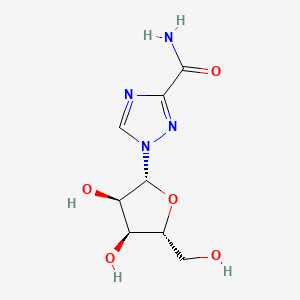
| Formula | C8H12N4O5 |
|---|---|
| Molecular weight | 244.21 g/mol |
| IUPAC name | 1-[(2R,3R,4S,5R)-3,4-dihydroxy-5-(hydroxymethyl)oxolan-2-yl]-1,2,4-triazole-3-carboxamide |
| CAS | 36791-04-5 |
| PubChem CID | 37542 |
| InChIKey | IWUCXVSUMQZMFG-AFCXAGJDSA-N |
| logP | -3.01 (XLogP -1.8) |
| Polar surface area | 143.72 Ų |
| H-bond acceptors / donors | 8 / 4 |
| Drug-likeness (QED) | 0.44 |
| Lipinski violations | 0 |
SMILES
NC(=O)c1ncn([C@@H]2O[C@H](CO)[C@@H](O)[C@H]2O)n1Biology & Pharmacokinetics
Pharmacokinetics
| BBB penetrant | No |
|---|
Transporters
BCRP (Inhibitor)BSEP (Inhibitor)BSEP (Inhibitor)CNT2 (Inhibitor)MRP1 (Inhibitor)MRP2 (Inhibitor)MRP3 (Inhibitor)MRP4 (Inhibitor)OATP1B1 (Inhibitor)OATP1B3 (Inhibitor)OATP1B3 (Inhibitor)P-gp (Inhibitor)CNT2 (Substrate)ENT1 (Substrate)Nucleoside transporters (unspecified) (Substrate)P-gp (Substrate)PEPT1 (Substrate)
Drug–drug interactions (6, DDInter)
| Interacting drug | Severity | Management |
|---|---|---|
| Azathioprine | major | |
| Bexarotene | major | |
| Mercaptopurine | major | |
| Cladribine | moderate | |
| Dicoumarol | moderate | |
| Warfarin | moderate |
Registered Products (1)
| Brand | Form / strength | Pack | Agent | Citizen (JOD) |
|---|---|---|---|---|
| Ribavin Cap | Capsule 200 mg | 60 cap | The Arab Pharmaceutical Manufactruing Co. | 139.660 |