Tazobactam
JFDA label: Piperacillin/Tazobactam 2.25g Injection
- – NOT FOR DIRECT INFUSION PHARMACY BULK PACKAGE – NOT FOR DIRECT INFUSION
Mechanism of Action
12.1 Mechanism of Action Piperacillin and tazobactam for injection is an antibacterial drug [see Microbiology ( 12.4 )] .
Indications
Approved
- Bacterial Infections — bacterial disease
Off-label
- Abscess
- Appendicitis
- Cholecystitis, Acute
- Communicable Diseases
- Diabetic Foot
- Enterobacteriaceae Infections
- Graft vs Host Disease
- Hematologic Neoplasms
- Infections
- Influenza, Human
- Lung Diseases
- Pneumonia
- Pneumonia, Bacterial
- Pneumonia, Ventilator-Associated
- Pseudomonas Infections
- Pyelonephritis
- Sepsis
- Severe Acute Respiratory Syndrome
- Shock, Septic
- Urinary Tract Infections
Antimicrobial Spectrum
Expected / intrinsic spectrum (EUCAST breakpoints & labels) — not local resistance. Source: openfda-label.
Bacteria
| Organism | Activity | MIC |
|---|---|---|
| Acinetobacter baumannii | Active | — |
| Bacteroides distasonis | Active | — |
| Bacteroides fragilis | Active | — |
| Bacteroides thetaiotaomicron | Active | — |
| Citrobacter koseri | Active | — |
| Clostridium difficile | Active | — |
| Clostridium perfringens | Active | — |
| Enterococcus faecalis | Active | — |
| Escherichia coli | Active | — |
| Haemophilus influenzae | Active | — |
| Klebsiella pneumoniae | Active | — |
| Moraxella catarrhalis | Active | — |
| Morganella morganii | Active | — |
| Neisseria gonorrhoeae | Active | — |
| Prevotella melaninogenica | Active | — |
| Proteus mirabilis | Active | — |
| Proteus vulgaris | Active | — |
| Providencia rettgeri | Active | — |
| Providencia stuartii | Active | — |
| Pseudomonas aeruginosa | Active | — |
| Salmonella enterica | Active | — |
| Serratia marcescens | Active | — |
| Staphylococcus aureus | Active | — |
| Staphylococcus epidermidis | Active | — |
| Streptococcus agalactiae | Active | — |
| Streptococcus pneumoniae | Active | — |
| Streptococcus pyogenes | Active | — |
Class profile
| gramStatus | Both |
|---|---|
| spectrumBreadth | Moderate |
| atypicalCoverage | No |
| isBactericidal | 1 |
| moaCategory | Beta-lactamase inhibitor (suicide substrate) |
| pdIndex | Time-dependent |
| postAntibioticEffect | None |
| mrsaCoverage | 0 |
| resistanceMechanisms | ESBL production (reduced susceptibility),Carbapenemase production |
Contraindications
Source: openFDA
- Piperacillin and tazobactam for injection is contraindicated in patients with a history of allergic reactions to any of the penicillins, cephalosporins, or beta-lactamase inhibitors. Patients with a history of allergic reactions to any of the penicillins, cephalosporins, or beta-lactamase inhibitors. ( 4 ) Absolute
Adverse Reactions
Vascular disorders (5)
Common Hypotension · Phlebitis · Thrombophlebitis · Vascular Disorders Phlebitis · Vascular Disorders Thrombophlebitis
Nervous system disorders (2)
Common Headache · Nervous System Disorders Headache
Hepatobiliary disorders (1)
Common Liver Function Test Abnormal
Renal and urinary disorders (1)
Common Blood Creatinine Increased
Immune system disorders (1)
Uncommon And Allergic Reactions
Gastrointestinal disorders (9)
Very Common Diarrhea · Dverse Reaction Gastrointestinal Disorders Diarrhea · Gastrointestinal Disorders Diarrhea
Common Abdominal Pain · Constipation · Dyspepsia · Nausea · Vomiting
Uncommon The Gastrointestinal System
Skin and subcutaneous tissue disorders (3)
Common Pruritus · Rash · Skin And Subcutaneous Tissue Disorders Rash
Psychiatric disorders (2)
Common Insomnia · Psychiatric Disorders Insomnia
Infections and infestations (2)
Common Infections And Infestations Candidiasis · Infections And Infestations Oral Candidiasis
Investigations (2)
Common Bun Increased · Investigations Bun Increased
General disorders and administration site conditions (9)
Very Common Twenty-Five
Common Ause Of Adverse Events Primarily Involving The Skin · Candidiasis · Disorders And Administration Site Conditions Fever · Fever · Lood And Lymphatic System Disorders Thrombocythemia · Oral Candidiasis · Six Patients · Thrombocythemia
Dosing
Source: openFDA
Warnings & Precautions
Source: openFDA
Boxed Warning
– NOT FOR DIRECT INFUSION PHARMACY BULK PACKAGE – NOT FOR DIRECT INFUSION
Warnings & Precautions
Serious hypersensitivity reactions (anaphylactic/anaphylactoid) have been reported in patients receiving piperacillin and tazobactam for injection. Discontinue piperacillin and tazobactam for injection if a reaction occurs. ( 5.1 ) Piperacillin and tazobactam for injection may cause severe cutaneous adverse reactions, such as Stevens-Johnson syndrome, toxic epidermal necrolysis, drug reaction with eosinophilia and systemic symptoms, and acute generalized exanthematous pustulosis. Discontinue piperacillin and tazobactam for injection for progressive rashes. ( 5.2 ) Hemophagocytic lymphohistiocytosis (HLH) has been reported with the use of piperacillin and tazobactam for injection. If HLH is suspected, discontinue piperacillin and tazobactam for injection immediately. ( 5.3 ) Rhabdomyolysis: If signs or symptoms of rhabdomyolysis are observed, discontinue piperacillin and tazobactam for injection and initiate appropriate therapy. ( 5.4 ) Hematological effects (including bleeding, leukopenia and neutropenia) have occurred. Monitor hematologic tests during prolonged therapy. ( 5.5 ) As with other penicillins, piperacillin and tazobactam for injection may cause neuromuscular excitability or seizures. Patients receiving higher doses, especially in the presence of renal impairment may be at greater risk. Closely monitor patients with renal impairment or seizure disorders for signs and symptoms of neuromuscular excitability or seizures. ( 5.6 ) Nephrotoxicity in critically ill patients has been observed; the use of piperacillin and tazobactam for injection was found to be an independent risk factor for renal failure and was associated with delayed recovery of renal function as compared to other beta-lactam antibacterial drugs in a randomized, multicenter, controlled trial in critically ill patients. Based on this study, alternative treatment options should be considered in the critically ill population. If alternative treatment options are inadequate or unavailable, monitor renal function during treatment with piperacillin and tazobactam for injection. ( 5.7 ) Clostridioides difficile -associated diarrhea: evaluate patients if diarrhea occurs. ( 5.9 )
Hypersensitivity Adverse Reactions Serious and occasionally fatal hype
Hypersensitivity Adverse Reactions Serious and occasionally fatal hypersensitivity (anaphylactic/anaphylactoid) reactions (including shock) have been reported in patients receiving therapy with piperacillin and tazobactam for injection. These reactions are more likely to occur in individuals with a history of penicillin, cephalosporin, or carbapenem hypersensitivity or a history of sensitivity to multiple allergens. Before initiating therapy with piperacillin and tazobactam for injection, careful inquiry should be made concerning previous hypersensitivity reactions. If an allergic reaction occurs, piperacillin and tazobactam for injection should be discontinued and appropriate therapy instituted.
Severe Cutaneous Adverse Reactions Piperacillin and tazobactam for inj
Severe Cutaneous Adverse Reactions Piperacillin and tazobactam for injection may cause severe cutaneous adverse reactions, such as Stevens-Johnson syndrome, toxic epidermal necrolysis, drug reaction with eosinophilia and systemic symptoms, and acute generalized exanthematous pustulosis. If patients develop a skin rash they should be monitored closely and piperacillin and tazobactam for injection discontinued if lesions progress.
Hemophagocytic Lymphohistiocytosis Cases of hemophagocytic lymphohisti
Hemophagocytic Lymphohistiocytosis Cases of hemophagocytic lymphohistiocytosis (HLH) have been reported in pediatric and adult patients treated with piperacillin and tazobactam for injection. Signs and symptoms of HLH may include fever, rash, lymphadenopathy, hepatosplenomegaly and cytopenia. If HLH is suspected, discontinue piperacillin and tazobactam for injection immediately and institute appropriate management.
Rhabdomyolysis Rhabdomyolysis has been reported with the use of pipera
Rhabdomyolysis Rhabdomyolysis has been reported with the use of piperacillin and tazobactam for injection [see Adverse Reactions ( 6.2 )] . If signs or symptoms of rhabdomyolysis such as muscle pain, tenderness or weakness, dark urine, or elevated creatine phosphokinase are observed, discontinue piperacillin and tazobactam for injection and initiate appropriate therapy.
Hematologic Adverse Reactions Bleeding manifestations have occurred in
Hematologic Adverse Reactions Bleeding manifestations have occurred in some patients receiving beta-lactam drugs, including piperacillin. These reactions have sometimes been associated with abnormalities of coagulation tests such as clotting time, platelet aggregation and prothrombin time, and are more likely to occur in patients with renal failure. If bleeding manifestations occur, piperacillin and tazobactam for injection should be discontinued and appropriate therapy instituted. The leukopenia/neutropenia associated with piperacillin and tazobactam for injection administration appears to be reversible and most frequently associated with prolonged administration. Periodic assessment of hematopoietic function should be performed, especially with prolonged therapy, i.e., ≥ 21 days [see Adverse Reactions ( 6.1 )] .
Central Nervous System Adverse Reactions As with other penicillins, pi
Central Nervous System Adverse Reactions As with other penicillins, piperacillin and tazobactam for injection may cause neuromuscular excitability or seizures. Patients receiving higher doses, especially patients with renal impairment may be at greater risk for central nervous system adverse reactions. Closely monitor patients with renal impairment or seizure disorders for signs and symptoms of neuromuscular excitability or seizures [see Adverse Reactions ( 6.2 )] .
Nephrotoxicity in Critically Ill Patients The use of piperacillin and
Nephrotoxicity in Critically Ill Patients The use of piperacillin and tazobactam for injection was found to be an independent risk factor for renal failure and was associated with delayed recovery of renal function as compared to other beta-lactam antibacterial drugs in a randomized, multicenter, controlled trial in critically ill patients [see Adverse Reactions ( 6.1 )] . Based on this study, alternative treatment options should be considered in the critically ill population. If alternative treatment options are inadequate or unavailable, monitor renal function during treatment with piperacillin and tazobactam for injection [see Dosage and Administration ( 2.3 )]. Combined use of piperacillin and tazobactam and vancomycin may be associated with an increased incidence of acute kidney injury [see Drug Interactions ( 7.3 )].
Electrolyte Effects Piperacillin and tazobactam for injection contains
Electrolyte Effects Piperacillin and tazobactam for injection contains a total of 2.35 mEq (54 mg) of Na + (sodium) per gram of piperacillin in the combination product. This should be considered when treating patients requiring restricted salt intake. Periodic electrolyte determinations should be performed in patients with low potassium reserves, and the possibility of hypokalemia should be kept in mind with patients who have potentially low potassium reserves and who are receiving cytotoxic therapy or diuretics.
Clostridioides difficile -Associated Diarrhea Clostridioides difficile
Clostridioides difficile -Associated Diarrhea Clostridioides difficile -associated diarrhea (CDAD) has been reported with use of nearly all antibacterial agents, including piperacillin and tazobactam for injection, and may range in severity from mild diarrhea to fatal colitis. Treatment with antibacterial agents alters the normal flora of the colon leading to overgrowth of C. difficile . C. difficile produces toxins A and B which contribute to the development of CDAD. Hypertoxin producing strains of C. difficile cause increased morbidity and mortality, as these infections can be refractory to antimicrobial therapy and may require colectomy. CDAD must be considered in all patients who present with diarrhea following antibacterial drug use. Careful medical history is necessary since CDAD has been reported to occur over two months after the administration of antibacterial agents. If CDAD is suspected or confirmed, ongoing antibacterial drug use not directed against C. difficile may need to be discontinued. Appropriate fluid and electrolyte management, protein supplementation, antibacterial treatment of C. difficile , and surgical evaluation should be instituted as clinically indicated.
Development of Drug-Resistant Bacteria Prescribing piperacillin and ta
Development of Drug-Resistant Bacteria Prescribing piperacillin and tazobactam for injection in the absence of a proven or strongly suspected bacterial infection or a prophylactic indication is unlikely to provide benefit to the patient and increases the risk of development of drug-resistant bacteria.
Monitoring
| Efficacy | Culture and susceptibility testing; clinical resolution (temperature, WBC, CRP, procalcitonin) |
|---|---|
| Toxicity | Renal function (dose adjustment in renal impairment); hepatic function for hepatically cleared agents; signs of C. difficile infection (diarrhoea) |
| Clinical pearl | Culture results guide de-escalation to narrower-spectrum therapy. Review antibiotic appropriateness at 48–72 h (antimicrobial stewardship). |
| Counseling | Complete the full course. Report persistent diarrhoea, rash, or lack of improvement after 48–72 h. |
Chemistry & Properties
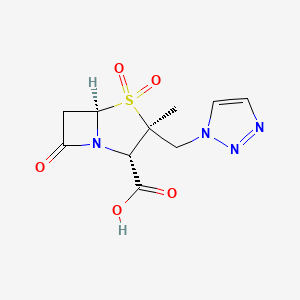
| Formula | C10H12N4O5S |
|---|---|
| Molecular weight | 300.3 g/mol |
| IUPAC name | (2S,3S,5R)-3-methyl-4,4,7-trioxo-3-(triazol-1-ylmethyl)-4lambda6-thia-1-azabicyclo[3.2.0]heptane-2-carboxylic acid |
| CAS | 89786-04-9 |
| PubChem CID | 123630 |
| InChIKey | LPQZKKCYTLCDGQ-WEDXCCLWSA-N |
| logP | -1.52 (XLogP -2.0) |
| Polar surface area | 122.46 Ų |
| H-bond acceptors / donors | 7 / 1 |
| Drug-likeness (QED) | 0.67 |
| Lipinski violations | 0 |
SMILES
C[C@]1(Cn2ccnn2)[C@H](C(=O)O)N2C(=O)C[C@H]2S1(=O)=OBiology & Pharmacokinetics
Pharmacokinetics
| BBB penetrant | No |
|---|
Enzyme interactions
| Enzyme | Role | Detail |
|---|---|---|
| CYP2C19 | Substrate | — |
Transporters
BCRP (Inhibitor)BSEP (Inhibitor)MRP1 (Inhibitor)OATP1B1 (Inhibitor)OATP1B3 (Inhibitor)P-gp (Inhibitor)OAT1 (Substrate)OAT3 (Substrate)P-gp (Substrate)
Registered Products (10)
| Brand | Form / strength | Pack | Agent | Citizen (JOD) |
|---|---|---|---|---|
| Piperacillin/Tazobactam | Powder for Injection 0.25 g, 2 g | 1 vial | Nabulsi Drug Store | — |
| Piperacillin/Tazobactam | Tablet 2000 mg, 250 mg | 12 vial | Petra Drug Store | — |
| Piperacillin/Tazobactam | Vial 4000 mg, 500 mg | 12 vial | Petra Drug Store | — |
| Piperacillin/Tazobactam Sandoz | Vial 0.5 g, 4 g | 1 vial pack varies | Nabulsi Drug Store | — |
| Piperacillin/Tazobactam Sandoz | Vial 0.5 g, 4 g | 10 vial pack varies | Nabulsi Drug Store | — |
| Prizma | Vial 4 g, 500 mg | 1 vial | Hikma Pharmaceuticals Co.Ltd/Jordan | — |
| Prizma Vial | Vial 2 g, 0.25 g | 1 vial | Hikma Pharmaceuticals Co.Ltd/Jordan | — |
| Yanoven 2G + | Vial 2 g, 0.25 g | 1 amp | Adonis Drug Store | — |
| Yanoven 4G + | Vial 4 g, 0.5 g | 1 vial | Adonis Drug Store | — |
| Zerbaxa Powder for Concentrate for Solution for Infusion | Infusion 500 mg, 1000 mg | 10 vial | Adatco Drug Store | — |