Prilocaine
🧬 Cross-allergy: Amide local anesthetics
JFDA label: Anesderm 5%
Mechanism of Action
Blocker of Sodium channel alpha subunit — Sodium channel alpha subunit blocker
| Target | Action | Gene / class |
|---|---|---|
| Sodium channel alpha subunit efficacy | BLOCKER |
Indications
Approved
- Local anesthesia
Contraindications
Source: Lexicomp
- Additional contraindications (not in US labeling): Citanest Plain Dental: Severe shock or heart block Absolute
- Hypersensitivity to local anesthetics of the amide type or any component of the formulation Absolute
- inflammation or sepsis in the region of proposed injection Absolute
- patients with congenital or idiopathic methemoglobinemia Absolute
Adverse Reactions
Cardiac disorders (6)
Not Known Bradycardia · cardiac arrest · cardiovascular signs and symptoms (stimulation/depression) · circulatory shock · edema · hypotension
Nervous system disorders (13)
Not Known Apprehension · confusion · convulsions · dizziness · drowsiness · euphoria · localized warm feeling · loss of consciousness · nervousness · numbness · oral paresthesia (may be persistent) · sensation of cold · twitching
Blood and lymphatic system disorders (1)
Not Known Methemoglobinemia
Immune system disorders (2)
Not Known Anaphylactoid reaction · hypersensitivity reaction
Gastrointestinal disorders (1)
Not Known Vomiting
Skin and subcutaneous tissue disorders (2)
Not Known Dermal ulcer · urticaria
Musculoskeletal and connective tissue disorders (1)
Not Known Tremor
Eye disorders (2)
Not Known Blurred vision · diplopia
Ear and labyrinth disorders (1)
Not Known Tinnitus
Respiratory, thoracic and mediastinal disorders (2)
Not Known Respiratory arrest · respiratory depression
Dosing
Source: Lexicomp
Warnings & Precautions
Source: Lexicomp
CNS toxicity
Careful and constant monitoring of the patient's state of consciousness should be done following each local anesthetic injection; at such times, restlessness, anxiety, tinnitus, dizziness, blurred vision, tremors, depression, or drowsiness may be early warning signs of CNS toxicity. Treatment is primarily symptomatic and supportive.
Methemoglobinemia
Use caution in patients who are very young or have glucose-6-phosphate deficiencies (G6PD). Use caution in patients taking concurrent drugs that can cause methemoglobinemia. Methemoglobinemia has been reported with local anesthetics including prilocaine; clinically significant methemoglobinemia requires immediate treatment. Use is contraindicated in patients with congenital or idiopathic methemoglobinemia.
Respiratory arrest
Local anesthetics have been associated with rare occurrences of sudden respiratory arrest.
Seizures
Convulsions due to systemic toxicity leading to cardiac arrest have also been reported, presumably following unintentional intravascular injection. Disease-related concerns:
Cardiovascular disease
Use with caution in patients with cardiovascular disease, severe shock, or heart block.
Familial malignant hyperthermia
Prilocaine may potentially trigger malignant hyperthermia; follow standard protocol for identification and treatment.
Hepatic impairment
Use with caution in patients with hepatic impairment; amide-type anesthetics are metabolized hepatically. Concurrent drug therapy issues:
Drug-drug interactions
Potentially significant interactions may exist, requiring dose or frequency adjustment, additional monitoring, and/or selection of alternative therapy. Consult drug interactions database for more detailed information. Special populations:
Acutely ill patients
Use with caution in acutely-ill patients; reduce dose consistent with age and physical status.
Debilitated patients
Use with caution in debilitated patients; reduce dose consistent with age and physical status.
Elderly
Use with caution in the elderly; reduce dose consistent with age and physical status.
Pediatric
Use with caution in children; reduce dose consistent with age and physical status. Other warnings/precautions:
Administration
Intravascular injections should be avoided; aspiration should be performed prior to administration; the needle must be repositioned until no return of blood can be elicited by aspiration; however, absence of blood in the syringe does not guarantee that intravascular injection has been avoided.
Appropriate dosing
To avoid serious adverse effects and high plasma concentrations, the lowest dosage resulting in effective anesthesia should be administered. Repeated doses may significantly increase blood concentrations of both the drug or its metabolites; tolerance to elevated blood concentrations varies with patient status. Reduced dosages, commensurate with age and physical condition, should be given to patients who are debilitated, elderly, acutely-ill, or pediatric.
Trained personnel
Dental practitioners using local anesthetic agents should be well trained in diagnosis and management of emergencies that may arise from the use of these agents. Resuscitative equipment, oxygen, and other resuscitative drugs should be available for immediate use.
Pregnancy & Lactation
Pregnancy
Adverse events have not been observed in animal reproduction studies. Prilocaine crosses the placenta.
Lactation
It is not known if prilocaine is excreted in breast milk. The manufacturer recommends that caution be exercised when administering prilocaine to nursing women.
Chemistry & Properties
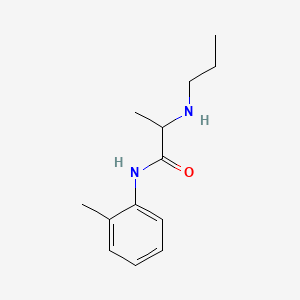
| Formula | C13H20N2O |
|---|---|
| Molecular weight | 220.32 g/mol |
| IUPAC name | N-(2-methylphenyl)-2-(propylamino)propanamide |
| CAS | 721-50-6 |
| PubChem CID | 4906 |
| InChIKey | MVFGUOIZUNYYSO-UHFFFAOYSA-N |
| logP | 2.32 (XLogP 2.1) |
| Polar surface area | 41.13 Ų |
| H-bond acceptors / donors | 2 / 2 |
| Drug-likeness (QED) | 0.80 |
| Lipinski violations | 0 |
SMILES
CCCNC(C)C(=O)Nc1ccccc1CBiology & Pharmacokinetics
Pharmacokinetics predicted
| Bioavailability | 70.0% |
|---|---|
| Half-life | 0.526 h |
| Volume of distribution | 3.784 L/kg |
| Protein binding | 40.0% |
| BBB penetrant | No |
Enzyme interactions
| Enzyme | Role | Detail |
|---|---|---|
| CYP1A2 | Substrate | — |
| CYP2C19 | Substrate | — |
| CYP3A4 | Substrate | — |
Transporters
BCRP (Inhibitor)BSEP (Inhibitor)MRP1 (Inhibitor)OATP1B1 (Inhibitor)OATP1B3 (Inhibitor)OATP1B3 (Inhibitor)P-gp (Inhibitor)P-gp (Substrate)
Drug–drug interactions (22, DDInter)
| Interacting drug | Severity | Management |
|---|---|---|
| Amyl Nitrite | major | |
| Benzocaine (topical) | major | |
| Chloroquine | major | |
| Cinchocaine (topical) | major | |
| Dapsone | major | |
| Dapsone (topical) | major | |
| Flutamide | major | |
| Lidocaine | major | |
| Lidocaine (topical) | major | |
| Metoclopramide | major | |
| Nitric Oxide | major | |
| Nitrous acid | major | |
| Primaquine | major | |
| Quinine | major | |
| Rasburicase | major | |
| Silver nitrate (topical) | major | |
| Silver sulfadiazine (topical) | major | |
| Sulfasalazine | major | |
| Tafenoquine | major | |
| Tetracaine (topical) | major | |
| Morphine (liposomal) | moderate | |
| Hyaluronidase | minor |
Registered Products (9)
| Brand | Form / strength | Pack | Agent | Citizen (JOD) |
|---|---|---|---|---|
| Anesderm | Cream 2.5 g/100 g, 2.5 g/100 g | 5 gm pack varies | Abu Sheikha Drug Store | 2.540 |
| Prolid | Cream 2.5 g/100 g, 2.5 g/100 g | 5 GM/1 TUB pack varies | شركة سنا لصناعة الادوية | 2.600 |
| Prolid | Cream 2.5 g/100 g, 2.5 g/100 g | 5 tubes of 5 gm pack varies | شركة سنا لصناعة الادوية | 10.500 |
| Locan | Cream 0.75 g, 0.75 g | 30 GM/1 TUB | / Dar Al Dawa Development and Investment Co Ltd/Jordan / General | 10.850 |
| Prolid | Cream 2.5 g/100 g, 2.5 g/100 g | 30 GM/1 TUB pack varies | شركة سنا لصناعة الادوية | 10.850 |
| Anesderm | Cream 2.5 g/100 g, 2.5 g/100 g | 5 X 5gm Tubes pack varies | Abu Sheikha Drug Store | 11.710 |
| Prila | Cream 2.5 %w/w, 2.5 %w/w | 5 X 5gm aluminium tub along with 5 sterile transparent dressing | Sabbagh Drug Store | 11.740 |
| Emla | Cream 2.5 %, 2.5 % | 30 g tube pack varies | Shawi & Rushedat Drug Store | 12.060 |
| Emla | Cream 2.5 %, 2.5 % | 5 g tube pack varies | Shawi & Rushedat Drug Store | 14.480 |