Metoclopramide
JFDA label: Clopram Ampoules
- Tardive dyskinesia:
Mechanism of Action
Blocks dopamine receptors and (when given in higher doses) also blocks serotonin receptors in chemoreceptor trigger zone of the CNS; enhances the response to acetylcholine of tissue in upper GI tract causing enhanced motility and accelerated gastric emptying without stimulating gastric, biliary, or pancreatic secretions; increases lower esophageal sphincter tone
Indications
Approved
- Diabetic gastroparesis
- Diabetic gastroparesis (diabetic gastric stasis)
- Gastroesophageal reflux
- Injection
- Oral
- Prevention of nausea and vomiting associated with emetogenic cancer chemotherapy
- Prevention of postoperative nausea and vomiting
- Radiological examination
- Small bowel intubation
Off-label
- Gastric bezoars
- Gastroparesis (regardless of etiology)
- Hiccups
- Migraine (acute)
- Prevention of chemotherapy-associated nausea and vomiting (pediatrics)
- Prevention of radiation therapy-induced nausea and vomiting (minimal emetic risk)
- Treatment of nausea and vomiting in advanced cancer
Contraindications
Source: Lexicomp
- Additional contraindications (not in the US labeling): Infants Absolute
- Hypersensitivity (eg, laryngeal and glossal angioedema, bronchospasm) to metoclopramide or any component of the formulation Absolute
- concomitant use with other agents likely to increase extrapyramidal reactions Absolute
- history of tardive dyskinesia or dystonic reaction to metoclopramide Absolute
- pheochromocytoma or other catecholamine-releasing paragangliomas Absolute
- seizure disorder (eg, epilepsy) Absolute
- situations where stimulation of gastrointestinal (GI) motility may be dangerous, including mechanical GI obstruction, perforation, or hemorrhage (except when used prior to endoscopy for evaluation of acute upper GI bleeding [Barkun 2010]) Absolute
Adverse Reactions
Cardiac disorders (7)
Not Known Atrioventricular block · bradycardia · cardiac failure · flushing (following high IV doses) · hypertension · hypotension · supraventricular tachycardia
Nervous system disorders (2)
Not Known Drowsiness · dystonic reaction (Dermatologic: Skin rash, urticaria
Hepatobiliary disorders (1)
Not Known Hepatotoxicity (rare)
Renal and urinary disorders (3)
Not Known Impotence · urinary frequency · urinary incontinence
Blood and lymphatic system disorders (5)
Not Known Agranulocytosis · leukopenia · methemoglobinemia · neutropenia · sulfhemoglobinemia
Immune system disorders (2)
Not Known Angioedema (rare) · hypersensitivity reaction
Metabolism and nutrition disorders (6)
Not Known Amenorrhea · fluid retention · galactorrhea · gynecomastia · hyperprolactinemia · porphyria
Gastrointestinal disorders (3)
Not Known diarrhea · Nausea · vomiting
Musculoskeletal and connective tissue disorders (1)
Not Known Laryngospasm (rare)
Eye disorders (1)
Not Known Visual disturbance
Respiratory, thoracic and mediastinal disorders (2)
Not Known Bronchospasm · laryngeal edema (rare)
Dosing
Source: Lexicomp
Warnings & Precautions
Source: Lexicomp
CNS depression
May cause CNS depression, which may impair physical or mental abilities; patients must be cautioned about performing tasks that require mental alertness (eg, operating machinery or driving).
Depression
Depression has occurred (in patients with and without a history of depression); symptoms have included suicidal ideation and suicide; avoid use in patients with a history of depression.
Extrapyramidal symptoms (EPS)
May cause extrapyramidal symptoms, generally manifested as acute dystonic reactions within the initial 24 to 48 hours of use at the usual adult dose (30 to 40 mg/day). Risk of these reactions is increased at higher than recommended doses, and in patients • Hyperprolactinemia: Metoclopramide elevates prolactin levels. Hyperprolactinemia may suppress hypothalamic GnRH, resulting in reduced pituitary gonadotropin secretion. This, in turn, may inhibit reproductive function by impairing gonadal steroidogenesis. Galactorrhea, amenorrhea, gynecomastia, and impotence have been reported. Hyperprolactinemia may potentially stimulate prolactin-dependent breast cancer. However, some clinical studies and epidemiology studies have not shown an association between administration of dopamine D2 receptor antagonists and tumorigenesis in humans.
Hypertension
May elevate blood pressure; avoid use in patients with hypertension (IV administration was shown to release catecholamines). There are reports of hypertensive crises in patients with undiagnosed pheochromocytoma; use is contraindicated in patients with pheochromocytoma or other catecholamine-releasing paragangliomas. Discontinue therapy in any patient with a rapid rise in blood pressure.
Neuroleptic malignant syndrome
Use may be associated with neuroleptic malignant syndrome (NMS); may be fatal. Monitor for manifestations of NMS, which include hyperpyrexia, muscle rigidity, altered mental status, and autonomic instability (irregular pulse or blood pressure, tachycardia, diaphoresis, and cardiac arrhythmias); additional signs may include elevated creatine phosphokinase, myoglobinuria, and acute renal failure. Discontinue immediately if signs/symptoms of NMS appear and begin intensive symptomatic management and monitoring.
Proarrhythmic effects
Metoclopramide has been known to cause sinus arrest (usually with rapid IV administration or higher doses) (Bentsen 2002; Malkoff 1995). The torsadogenic potential for metoclopramide is considered to be low (Claassen 2005). Based on case reports, however, metoclopramide may cause QT prolongation and torsades de pointes in certain individuals (eg, heart failure patients with renal impairment) (Siddique 2009). There is data in healthy male volunteers to show that metoclopramide actually shortens the QT interval while at the same time increasing QT variance (Ellidokuz 2003). No human data other than case reports, however, has demonstrated a consistent QT prolonging effect with metoclopramide nor is there any substantiated evidence to show a direct association with the development of torsades de pointes.
Tardive dyskinesia
May cause tardive dyskinesia, a serious movement disorder that is often irreversible with no known treatment; the risk of developing tardive dyskinesia increases with duration of treatment and total cumulative dose. Discontinue metoclopramide in patients who develop signs/symptoms of tardive dyskinesia; in some patients, symptoms may lessen or resolve after metoclopramide is stopped. Avoid treatment with metoclopramide for longer than 12 weeks because of the increased risk of developing tardive dyskinesia with longer-term use. Avoid metoclopramide in patients receiving other drugs that are likely to cause tardive dyskinesia (eg, antipsychotics). Tardive dyskinesia is characterized by disfiguring involuntary movements of the face, tongue, and sometimes of the trunk and/or extremities; movements may be choreoathetotic in appearance. Metoclopramide may mask underlying tardive disease by suppressing or partially suppressing tardive dyskinesia signs; the effect of this symptomatic suppression upon the long-term course of tardive dyskinesia is unknown. The risk of developing tardive dyskinesia is increased in the elderly, especially elderly women, and diabetics, although it is not possible to predict which patients will develop tardive dyskinesia. Discontinue metoclopramide immediately in patients who develop signs/symptoms of tardive dyskinesia. There is no known effective treatment for established cases of tardive dyskinesia, although in some patients, tardive dyskinesia may remi
Cardiovascular disease
Use with caution in patients with heart failure and concomitant renal impairment; may be at risk for development of QT prolongation and torsades de pointes (Siddique 2009).
Edematous conditions
Use with caution in patients who are at risk of fluid overload (HF, cirrhosis). Metoclopramide causes a transient increase in serum aldosterone and increases the risk for fluid retention and volume overload. Discontinue if adverse events or signs/symptoms appear.
Hepatic impairment
Use caution in patients with moderate to severe hepatic impairment; risk of adverse reactions may be increased due to increased systemic exposure; dosage adjustment recommended.
Parkinson disease
Symptoms of Parkinson disease may be exacerbated; avoid use in patients with Parkinson disease and other patients being treated with antiparkinsonian drugs.
Renal impairment
Use with caution in patients with moderate to severe renal impairment; risk of adverse reactions may be increased due to increased systemic exposure; dosage adjustment recommended.
Surgical anastomosis/closure
Use with caution following surgical anastomosis/closure; promotility agents may theoretically increase pressure in suture lines. Concurrent drug therapy issues:
Drug-drug interactions
Potentially significant interactions may exist, requiring dose or frequency adjustment, additional monitoring, and/or selection of alternative therapy. Consult drug interactions database for more detailed information. Special populations:
CYP2D6 poor metabolizers
Elimination of metoclopramide may be slowed possibly increasing the risk of dystonic and other adverse reactions; dosage reduction recommended.
Elderly
Risk of tardive dyskinesia may be increased in elderly, especially in elderly women.
Pediatric
Not recommended for use (oral formulation) due to increased risk of tardive dyskinesia and other extrapyramidal symptoms as well as the risk of methemoglobinemia in neonates (neonates may have decreased levels of NADH-cytochrome b5 reductase, which increases the risk of methemoglobinemia). Dosage form specific issues:
Benzyl alcohol and derivatives
Some dosage forms may contain sodium benzoate/benzoic acid; benzoic acid (benzoate) is a metabolite of benzyl alcohol; large amounts of benzyl alcohol (≥99 mg/kg/day) have been associated with a potentially fatal toxicity (“gasping syndrome”) in neonates; the “gasping syndrome” consists of metabolic acidosis, respiratory distress, gasping respirations, CNS dysfunction (including convulsions, intracranial hemorrhage), hypotension, and cardiovascular collapse (AAP ["Inactive" 1997]; CDC 1982); some data suggest that benzoate displaces bilirubin from protein binding sites (Ahlfors 2001); avoid or use dosage forms containing benzyl alcohol derivative with caution in neonates. See manufacturer's labeling.
Pregnancy & Lactation
Pregnancy
Safe
First-line antiemetic for NVP/HG in many guidelines. Short courses safe; avoid prolonged use in T3 (neonatal EPS withdrawal)
Lactation
Metoclopramide is present in breast milk. The relative infant dose (RID) of metoclopramide is ~4.6% when calculated using the highest breast milk concentration located and compared to an infant therapeutic dose of 0.5 mg/kg/day. In general, breastfeeding is considered acceptable when the RID of a medication is The RID of metoclopramide was calculated using a milk concentration of 0.1565 mcg/mL, providing an estimated daily infant dose via breast milk of 0.023 mg/kg/day. This milk concentrati
Monitoring
| Clinical pearl | Signs of tardive dyskinesias, extrapyramidal symptoms; signs/symptoms of neuroleptic malignant syndrome |
|---|
Chemistry & Properties
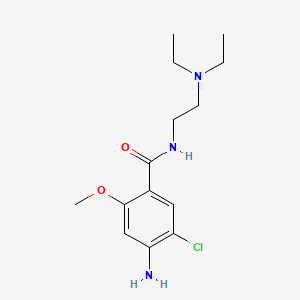
| Formula | C14H22ClN3O2 |
|---|---|
| Molecular weight | 299.8 g/mol |
| IUPAC name | 4-amino-5-chloro-N-[2-(diethylamino)ethyl]-2-methoxybenzamide |
| CAS | 364-62-5 |
| PubChem CID | 4168 |
| InChIKey | TTWJBBZEZQICBI-UHFFFAOYSA-N |
| logP | 2.0 (XLogP 2.6) |
| Polar surface area | 67.59 Ų |
| H-bond acceptors / donors | 4 / 2 |
| Drug-likeness (QED) | 0.76 |
| Lipinski violations | 0 |
SMILES
CCN(CC)CCNC(=O)c1cc(Cl)c(N)cc1OCBiology & Pharmacokinetics
Pharmacokinetics
| BBB penetrant | Yes (logBB 0.9) |
|---|
Enzyme interactions
| Enzyme | Role | Detail |
|---|---|---|
| CYP2C19 | Substrate | — |
| CYP2D6 | Inhibitor | Ki 0.96 µM |
| CYP2D6 | Substrate | — |
Receptor binding (top 4)
| Target | Action | Affinity |
|---|---|---|
| DOPAMINE D3 (DRD3) | Binding | pKi 7.8 |
| DOPAMINE D2 (DRD2) | Binding | pKi 7.2 |
| 5-HT3 (HTR3A) | Binding | pKi 6.2 |
| 5-HT3AB (HTR3A|HTR3B) | Antagonist | pKi 5.7 |
Transporters
BCRP (Inhibitor)BCRP (Inhibitor)BSEP (Inhibitor)BSEP (Inhibitor)MRP1 (Inhibitor)MRP2 (Inhibitor)MRP3 (Inhibitor)MRP4 (Inhibitor)OATP1B1 (Inhibitor)OATP1B1 (Inhibitor)OATP1B3 (Inhibitor)OCT1 (Inhibitor)OCTN2 (Inhibitor)P-gp (Inhibitor)MDR1 (Substrate)OATP1A2 (Substrate)OCT1 (Substrate)P-gp (Substrate)
Drug–drug interactions (100+, DDInter)
| Interacting drug | Severity | Management |
|---|---|---|
| Alimemazine | major | |
| Amisulpride | major | |
| Amoxapine | major | |
| Aripiprazole | major | |
| Asenapine | major | |
| Brexpiprazole | major | |
| Bupropion | major | |
| Cariprazine | major | |
| Chlorpromazine | major | |
| Clozapine | major | |
| Deutetrabenazine | major | |
| Dextropropoxyphene | major | |
| Droperidol | major | |
| Fluphenazine | major | |
| Haloperidol | major | |
| Iloperidone | major | |
| Iohexol | major | |
| Iopamidol | major | |
| Loxapine | major | |
| Lumateperone | major | |
| Lurasidone | major | |
| Mesoridazine | major | |
| Methdilazine | major | |
| Methotrimeprazine | major | |
| Molindone | major | |
| Nitrous acid | major | |
| Olanzapine | major | |
| Paliperidone | major | |
| Perphenazine | major | |
| Pimozide | major | |
| Prilocaine | major | |
| Prilocaine (topiclal) | major | |
| Prochlorperazine | major | |
| Promazine | major | |
| Promethazine | major | |
| Propiomazine | major | |
| Quetiapine | major | |
| Risperidone | major | |
| Sodium oxybate | major | |
| Tetrabenazine | major |
Showing 40 of 100+.
Registered Products (15)
| Brand | Form / strength | Pack | Agent | Citizen (JOD) |
|---|---|---|---|---|
| Pylomid syrup | Syrup 5 mg/5 ml | 60 ml pack varies | THE JORDANIAN PHARMACEUTICAL MANUFACTURING COMPANY/JORDAN | 0.330 |
| Pylomid syrup | Syrup 5 mg/5 ml | 100 ml pack varies | THE JORDANIAN PHARMACEUTICAL MANUFACTURING COMPANY/JORDAN | 0.560 |
| Clopram Syrup | Syrup 5 mg/5 ml | 100 ml | The Arab Pharmaceutical Manufactruing Co. | 0.600 |
| Pylomid tablet | Tablet 10 mg | 30 tab | THE JORDANIAN PHARMACEUTICAL MANUFACTURING COMPANY/JORDAN | 0.600 |
| Clopram Tablets | Tablet Anhydrous 10 mg | 30 tab pack varies | The Arab Pharmaceutical Manufacturing PSC/Salt | 0.720 |
| Metoclop | Solution 5 mg/5 ml | 100 ml | Al-Gadeed Pharmaceutical Industries/JORDAN | 0.770 |
| Antivot | Ampoule 10 mg/2 ml | 5 amp pack varies | AL-Faiasel Drug Store | 0.780 |
| ELITAN TAB | Tablet Anhydrous 10 mg | 40 tab | Al Hilal Drug Store | 0.990 |
| Metoclopramide S.A.L.F Solution for Injection | Injection monohydrate 10 mg/2 ml | 5 amp | Reda Jardaneh Drug Store | 1.010 |
| Clopram Ampoules | Ampoule anhydrous 10 mg/2 ml | 5 amp pack varies | The Arab Pharmaceutical Manufacturing PSC/Salt | 1.090 |
| PRIMPERAN TAB | Tablet 10 mg | 20 tab | Ulfa Pharma Co. | 1.150 |
| Elitan | Ampoule Anhydrous 10 mg/2 ml | 10 amp | Al Hilal Drug Store | 1.500 |
| Antivot | Ampoule 10 mg/2 ml | 100 amp pack varies | AL-Faiasel Drug Store | 13.260 |
| Clopram Ampoules | Ampoule anhydrous 10 mg/2 ml | 100 pack varies | The Arab Pharmaceutical Manufacturing PSC/Salt | 18.530 |
| Clopram Tablets | Tablet Anhydrous 10 mg | 100x10 pack varies | The Arab Pharmaceutical Manufacturing PSC/Salt | 20.400 |