Bupropion
JFDA label: Bupran SR
- Suicidality and antidepressant drugs:
Mechanism of Action
Aminoketone antidepressant structurally different from all other marketed antidepressants; like other antidepressants the mechanism of bupropion's activity is not fully understood. Bupropion is a relatively weak inhibitor of the neuronal uptake of norepinephrine and dopamine, and does not inhibit monoamine oxidase or the reuptake of serotonin. Metabolite inhibits the reuptake of norepinephrine. The primary mechanism of action is thought to be dopaminergic and/or noradrenergic.
Indications
Approved
- Seasonal affective disorder (Aplenzin, Wellbutrin XL)
- Smoking cessation (Zyban)
Off-label
- Antidepressant-induced sexual dysfunction
- Attention deficit hyperactivity disorder (adults)
- Attention deficit hyperactivity disorder (children/adolescents)
- Depression associated with bipolar disorder
- Obesity
Contraindications
Source: Lexicomp
- Additional contraindications (not in US labeling): Concurrent use or use within 14 days of thioridazine Absolute
- Hypersensitivity to bupropion or any component of the formulation Absolute
- concurrent use with other dosage forms of bupropion Absolute
- history of anorexia/bulimia Absolute
- initiation of bupropion in a patient receiving linezolid or intravenous methylene blue Aplenzin, Forfivo XL, Wellbutrin XL: Additional contraindications: Other conditions that increase seizure risk, including arteriovenous malformation, severe head injury, severe stroke, CNS tumor, CNS infection Forfivo XL: Additional contraindications: Patients receiving other dosage forms of bupropion Absolute
- patients undergoing abrupt discontinuation of ethanol or sedatives, including benzodiazepines, barbiturates, or antiepileptic drugs Absolute
- seizure disorder Absolute
- use of MAO inhibitors (concurrently or within 14 days of discontinuing either bupropion or the MAO inhibitor) Absolute
Adverse Reactions
Cardiac disorders (7)
Very Common Tachycardia
Common cardiac arrhythmia · chest pain · flushing · hypertension · hypotension · Palpitations
Nervous system disorders (24)
Very Common agitation · dizziness · headache · Insomnia
Common abnormal dreams · abnormality in thinking · akathisia · anxiety · central nervous system stimulation · confusion · depression · drowsiness · dystonia · hostility · irritability · Lack of concentration · memory impairment · migraine · nervousness · pain · paresthesia · sensory disturbance · sleep disorder · twitching
Renal and urinary disorders (5)
Common Polyuria · Urinary frequency · urinary tract infection · urinary urgency · vaginal hemorrhage
Immune system disorders (1)
Common Hypersensitivity reaction
Metabolism and nutrition disorders (5)
Very Common Weight loss
Common decreased libido · hot flash · menstrual disease · Weight gain
Gastrointestinal disorders (14)
Very Common constipation · nausea · nausea and vomiting · Xerostomia
Common Abdominal pain · anorexia · diarrhea · dysgeusia · dyspepsia · dysphagia · flatulence · increased appetite · oral mucosa ulcer · vomiting
Skin and subcutaneous tissue disorders (5)
Very Common Diaphoresis
Common pruritus · Skin rash · urticaria · xeroderma
Musculoskeletal and connective tissue disorders (7)
Very Common Tremor
Common arthralgia · arthritis · dyskinesia · Myalgia · neck pain · weakness
Eye disorders (1)
Very Common Blurred vision
Ear and labyrinth disorders (2)
Common auditory disturbance · Tinnitus
Infections and infestations (1)
Common Infection
General disorders and administration site conditions (2)
Common Accidental injury · fever
Respiratory, thoracic and mediastinal disorders (9)
Very Common Nasopharyngitis · pharyngitis · rhinitis
Common bronchitis · cough · epistaxis · increased cough · sinusitis · Upper respiratory infection
Other (1)
Not Known Ophthalmic: Diplopia
Dosing
Source: Lexicomp
Warnings & Precautions
Source: Lexicomp
Suicidal thinking/behavior (use in treating psychiatric disorders)
Antidepressants increased the risk of suicidal thoughts and behavior in children, adolescents, and young adults in short-term trials. These trials did not show an increase in the risk of suicidal thoughts and behavior with antidepressant use in subjects aged 65 and older. In patients of all ages who are started on antidepressant therapy, monitor closely for worsening and for emergence of suicidal thoughts and behaviors, particularly during the initial 1 to 2 months of therapy or during periods of dosage adjustments (increases or decreases); advise families and caregivers of the need for close observation and communication with the prescriber. A medication guide concerning the use of antidepressants should be dispensed with each prescription.
CNS stimulation
May cause CNS stimulation (restlessness, anxiety, insomnia) or anorexia.
Cognitive impairment
May cause motor or cognitive impairment in some patients, which may impair physical or mental abilities; patients must be cautioned about performing tasks which require mental alertness (eg, operating machinery or driving).
Hypersensitivity reactions
Anaphylactoid/anaphylactic reactions have occurred, with symptoms of pruritus, urticaria, angioedema, and dyspnea. Serious reactions have been (rarely) reported, including erythema multiforme, Stevens-Johnson syndrome and anaphylactic shock. Arthralgia, myalgia, and fever with rash and other symptoms suggestive of delayed hypersensitivity resembling serum sickness have been reported.
Hypertension
May elevate blood pressure and cause hypertension. Events have been observed in patients with or without evidence of preexisting hypertension. The risk is increased when used concomitantly with monoamine oxidase inhibitors, nicotine replacement, or other drugs that increase dopaminergic or noradrenergic activity. Assess blood pressure before treatment and monitor periodically.
Mania/hypomania
May precipitate a manic, mixed, or hypomanic episode; risk is increased in patients with bipolar disorder or who have risk factors for bipolar disorder. Screen patients for a history of bipolar disorder and the presence of risk factors including a family history of bipolar disorder, suicide, or depression. Bupropion is not FDA approved for bipolar depression.
Neuropsychiatric effect (use in smoking cessation)
Serious neuropsychiatric events have occurred in patients taking bupropion for smoking cessation, including changes in mood (eg, depression, mania), psychosis, hallucinations, paranoia, delusions, homicidal ideation, hostility, agitation, aggression, anxiety, panic, suicidal ideation, suicide attempt, and completed suicide. The majority occurred during bupropion treatment; some occurred during treatment discontinuation. A causal relationship is uncertain as depressed mood may be a symptom of nicotine withdrawal. Some cases also occurred in patients taking bupropion who continued to smoke. Neuropsychiatric effects occurred in patients with and without preexisting psychiatric disease; some patients experienced a worsening of their psychiatric illnesses. However, subsequent controlled trials in patients with or without psychiatric disorders have not identified significant differences in neuropsychiatric effects for patients taking bupropion, varenicline, nicotine patches, or placebo (Anthenelli 2016; Cinciripini 2013). Observe all patients taking bupropion for neuropsychiatric reactions. Instruct patients to stop taking bupropion and contact a health care provider if neuropsychiatric reactions occur.
Ocular effects
May cause mild pupillary dilation, which in susceptible individuals can lead to an episode of narrow-angle glaucoma. Consider evaluating patients who have not had an iridectomy for narrow-angle glaucoma risk factors.
Psychosis
May cause delusions, hallucinations, psychosis, concentration disturbance, paranoia, and confusion; most common in depressed patients and patients with a diagnosis of bipolar disorder. Symptoms may abate with dose reduction and/or withdrawal of treatment.
Seizures
May cause a dose-related risk of seizures. Use is contraindicated in patients with a history of seizures or certain conditions with high seizure risk (eg, history of anorexia/bulimia or patients undergoing abrupt discontinuation of ethanol, benzodiazepines, barbiturates, or antiepileptic drugs). Aplenzin, Forfivo XL, and Wellbutrin XL are also contraindicated in patients with certain conditions with high seizure risk (eg, arteriovenous malformation, severe head injury, severe stroke, CNS tumor, and CNS infection). Use caution with concurrent use of antipsychotics, antidepressants, theophylline, systemic corticosteroids, stimulants (including cocaine), anorexiants, or hypoglycemic agents, or with excessive use of ethanol, benzodiazepines, sedative/hypnotics, or opioids. Use with caution in seizure-potentiating metabolic disorders (hypoglycemia, hyponatremia, severe hepatic impairment, and hypoxia). The dose-dependent risk of seizures may be reduced by gradual dose increases and by not exceeding the maximum daily dose. Do not coadminister with other bupropion-containing formulations; Forfivo XL is contraindicated in patients receiving other dosage forms of bupropion. Permanently discontinue if seizure occurs during therapy. Chewing, crushing, injecting, or dividing long-acting products may increase seizure risk.
Sexual dysfunction
The incidence of sexual dysfunction with bupropion is generally lower than with SSRIs (Clayton 2004).
Weight loss
May cause weight loss; use caution in patients where weight loss is not desirable. Disease-related concerns:
ADHD (off-label use)
All children diagnosed with ADHD who may be candidates for stimulant medications should have a thorough cardiovascular assessment to identify risk factors for sudden cardiac death prior to initiation of drug therapy.
Cardiovascular disease
Use with caution in patients with cardiovascular disease, history of hypertension, or coronary artery disease; treatment-emergent hypertension (including some severe cases) has been reported, both with bupropion alone and in combination with nicotine transdermal systems.
Hepatic impairment
Use with caution in patients with hepatic impairment; consider a reduction in dose and/or frequency; Forfivo XL is not recommended in patients with hepatic impairment.
Renal impairment
Use with caution in patients with renal impairment; consider a reduction in dose and/or frequency; Forfivo XL is not recommended in patients with renal impairment. Concurrent drug therapy issues:
Drug-drug interactions
Potentially significant interactions may exist, requiring dose or frequency adjustment, additional monitoring, and/or selection of alternative therapy. Consult drug interactions database for more detailed information. Special populations:
Elderly
Use with caution in the elderly; may be at greater risk of drug accumulation during chronic dosing. Consider a reduction in dose. Dosage form specific issues:
Extended release tablet
Insoluble tablet shell may remain intact and be visible in the stool. Other warnings/precautions:
Abuse/misuse
Using doses higher than prescribed may result in increased motor activity, agitation/excitement and euphoria. Inhalation of crushed tablets or injection of dissolved bupropion has been reported, some resulting in seizures and death.
Electroconvulsive therapy (ECT)
May increase the risks associated with ECT; consider discontinuing, when possible, prior to ECT treatment (APA 2010).
Pregnancy & Lactation
Pregnancy
Adverse events have been observed in some animal reproduction studies. Bupropion and its metabolites were found to cross the placenta in in vitro studies (Earhart 2012). An increased risk of congenital malformations has not been observed following maternal use of bupropion during pregnancy; however, data specific to cardiovascular malformations is inconsistent. The long-term effects on development and behavior have not been studied. The ACOG recommends that antidepressant therapy during pregnancy be individualized; treatment of depression during pregnancy should incorporate the clinical expertise of the mental health clinician, obstetrician, primary health care provider, and pediatrician. According to the American Psychiatric Association (APA), the risks of medication treatment should be weighed against other treatment options and untreated depression. For women who discontinue antidepressant medications during pregnancy and who may be at high risk for postpartum depression, the medi
Lactation
Bupropion and its active metabolites are present in breast milk. The manufacturer reports the relative infant dose (RID) of bupropion and its active metabolites to be ~2% of a weight-adjusted maternal dose. In one report, the RID of bupropion ranged from 1.4% to 10.6% of the maternal dose when calculated using actual infant weights and maternal doses ranging from 150 to 300 mg/day (Davis 2009). In general, breastfeeding is considered acceptable when the RID is 25%, breastfeeding should general
Monitoring
| Clinical pearl | Body weight; mental status for depression, suicidal ideation (especially at the beginning of therapy or when doses are increased or decreased), anxiety, social functioning, mania, panic attacks; blood pressure (baseline and periodically especially when used in conjunction with nicotine transdermal replacement); renal and hepatic function When used for the treatment of ADHD, thoroughly evaluate for cardiovascular risk. Monitor heart rate, blood pressure, and consider obtaining ECG prior to initiation (Vetter 2008). |
|---|
Chemistry & Properties
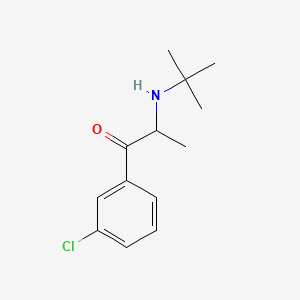
| Formula | C13H18ClNO |
|---|---|
| Molecular weight | 239.75 g/mol |
| IUPAC name | 2-(tert-butylamino)-1-(3-chlorophenyl)propan-1-one |
| CAS | 34911-55-2 |
| PubChem CID | 444 |
| InChIKey | SNPPWIUOZRMYNY-UHFFFAOYSA-N |
| logP | 3.3 (XLogP 3.2) |
| Polar surface area | 29.1 Ų |
| H-bond acceptors / donors | 2 / 1 |
| Drug-likeness (QED) | 0.82 |
| Lipinski violations | 0 |
SMILES
CC(NC(C)(C)C)C(=O)c1cccc(Cl)c1Biology & Pharmacokinetics
Pharmacokinetics
| BBB penetrant | Yes (logBB 1.4) |
|---|
Enzyme interactions
| Enzyme | Role | Detail |
|---|---|---|
| CYP1A2 | Substrate | — |
| CYP2B6 | Substrate | — |
| CYP2C19 | Inhibitor | IC₅₀ 1.9982999999999993 µM |
| CYP2C19 | Substrate | — |
| CYP2C9 | Substrate | — |
| CYP2D6 | Inhibitor | — |
| CYP2D6 | Substrate | — |
Receptor binding (top 10)
| Target | Action | Affinity |
|---|---|---|
| NET (SLC6A2) | Inhibitor | pKi 6.4 |
| DAT (SLC6A3) | Inhibitor | pIC50 6.3 |
| Dopamine Transporter (SLC6A3) | Binding | pKi 6.1 |
| Cholinergic, Nicotinic Alpha3Beta4 | Binding | pKi 5.7 |
| adrenergic Alpha1 | Binding | pKi 5.4 |
| Alpha 1 Adrenergic Receptor | Binding | pKi 5.3 |
| H1 | Binding | pKi 5.2 |
| Norepinephrine transporter (SLC6A2) | Binding | pKi 5.2 |
| Cholinergic, nicotinic Alpha1 | Binding | pKi 5.1 |
| 5-HT Transporter (SLC6A4) | Binding | pKi 5.0 |
Transporters
BCRP (Inhibitor)BCRP (Inhibitor)BSEP (Inhibitor)BSEP (Inhibitor)MRP1 (Inhibitor)MRP2 (Inhibitor)MRP4 (Inhibitor)OATP1B1 (Inhibitor)OATP1B1 (Inhibitor)OATP1B3 (Inhibitor)OATP1B3 (Inhibitor)OATP2B1 (Inhibitor)OCT2 (Inhibitor)OCTN2 (Inhibitor)P-gp (Inhibitor)BCRP (Substrate)MDR1 (Substrate)P-gp (Substrate)
Drug–drug interactions (100+, DDInter)
| Interacting drug | Severity | Management |
|---|---|---|
| Aldesleukin | major | |
| Alfentanil | major | |
| Alimemazine | major | |
| Amantadine | major | |
| Amifampridine | major | |
| Aminophylline | major | |
| Amitriptyline | major | |
| Amoxapine | major | |
| Amphetamine | major | |
| Apalutamide | major | |
| Aripiprazole | major | |
| Asenapine | major | |
| Benzhydrocodone | major | |
| Benzphetamine | major | |
| Betamethasone | major | |
| Bethanechol | major | |
| Blinatumomab | major | |
| Brexpiprazole | major | |
| Buprenorphine | major | |
| Butorphanol | major | |
| Cariprazine | major | |
| Cefiderocol | major | |
| Chloroquine | major | |
| Chlorpromazine | major | |
| Cinoxacin | major | |
| Ciprofloxacin | major | |
| Citalopram | major | |
| Clomipramine | major | |
| Clozapine | major | |
| Cocaine (nasal) | major | |
| Codeine | major | |
| Corticotropin | major | |
| Cyclobenzaprine | major | |
| Cycloserine | major | |
| Dalfampridine | major | |
| Deflazacort | major | |
| Delafloxacin | major | |
| Desipramine | major | |
| Desvenlafaxine | major | |
| Deutetrabenazine | major |
Showing 40 of 100+.
Registered Products (1)
| Brand | Form / strength | Pack | Agent | Citizen (JOD) |
|---|---|---|---|---|
| Bupran SR | Tablet 150 mg | 30 tab | JORDAN SWEDEN MEDICAL&STERILE.CO(JOSWE)/JORDAN | 14.420 |