Delafloxacin
JFDA label: Baxdela
- Serious adverse reactions:
- Exacerbation of myasthenia gravis:
Mechanism of Action
Delafloxacin inhibits DNA gyrase (topoisomerase II) and topoisomerase IV enzymes, which are required for bacterial DNA replication, transcription, repair, and recombination.
Indications
Approved
- Skin and skin structure infections
Antimicrobial Spectrum
Expected / intrinsic spectrum (EUCAST breakpoints & labels) — not local resistance. Source: EUCAST v16 · curated · openfda-label.
Bacteria
| Organism | Activity | MIC |
|---|---|---|
| Chlamydia pneumoniae | Active | — |
| Enterobacter aerogenes | Active | — |
| Enterobacter cloacae | Active | — |
| Enterococcus faecalis | Active | — |
| Escherichia coli | Susceptible | 0.25 mg/L |
| Haemophilus influenzae | Susceptible | 0.06 mg/L |
| Haemophilus parainfluenzae | Active | — |
| Klebsiella oxytoca | Active | — |
| Klebsiella pneumoniae | Active | — |
| Legionella pneumophila | Active | — |
| Moraxella catarrhalis | Active | — |
| Mycoplasma pneumoniae | Active | — |
| Proteus mirabilis | Active | — |
| Pseudomonas aeruginosa | Active | — |
| Staphylococcus aureus | Susceptible | 0.25 mg/L |
| Staphylococcus haemolyticus | Active | — |
| Staphylococcus lugdunensis | Active | — |
| Streptococcus A/B/C/G | Susceptible | 0.03 mg/L |
| Streptococcus agalactiae | Active | — |
| Streptococcus anginosus | Active | — |
| Streptococcus constellatus | Active | — |
| Streptococcus dysgalactiae | Active | — |
| Streptococcus intermedius | Active | — |
| Streptococcus pneumoniae | Susceptible | 0.25 mg/L |
| Streptococcus pyogenes | Active | — |
Class profile
| gramStatus | Both |
|---|---|
| spectrumBreadth | Broad |
| atypicalCoverage | No |
| isBactericidal | 1 |
| moaCategory | DNA synthesis inhibitor (topoisomerase II/IV, anionic fluoroquinolone) |
| pdIndex | Concentration-dependent |
| postAntibioticEffect | Prolonged |
| mrsaCoverage | 1 |
| resistanceMechanisms | Target site mutations (gyrA,gyrB,parC,parE),Active efflux pumps |
Contraindications
Source: Lexicomp
- Hypersensitivity to delafloxacin, other fluoroquinolones, or any component of the formulation Absolute
Adverse Reactions
Cardiac disorders (1)
Common Bradycardia, abnormal dreams, nausea, abdominal pain, increased serum alkaline phosphatase (Hypersensitivity: Hypersensitivity reaction (Infection: Fungal infection (Local: Infusion site irritation (N
Dosing
Source: Lexicomp
Warnings & Precautions
Source: Lexicomp
Hypersensitivity reactions
Severe and sometimes fatal hypersensitivity reactions, including anaphylaxis, have occurred with fluoroquinolone therapy. May occur after first or subsequent doses, and may be accompanied by cardiovascular collapse, loss of consciousness, tingling, pharyngeal or facial edema, dyspnea, urticaria, and pruritus. Discontinue therapy at the first sign of skin rash or any other sign of a hypersensitivity reaction.
Serious adverse reactions
Fluoroquinolones are associated with disabling and potentially irreversible serious adverse reactions that may occur together, including tendinitis and tendon rupture, peripheral neuropathy, and CNS effects. Discontinue delafloxacin immediately and avoid use of fluoroquinolones in patients who experience any of these serious adverse reactions. Patients of any age or without preexisting risk factors have experienced these reactions; may occur within hours to weeks after initiation. - CNS effects: Fluoroquinolones have been associated with an increased risk of CNS effects including seizures, increased intracranial pressure (including pseudotumor cerebri), and toxic psychosis; may also cause nervousness, agitation, insomnia, anxiety, nightmares, paranoia, dizziness, confusion, tremors, hallucinations, depression, and suicidal thoughts or actions. May occur following the first dose; discontinue immediately and avoid further use of fluoroquinolones in patients who experience these reactions. Use with caution in patients with known or suspected CNS disorder, or risk factors that may predispose to seizures or lower the seizure threshold. - Peripheral neuropathy: Fluoroquinolones have been associated with an increased risk of peripheral neuropathy; may occur soon after initiation of therapy and may be irreversible; discontinue if symptoms of sensory or sensorimotor neuropathy occur. Avoid use in patients who have previously experienced peripheral neuropathy. - Tendinitis/Tendon ruptu
Superinfection
Prolonged use may result in fungal or bacterial superinfection, including C. difficile-associated diarrhea (CDAD) and pseudomembranous colitis; CDAD has been observed >2 months postantibiotic treatment. Disease-related concerns:
Myasthenia gravis
May exacerbate muscle weakness related to myasthenia gravis; avoid use in patients with known history of myasthenia gravis. Cases of severe exacerbations, including the need for ventilatory support, and deaths have been reported.
Renal impairment
Use with caution and reduce dose in patients with severe renal impairment (estimated glomerular filtration rate [eGFR] 15 to 29 mL/minute/1.73 m2). Use is not recommended in patients with end-stage renal disease (eGFR 2). See also “Dosage form specific issues: Injection”. Concurrent drug therapy issues:
Drug-drug interactions
Potentially significant interactions may exist, requiring dose or frequency adjustment, additional monitoring, and/or selection of alternative therapy. Consult drug interactions database for more detailed information. Special populations:
Elderly
Adverse effects (eg, tendon rupture) may be increased in elderly patients. Dosage form specific issues:
Injection
Avoid use of IV formulation in patients with end-stage renal disease (eGFR 2); injection contains excipient cyclodextrin (sulfobutylether-beta-cyclodextrin [SBECD]), which may accumulate. Closely monitor serum creatinine levels in patients with severe renal impairment (eGFR 15 to 29 mL/minute/1.73 m2) and consider using oral delafloxacin in these patients if serum creatinine levels increase; discontinue use if eGFR decreases to 2.
Pregnancy & Lactation
Pregnancy
Adverse events were observed in some animal reproduction studies.
Lactation
It is not known if delafloxacin is present in breast milk. According to the manufacturer, the decision to breastfeed during therapy should consider the risk of infant exposure, the benefits of breastfeeding to the infant, and benefits of treatment to the mother.
Monitoring
| Efficacy | Culture and susceptibility testing; clinical resolution (temperature, WBC, CRP, procalcitonin) |
|---|---|
| Toxicity | Renal function (dose adjustment in renal impairment); hepatic function for hepatically cleared agents; signs of C. difficile infection (diarrhoea) |
| Clinical pearl | Culture results guide de-escalation to narrower-spectrum therapy. Review antibiotic appropriateness at 48–72 h (antimicrobial stewardship). |
| Counseling | Complete the full course. Report persistent diarrhoea, rash, or lack of improvement after 48–72 h. |
Chemistry & Properties
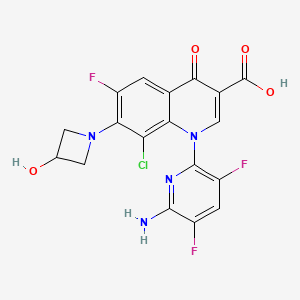
| Formula | C18H12ClF3N4O4 |
|---|---|
| Molecular weight | 440.77 g/mol |
| IUPAC name | 1-(6-amino-3,5-difluoro-2-pyridinyl)-8-chloro-6-fluoro-7-(3-hydroxyazetidin-1-yl)-4-oxoquinoline-3-carboxylic acid |
| CAS | 189279-58-1 |
| PubChem CID | 487101 |
| InChIKey | DYDCPNMLZGFQTM-UHFFFAOYSA-N |
| logP | 1.92 (XLogP 2.7) |
| Polar surface area | 121.68 Ų |
| H-bond acceptors / donors | 7 / 3 |
| Drug-likeness (QED) | 0.57 |
| Lipinski violations | 0 |
SMILES
Nc1nc(-n2cc(C(=O)O)c(=O)c3cc(F)c(N4CC(O)C4)c(Cl)c32)c(F)cc1FBiology & Pharmacokinetics
Pharmacokinetics predicted
| Bioavailability | 10.0% |
|---|---|
| Half-life | 1.536 h |
| Volume of distribution | 0.28 L/kg |
| Protein binding | 85.5% |
| BBB penetrant | No |
Enzyme interactions
| Enzyme | Role | Detail |
|---|---|---|
| CYP2C8 | Inhibitor | — |
Transporters
BCRP (Inhibitor)BCRP (Inhibitor)BSEP (Inhibitor)BSEP (Inhibitor)MDR1 (Inhibitor)MRP1 (Inhibitor)OAT1 (Inhibitor)OAT3 (Inhibitor)OATP1B1 (Inhibitor)OATP1B1 (Inhibitor)OATP1B3 (Inhibitor)OATP1B3 (Inhibitor)OCT1 (Inhibitor)OCT2 (Inhibitor)P-gp (Inhibitor)BCRP (Substrate)MDR1 (Substrate)OATP1B3 (Substrate)OCT1 (Substrate)OCT2 (Substrate)P-gp (Substrate)
Drug–drug interactions (100+, DDInter)
| Interacting drug | Severity | Management |
|---|---|---|
| Acetohexamide | major | |
| Betamethasone | major | |
| Bupropion | major | |
| Chlorpropamide | major | |
| Deflazacort | major | |
| Dexamethasone | major | |
| Fludrocortisone | major | |
| Glimepiride | major | |
| Glipizide | major | |
| Glyburide | major | |
| Hydrocortisone | major | |
| Insulin aspart (aspart protamine) | major | |
| Insulin aspart (aspart) | major | |
| Insulin degludec | major | |
| Insulin detemir | major | |
| Insulin glargine | major | |
| Insulin glulisine | major | |
| Insulin human | major | |
| Insulin human (inhalation, rapid acting) | major | |
| Insulin human (isophane) | major | |
| Insulin human (regular) | major | |
| Insulin human (zinc extended) | major | |
| Insulin human (zinc) | major | |
| Insulin lispro | major | |
| Insulin lispro (protamine) | major | |
| Iohexol | major | |
| Iopamidol | major | |
| Methylprednisolone | major | |
| Nateglinide | major | |
| Prednisolone | major | |
| Prednisone | major | |
| Repaglinide | major | |
| Tolazamide | major | |
| Tolbutamide | major | |
| Triamcinolone | major | |
| Acarbose | moderate | |
| Acetylsalicylic acid | moderate | |
| Albiglutide | moderate | |
| Alogliptin | moderate | |
| Alpelisib | moderate |
Showing 40 of 100+.
Registered Products (2)
| Brand | Form / strength | Pack | Agent | Citizen (JOD) |
|---|---|---|---|---|
| Baxdela | Vial 300 mg | 10 vial | Hikma Pharmaceuticals Co.Ltd/Jordan | — |
| Baxdela | Tablet 450 mg | 20 tab | Hikma Pharmaceuticals Co.Ltd/Jordan | — |