Deflazacort
Active form: 21-Desacetyldeflazacort.
JFDA label: Defal 30mg Tab
Mechanism of Action
Agonist of Glucocorticoid receptor — Glucocorticoid receptor agonist
| Target | Action | Gene / class |
|---|---|---|
| Glucocorticoid receptor efficacy | AGONIST | NR3C1 |
Indications
Approved
- Duchenne muscular dystrophy
Contraindications
Source: Lexicomp
- Hypersensitivity to deflazacort or any component of the formulation Absolute
Adverse Reactions
Cardiac disorders (1)
Common Cardiac arrhythmia
Nervous system disorders (14)
Common abnormal behavior · aggressive behavior · depression · dizziness · emotional disturbance · emotional lability · heat exhaustion · hypertonia · insomnia · Irritability · mood changes · psychomotor agitation · sleep disorder
Not Known Myasthenia (associated with long-term use)
Renal and urinary disorders (5)
Very Common Pollakiuria
Common Dysuria · testicular pain · urinary tract infection · urine discoloration
Blood and lymphatic system disorders (1)
Common Bruise
Metabolism and nutrition disorders (7)
Very Common Cushingoid appearance · hirsutism · obesity · weight gain
Common Glycosuria · hot flash · increased thirst
Gastrointestinal disorders (7)
Very Common Abdominal pain · increased appetite
Common abdominal distress · Constipation · dyspepsia · gastrointestinal disease · nausea
Skin and subcutaneous tissue disorders (7)
Very Common Erythema
Common acne vulgaris · acneiform eruption · alopecia · atrophic striae · impetigo · Skin rash
Musculoskeletal and connective tissue disorders (10)
Common back injury · Back pain · limb pain · muscle spasm · myalgia · neck pain
Not Known Bone fracture (long bones including the fibula as well as greenstick fractures) · decreased bone mineral density · osteopenia (associated with long-term use) · tendon disease (associated with long-term use)
Eye disorders (2)
Common Hordeolum · increased lacrimation
Ear and labyrinth disorders (1)
Common Otitis externa
Infections and infestations (3)
Common Influenza · tooth abscess · viral infection
General disorders and administration site conditions (3)
Common accidental injury · Fever · mass
Respiratory, thoracic and mediastinal disorders (7)
Very Common Cough · upper respiratory tract infection
Common epistaxis · hypoventilation · Nasopharyngitis · pharyngitis · rhinorrhea
Dosing
Source: Lexicomp
Warnings & Precautions
Source: Lexicomp
Adrenal suppression
May cause hypercortisolism or suppression of hypothalamic-pituitary-adrenal (HPA) axis. HPA axis suppression may lead to adrenal crisis. Withdrawal and discontinuation of a corticosteroid should be done slowly and carefully.
Anaphylaxis
Rare cases of anaphylaxis have occurred in patients receiving corticosteroids.
Immunosuppression
Prolonged use of corticosteroids may increase the incidence of secondary infection, cause activation of latent infections, mask acute infection (including fungal infections), prolong or exacerbate existing infections, or limit response to killed or inactivated vaccines. Exposure to chickenpox or measles should be avoided. Close observation is required in patients with latent tuberculosis and/or TB reactivity; restrict use in active TB (only in conjunction with antituberculosis treatment). Avoid use in patients with active ocular herpes simplex. Hepatitis B reactivation can occur in patients who are hepatitis B carriers. Amebiasis should be ruled out in any patient with recent travel to tropic climates or unexplained diarrhea prior to initiation of corticosteroids. Use with extreme caution in patients with Strongyloides infections; hyperinfection, dissemination and fatalities have occurred.
Kaposi sarcoma
Prolonged treatment with corticosteroids has been associated with the development of Kaposi sarcoma (case reports); if noted, discontinuation of therapy should be considered (Goedert 2002).
Myopathy
Acute myopathy has been reported with high dose corticosteroids, usually in patients with neuromuscular transmission disorders; may involve ocular and/or respiratory muscles; monitor creatinine kinase; recovery may be delayed.
Ocular effects
Prolonged use may cause posterior subcapsular cataracts, glaucoma (with possible nerve damage), and increased intraocular pressure. Consider routine eye exams in chronic users.
Psychiatric disturbances
Corticosteroid use may cause psychiatric disturbances, including depression, euphoria, insomnia, mood swings, and personality changes. Preexisting psychiatric conditions may be exacerbated by corticosteroid use.
Skin reactions
Toxic epidermal necrolysis has been reported within 8 weeks of starting treatment; discontinue at first sign of rash, unless rash is clearly not drug-related.
Thromboembolic events
Higher cumulative doses of corticosteroids have been associated with an increased risk of thromboembolism. Use caution in patients with a history of or at increased risk for thromboembolic disorders. Disease-related concerns:
Cardiovascular disease
Use with caution in patients with heart failure and/or hypertension; use has been associated with fluid retention, electrolyte disturbances, and hypertension. Use with caution following acute MI; corticosteroids have been associated with myocardial rupture.
Diabetes
Use with caution in patients with diabetes mellitus; may alter glucose production/regulation leading to hyperglycemia.
Gastrointestinal disease
Use with caution in patients with GI diseases (diverticulitis, fresh intestinal anastomoses, ulcerative colitis, active or latent peptic ulcer, abscess or other pyogenic infections) due to perforation risk. Avoid use if there is a probability of impending perforation, abscess, or other pyogenic infection.
Hepatic impairment
Use with caution in patients with severe hepatic impairment.
Myasthenia gravis
Use with caution in patients with myasthenia gravis; exacerbation of symptoms has occurred especially during initial treatment with corticosteroids.
Osteoporosis
Use with caution in patients with or who are at risk for osteoporosis; high doses and/or long-term use of corticosteroids have been associated with increased bone loss, osteoporotic fractures, and avascular necrosis.
Pheochromocytoma
Use with caution in patients with pheochromocytoma; cases of pheochromocytoma crisis, which can be fatal, have been reported with corticosteroids.
Renal impairment
Use with caution in renal impairment; fluid retention may occur.
Seizure disorders
Use with caution in patients with a history of seizure disorder.
Thyroid disease
Changes in thyroid status may necessitate dosage adjustments; metabolic clearance of corticosteroids increases in hyperthyroid patients and decreases in hypothyroid ones. Concurrent drug therapy issues:
Drug-drug interactions
Potentially significant interactions may exist, requiring dose or frequency adjustment, additional monitoring, and/or selection of alternative therapy. Consult drug interactions database for more detailed information. Special populations:
Pediatric
May affect growth velocity; growth should be routinely monitored in pediatric patients. Dosage form specific issues:
Benzyl alcohol and derivatives
Some dosage forms may contain benzyl alcohol; large amounts of benzyl alcohol (≥99 mg/kg/day) have been associated with a potentially fatal toxicity (“gasping syndrome”) in neonates; the “gasping syndrome” consists of metabolic acidosis, respiratory distress, gasping respirations, CNS dysfunction (including convulsions, intracranial hemorrhage), hypotension and cardiovascular collapse (AAP 1997; CDC 1982); some data suggests that benzoate displaces bilirubin from protein binding sites (Ahlfors 2001); avoid or use dosage forms containing benzyl alcohol with caution in neonates. See manufacturer’s labeling. Other warnings/precautions:
Discontinuation of therapy
Withdraw therapy with gradual tapering of dose.
Stress
Patients may require higher doses when subject to stress (ie, trauma, surgery, severe infection).
Pregnancy & Lactation
Pregnancy
Deflazacort crosses the placenta. Orofacial clefts, intrauterine growth restriction, and decreased birth weight have been reported following maternal use. Hypoadrenalism may occur in newborns following maternal use of corticosteroids in pregnancy; monitor.
Lactation
Corticosteroids are excreted in breast milk. Information specific to deflazacort has not been located. According to the manufacturer, the decision to continue or discontinue breast-feeding during therapy should take into account the risk of infant exposure, the benefits of breastfeeding to the infant, and benefits of treatment to the mother.
Monitoring
| Clinical pearl | Blood pressure, blood glucose, electrolytes Following prolonged use: Bone mass density, assess HPA axis suppression (eg, ACTH stimulation test, morning plasma cortisol test, urinary free cortisol test), growth in children, signs and symptoms of infection, cataract formation, intraocular pressure. |
|---|
Chemistry & Properties
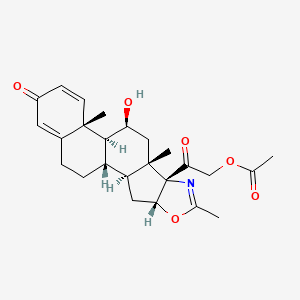
| Formula | C25H31NO6 |
|---|---|
| Molecular weight | 441.52 g/mol |
| IUPAC name | [2-[(1S,2S,4R,8S,9S,11S,12S,13R)-11-hydroxy-6,9,13-trimethyl-16-oxo-5-oxa-7-azapentacyclo[10.8.0.02,9.04,8.013,18]icosa-6,14,17-trien-8-yl]-2-oxoethyl] acetate |
| CAS | 14484-47-0 |
| PubChem CID | 189821 |
| InChIKey | FBHSPRKOSMHSIF-GRMWVWQJSA-N |
| logP | 2.56 (XLogP 2.0) |
| Polar surface area | 102.26 Ų |
| H-bond acceptors / donors | 7 / 1 |
| Drug-likeness (QED) | 0.68 |
| Lipinski violations | 0 |
SMILES
CC(=O)OCC(=O)[C@@]12N=C(C)O[C@@H]1C[C@H]1[C@@H]3CCC4=CC(=O)C=C[C@]4(C)[C@H]3[C@@H](O)C[C@@]12CBiology & Pharmacokinetics
Pharmacokinetics
| BBB penetrant | Yes |
|---|
Enzyme interactions
| Enzyme | Role | Detail |
|---|---|---|
| CYP2B6 | Inhibitor | — |
| CYP2C8 | Inhibitor | — |
| CYP3A4 | Substrate | — |
Transporters
BCRP (Inhibitor)BSEP (Inhibitor)MRP1 (Inhibitor)OATP1B1 (Inhibitor)OATP1B3 (Inhibitor)P-gp (Inhibitor)MDR1 (Substrate)P-gp (Substrate)
Drug–drug interactions (100+, DDInter)
| Interacting drug | Severity | Management |
|---|---|---|
| Adalimumab | major | |
| Amprenavir | major | |
| Apalutamide | major | |
| Aprepitant | major | |
| Atazanavir | major | |
| Bacillus calmette-guerin substrain tice live antigen | major | |
| Baricitinib | major | |
| Bempedoic acid | major | |
| Berotralstat | major | |
| Boceprevir | major | |
| Bosentan | major | |
| Brexucabtagene autoleucel | major | |
| Bupropion | major | |
| Carbamazepine | major | |
| Cenobamate | major | |
| Ceritinib | major | |
| Certolizumab pegol | major | |
| Cinoxacin | major | |
| Ciprofloxacin | major | |
| Cladribine | major | |
| Clarithromycin | major | |
| Cobicistat | major | |
| Conivaptan | major | |
| Crizotinib | major | |
| Dabrafenib | major | |
| Dalfopristin | major | |
| Darunavir | major | |
| Deferasirox | major | |
| Delafloxacin | major | |
| Delavirdine | major | |
| Desirudin | major | |
| Desmopressin | major | |
| Dexamethasone | major | |
| Diltiazem | major | |
| Dinutuximab | major | |
| Dronedarone | major | |
| Duvelisib | major | |
| Efavirenz | major | |
| Enoxacin | major | |
| Enzalutamide | major |
Showing 40 of 100+.
Registered Products (2)
| Brand | Form / strength | Pack | Agent | Citizen (JOD) |
|---|---|---|---|---|
| Defal | Tablet 6 mg | 20 tab | Al-Mutawafiqa Modern Drug Store MMDS | 2.880 |
| Defal | Tablet 30 mg | 10 tab | Al-Mutawafiqa Modern Drug Store MMDS | 5.320 |