Bempedoic Acid
JFDA label: Averto
Mechanism of Action
Inhibitor of ATP-citrate synthase — ATP-citrate synthase inhibitor
| Target | Action | Gene / class |
|---|---|---|
| ATP-citrate synthase efficacy | INHIBITOR | ACLY |
Indications
Approved
- Atherosclerosis — atherosclerosis
- Cardiovascular Diseases — cardiovascular disease
- Coronary Artery Disease — coronary artery disease
- Dyslipidemias — Abnormal circulating lipid concentration
- Hypercholesterolemia — Hypercholesterolemia
- Hyperlipoproteinemia Type II — familial hypercholesterolemia
Off-label
- Diabetes Mellitus, Type 2
- Hyperlipidemias
- Lipid Metabolism Disorders
Contraindications
Source: openFDA
- is contraindicated in patients with a prior hypersensitivity to ezetimibe or bempedoic acid or any of the excipients in NEXLIZET [see Adverse Reactions (6.2) ] . Serious hypersensitivity reactions, such as anaphylaxis, angioedema, rash and urticaria have been reported with ezetimibe or bempedoic acid. Known hypersensitivity to ezetimibe or bempedoic acid or any of the excipients in NEXLIZET. ( 4 , 6.2 ) Absolute
Adverse Reactions
Nervous system disorders (2)
Not Known Myopathy Rhabdomyolysis Nervous System Disorders Dizziness · Paresthesia
Hepatobiliary disorders (1)
Not Known Hepatitis
Blood and lymphatic system disorders (1)
Not Known Thrombocytopenia Gastrointestinal Disorders Abdominal Pain
Gastrointestinal disorders (1)
Not Known Pancreatitis
Psychiatric disorders (1)
Not Known Depression
Investigations (1)
Not Known Elevated Creatine Phosphokinase
General disorders and administration site conditions (2)
Not Known Cholelithiasis · Including Elevations More Than 5 Uln
Dosing
Source: openFDA
Warnings & Precautions
Source: openFDA
Warnings & Precautions
Hyperuricemia: Elevations in serum uric acid have occurred. Assess uric acid levels periodically as clinically indicated. Monitor for signs and symptoms of hyperuricemia, and initiate treatment with urate-lowering drugs as appropriate. ( 5.1 ) Tendon Rupture: Tendon rupture has occurred. Discontinue NEXLIZET at the first sign of tendon rupture. Avoid NEXLIZET in patients who have a history of tendon disorders or tendon rupture. ( 5.2 )
Hyperuricemia Bempedoic acid, a component of NEXLIZET, inhibits renal
Hyperuricemia Bempedoic acid, a component of NEXLIZET, inhibits renal tubular OAT2 and may increase blood uric acid levels [see Clinical Pharmacology (12.3) ] . In the primary hypercholesterolemia trials [see Clinical Studies (14.1) ] , 26% of bempedoic acid-treated patients with normal baseline uric acid values (versus 9.5% placebo) experienced hyperuricemia one or more times, and 3.5% of patients experienced clinically significant hyperuricemia reported as an adverse reaction (versus 1.1% placebo). Increases in uric acid levels usually occurred within the first 4 weeks of treatment initiation, persisted throughout treatment, and returned to baseline following discontinuation of treatment. After 12 weeks of treatment, the mean placebo-adjusted increase in uric acid compared to baseline was 0.8 mg/dL for patients treated with bempedoic acid. In the cardiovascular outcomes trial [see Clinical Studies (14.2) ] , 16.4% of bempedoic acid-treated patients experienced clinically significant hyperuricemia reported as an adverse reaction (versus 8.2% placebo). Elevated blood uric acid may lead to the development of gout. In the primary hypercholesterolemia trials, gout was reported in 1.5% of patients treated with bempedoic acid versus 0.4% of patients treated with placebo. In the cardiovascular outcomes trial, gout was reported in 3.2% of patients treated with bempedoic acid and 2.2% treated with placebo. Advise patients to contact their healthcare provider if symptoms of hyperuricemia occur. Assess serum uric acid when clinically indicated. Monitor patients for signs and symptoms of hyperuricemia, and initiate treatment with urate-lowering drugs as appropriate.
Tendon Rupture Bempedoic acid, a component of NEXLIZET, is associated
Tendon Rupture Bempedoic acid, a component of NEXLIZET, is associated with an increased risk of tendon rupture or injury. In the primary hypercholesterolemia trials [see Clinical Studies (14.1) ] , tendon rupture occurred in 0.5% of patients treated with bempedoic acid versus 0% of placebo-treated patients and involved the rotator cuff (the shoulder), biceps tendon, or Achilles tendon. Tendon rupture occurred within weeks to months of starting bempedoic acid. In the cardiovascular outcomes trial [see Clinical Studies (14.2) ] , tendon rupture events occurred in 1.2% of bempedoic acid-treated patients versus 0.9% of placebo-treated patients. Tendon rupture may occur more frequently in patients over 60 years of age, in those taking corticosteroid or fluoroquinolone drugs, in patients with renal failure, and in patients with previous tendon disorders. Discontinue NEXLIZET immediately if the patient experiences rupture of a tendon. Consider discontinuing NEXLIZET if the patient experiences joint pain, swelling, or inflammation. Advise patients to rest at the first sign of tendinitis or tendon rupture and to contact their healthcare provider if tendinitis or tendon rupture symptoms occur. Consider alternative therapy in patients with a history of tendon disorders or tendon rupture.
Pregnancy & Lactation
Lactation
If a mother requires bempedoic acid, it is not a reason to discontinue breastfeeding.
Chemistry & Properties
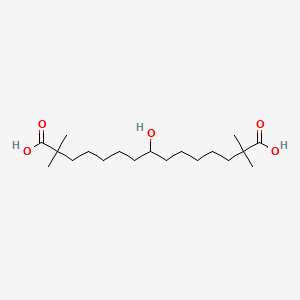
| Formula | C19H36O5 |
|---|---|
| Molecular weight | 344.49 g/mol |
| IUPAC name | 8-hydroxy-2,2,14,14-tetramethylpentadecanedioic acid |
| CAS | 738606-46-7 |
| PubChem CID | 10472693 |
| InChIKey | HYHMLYSLQUKXKP-UHFFFAOYSA-N |
| logP | 4.47 (XLogP 4.8) |
| Polar surface area | 94.83 Ų |
| H-bond acceptors / donors | 3 / 3 |
| Drug-likeness (QED) | 0.40 |
| Lipinski violations | 0 |
SMILES
CC(C)(CCCCCC(O)CCCCCC(C)(C)C(=O)O)C(=O)OBiology & Pharmacokinetics
Pharmacokinetics predicted
| Bioavailability | 10.0% |
|---|---|
| Half-life | 1.024 h |
| Volume of distribution | 0.472 L/kg |
| Protein binding | 77.7% |
| BBB penetrant | No |
Enzyme interactions
| Enzyme | Role | Detail |
|---|---|---|
| CYP3A4 | Substrate | — |
Receptor binding (top 1)
| Target | Action | Affinity |
|---|---|---|
| ATP citrate lyase (ACLY) | Inhibitor | pKi 5.7 |
Transporters
BCRP (Inhibitor)BSEP (Inhibitor)MRP1 (Inhibitor)OATP (Inhibitor)OATP1B1 (Inhibitor)OATP1B1 (Inhibitor)OATP1B3 (Inhibitor)OATP1B3 (Inhibitor)P-gp (Inhibitor)BSEP (Substrate)MATE1 (Substrate)MATE2 (Substrate)OAT1 (Substrate)OAT2 (Substrate)OAT3 (Substrate)OATP1B3 (Substrate)OCT1 (Substrate)P-gp (Substrate)
Drug–drug interactions (22, DDInter)
| Interacting drug | Severity | Management |
|---|---|---|
| Betamethasone | major | |
| Budesonide | major | |
| Deflazacort | major | |
| Dexamethasone | major | |
| Fludrocortisone | major | |
| Hydrocortisone | major | |
| Levofloxacin | major | |
| Methylprednisolone | major | |
| Prednisolone | major | |
| Prednisone | major | |
| Simvastatin | major | |
| Triamcinolone | major | |
| Empagliflozin | moderate | |
| Fexofenadine | moderate | |
| Glyburide | moderate | |
| Irinotecan | moderate | |
| Methotrexate | moderate | |
| Repaglinide | moderate | |
| Revefenacin | moderate | |
| Rifaximin | moderate | |
| Rosuvastatin | moderate | |
| Selexipag | moderate |
Registered Products (2)
| Brand | Form / strength | Pack | Agent | Citizen (JOD) |
|---|---|---|---|---|
| Averto | Tablet Bempedoic acid 180 mg | 30 tab | Hikma Pharmaceuticals // شركة أدوية الحكمة | 40.000 |
| Averto Plus | Tablet 180/10 mg | 30 tab | Hikma Pharmaceuticals // شركة أدوية الحكمة | 40.000 |