Methotrexate
JFDA label: Methotrexat Ebewe
- Intrathecal and high-dose therapy:
- Appropriate use:
- Pregnancy:
- Bone marrow suppression:
- Renal impairment:
- Hepatotoxicity:
- Pneumonitis:
- Gastrointestinal toxicity:
- Secondary malignancy:
- Tumor lysis syndrome:
- Dermatologic toxicity:
- Opportunistic infections:
- Radiotherapy:
- Severe toxic reactions, including embryo-fetal toxicity
- Experienced physician (injection):
- tumor lysis syndrome
- hepatotoxicity
Mechanism of Action
Inhibitor of Dihydrofolate reductase — Dihydrofolate reductase inhibitor
| Target | Action | Gene / class |
|---|---|---|
| Dihydrofolate reductase efficacy | INHIBITOR | DHFR |
Indications
Approved
- Nononcology uses
- Oncology uses
Off-label
- Abortion (medical management)
- Acute graft-versus-host disease (prophylaxis)
- Acute promyelocytic leukemia (APL) maintenance (adults)
- Bladder cancer
- CNS lymphoma
- Crohn disease (maintenance of remission)
- Dermatomyositis/polymyositis
- Ectopic pregnancy
- Multiple sclerosis
- Nonleukemic meningeal cancer
- Soft tissue sarcoma (desmoid tumors, aggressive fibromatosis), advanced
- Systemic lupus erythematosus, moderate-to-severe
- Takayasu arteritis, refractory or relapsing disease
- Uveitis (adults)
Class profile
| mechanismClass | Antimetabolite (folate antagonist) |
|---|---|
| targetMolecule | DHFR + thymidylate synthase |
| targetPathway | Folate/purine synthesis |
| generation | Classic |
| primaryTumors | ALL,Lymphoma,Osteosarcoma,Breast,Choriocarcinoma (also rheumatology) |
| resistanceMechanisms | DHFR amplification,Reduced methotrexate polyglutamation (FPGS mutation),Impaired membrane transport (RFC1 mutation) |
| source | NCCN/OncoKB/Goodman&Gilman13ed |
Contraindications
Source: Curated · Lexicomp
- Hepatic cirrhosis, active hepatitis, or alcohol abuse Absolute
- Immunodeficiency syndromes or pre-existing blood dyscrasias Absolute
- Known hypersensitivity to methotrexate or any component of the formulation Absolute
- Pregnancy — absolute CI (abortifacient and teratogenic) Absolute
- Severe renal impairment (CrCl < 20 mL/min) Absolute
- breast-feeding Additional contraindications for patients with psoriasis, rheumatoid arthritis or polyarticular-course juvenile idiopathic arthritis: Pregnancy, alcoholism, alcoholic liver disease or other chronic liver disease, immunodeficiency syndromes (overt or laboratory evidence) Absolute
- preexisting blood dyscrasias (eg, bone marrow hypoplasia, leukopenia, thrombocytopenia, significant anemia) Absolute
Adverse Reactions
Cardiac disorders (12)
Not Known Arterial thrombosis · cerebral thrombosis · chest pain · deep vein thrombosis · hypotension · pericardial effusion · pericarditis · plaque erosion (psoriasis) · pulmonary embolism · retinal thrombosis · thrombophlebitis · vasculitis
Nervous system disorders (15)
Not Known abnormal cranial sensation · brain disease · chemical arachnoiditis (intrathecal; acute) · chills · cognitive dysfunction (has been reported at low dosage) · Dizziness · drowsiness · fatigue · headache · leukoencephalopathy (intravenous administration after craniospinal irradiation or repeated high-dose therapy; may be chronic) · malaise · mood changes (has been reported at low dosage) · neurological signs and symptoms (at high dosages; including confusion, hemiparesis, transient blindness, seizures, and coma) · severe neurotoxicity (reported with unexpectedly increased frequency among pediatric patients with acute lymphoblastic leukemia who were treated with intermediate-dose intravenous methotrexate) · speech disturbance
Hepatobiliary disorders (7)
Very Common Elevated liver enzymes
Uncommon Hepatic fibrosis / cirrhosis (cumulative dose)
Not Known cirrhosis (chronic therapy) · hepatic failure · hepatic fibrosis (chronic therapy) · hepatitis (acute) · Increased liver enzymes
Renal and urinary disorders (15)
Common Nephrotoxicity (high-dose)
Not Known Azotemia · cystitis · defective oogenesis · defective spermatogenesis · dysuria · hematuria · impotence · infertility · oligospermia · pancreatitis · proteinuria · Renal failure · severe renal disease · vaginal discharge
Blood and lymphatic system disorders (18)
Common Leucopenia · Thrombocytopenia
Not Known agranulocytosis · anemia · aplastic anemia · bone marrow depression (nadir: 7-10 days) · decreased hematocrit · eosinophilia · gastric ulcer · hypogammaglobulinemia · leukopenia · lymphadenopathy · lymphoma · lymphoproliferative disorder · neutropenia · non-Hodgkin’s lymphoma (in patients receiving low-dose oral methotrexate) · pancytopenia · Thrombocytopenia
Immune system disorders (1)
Not Known Anaphylactoid reaction
Metabolism and nutrition disorders (5)
Not Known Decreased libido · decreased serum albumin · diabetes mellitus · gynecomastia · menstrual disease
Gastrointestinal disorders (14)
Very Common Nausea and vomiting
Common Mucositis / oral ulcers
Not Known abdominal distress · anorexia · aphthous stomatitis · Diarrhea · enteritis · gastrointestinal hemorrhage · gingivitis · hematemesis · intestinal perforation · melena · nausea and vomiting · stomatitis
Skin and subcutaneous tissue disorders (23)
Uncommon Photosensitivity
Not Known acne vulgaris · Alopecia · burning sensation of skin · dermal ulcer · dermatitis · diaphoresis · ecchymoses · erythema multiforme · erythematous rash · exfoliative dermatitis · furunculosis · hyperpigmentation · hypopigmentation · pruritus · skin abnormalities related to radiation recall · skin necrosis · skin photosensitivity · skin rash · Stevens-Johnson syndrome · telangiectasia · toxic epidermal necrolysis · urticaria
Musculoskeletal and connective tissue disorders (5)
Not Known Arthralgia · myalgia · myelopathy (subacute) · osteonecrosis (with radiotherapy) · osteoporosis
Eye disorders (4)
Not Known Blurred vision · conjunctivitis · eye pain · visual disturbance
Ear and labyrinth disorders (1)
Not Known Tinnitus
Infections and infestations (7)
Not Known Cryptococcosis · cytomegalovirus disease (including cytomegaloviral pneumonia, sepsis, nocardiosis) · herpes simplex infection · herpes zoster · histoplasmosis · infection · vaccinia (disseminated; following smallpox immunization)
General disorders and administration site conditions (4)
Very Common Fatigue
Not Known Fever · nodule · tissue necrosis
Respiratory, thoracic and mediastinal disorders (12)
Uncommon Pulmonary toxicity (methotrexate pneumonitis)
Not Known chronic obstructive pulmonary disease · cough · epistaxis · Interstitial pneumonitis · pharyngitis · pneumonia (including Pneumocystis jirovecii) · pulmonary alveolitis · pulmonary disease · pulmonary fibrosis · respiratory failure · upper respiratory tract infection
Other (1)
Not Known Adverse reactions vary by route and dosage. Frequency not always defined
Dosing
Source: Lexicomp
Warnings & Precautions
Source: Lexicomp
Acute renal failure
May cause renal damage leading to acute renal failure, especially with high-dose methotrexate; monitor renal function and methotrexate levels closely, maintain adequate hydration and urinary alkalinization. Use with caution in osteosarcoma patients treated with high-dose methotrexate in combination with nephrotoxic chemotherapy (eg, cisplatin).
Bone marrow suppression
Unexpectedly severe (sometimes fatal) bone marrow suppression and aplastic anemia have been reported with concomitant administration of methotrexate (usually in high dosage) along with some nonsteroidal anti-inflammatory drugs (NSAIDs); anemia, pancytopenia, leukopenia, neutropenia, and/or thrombocytopenia may occur. Monitor blood counts. Use with caution in patients with preexisting bone marrow suppression. Discontinue treatment (immediately) in rheumatoid arthritis (RA) or psoriasis if a significant decrease in hematologic components is noted.
CNS effects
May cause neurotoxicity. Leukoencephalopathy has been reported (case reports), usually in patients who have received cranial irradiation and IV methotrexate. Chronic leukoencephalopathy has been reported with high-dose methotrexate (with leucovorin rescue and even without cranial irradiation) and with intrathecal methotrexate; discontinuing methotrexate does not always result in complete recovery; may be progressive and fatal. Serious neurotoxicity, including generalized and focal seizures has occurred (usually in pediatric ALL patients receiving intermediate-dose (1 g/m2 IV methotrexate); leukoencephalopathy and/or microangiopathic calcifications were noted on diagnostic imaging studies in symptomatic patients. A transient acute stroke-like encephalopathy has been observed, usually with high-dose regimens; manifestations may include confusion, hemiparesis, transient blindness, seizure, and coma. Chemical arachnoiditis (headache, back pain, nuchal rigidity, fever) and myelopathy may result from intrathecal administration. May cause dizziness and fatigue; may affect the ability to drive or operate heavy machinery.
Dermatologic toxicity
Severe, occasionally fatal skin reactions have been reported following single or multiple doses of methotrexate. Reactions have occurred within days of oral, intramuscular, intravenous, or intrathecal methotrexate administration. Recovery has been reported with discontinuation of therapy. Severe dermatologic reactions have included toxic epidermal necrolysis, Stevens-Johnson syndrome, exfoliative dermatitis, skin necrosis, and erythema multiforme; discontinue methotrexate if severe reactions occur. Radiation recall dermatitis and sunburn may be precipitated by methotrexate administration. Psoriatic lesions may be worsened by concomitant exposure to ultraviolet radiation.
Fertility
May cause impairment of fertility, oligospermia, and menstrual dysfunction; it is not known if fertility impairment is reversible.
Gastrointestinal toxicity
Gastrointestinal toxicity may occur (may be unexpectedly severe, usually occurs with high doses along with concomitant use of some NSAIDs); diarrhea and ulcerative stomatitis may require treatment interruption; otherwise hemorrhagic enteritis and death from intestinal perforation may occur. Diarrhea or stomatitis may also require discontinuation. Use with caution in patients with peptic ulcer disease or ulcerative colitis; the risk of GI adverse effects may be increased. In children, doses ≥12 g/m2 (IV) are associated with a high emetic potential; doses ≥250 mg/m2 (IV) in adults and children are associated with moderate emetic potential (Dupuis 2011). Antiemetics may be recommended to prevent nausea and vomiting.
Hepatotoxicity
Methotrexate causes hepatotoxicity, fibrosis, and cirrhosis, but generally only after prolonged use. Acutely, liver enzyme elevations are frequently seen. These are usually transient and asymptomatic, and also do not appear predictive of subsequent hepatic disease. Liver biopsy after sustained use often shows histologic changes, and fibrosis and cirrhosis have been reported; these latter lesions often are not preceded by symptoms or abnormal liver function tests in the psoriasis population. For this reason, periodic liver biopsies are usually recommended for psoriatic patients who are under long-term treatment. Persistent abnormalities in liver function tests may precede appearance of fibrosis or cirrhosis in the rheumatoid arthritis population. Risk is related to cumulative dose (≥1.5 g) and prolonged exposure. Monitor closely (with liver function tests, including serum albumin) for liver toxicities. Liver enzyme elevations may be noted, but may not be predictive of hepatic disease in long term treatment for psoriasis (but generally is predictive in RA treatment). Discontinue methotrexate with moderate to severe change in liver biopsy. Risk factors for hepatotoxicity include history of above moderate ethanol consumption, persistent abnormal liver chemistries, history of chronic liver disease (including hepatitis B or C), family history of inheritable liver disease, diabetes, obesity, hyperlipidemia, lack of folate supplementation during methotrexate therapy, cumulative metho
Hypersensitivity
Anaphylaxis may occur; if anaphylaxis or other serious hypersensitivity reaction occurs, discontinue methotrexate immediately and institute appropriate management.
Infections
Immune suppression may lead to potentially fatal opportunistic infections, including Pneumocystis jirovecii pneumonia (PCP). Methotrexate use increases the risk for developing life-threatening or fatal bacterial, fungal, or viral infections, including invasive fungal infections, hepatitis B reactivation, tuberculosis (primary infection or reactivation), disseminated herpes zoster infection and/or cytomegalovirus infection. Use methotrexate with extreme caution in patients with an active infection (contraindicated in patients with immunodeficiency syndrome). Monitor for signs/symptoms of infection during and after treatment; manage promptly if infections occurs. Dose reduction or discontinuation may be necessary for serious infection.
Pneumonitis
Methotrexate-induced lung disease, including acute or chronic interstitial pneumonitis, is a potentially dangerous lesion, which may occur acutely at any time during therapy and has been reported at low doses. It is not always fully reversible and fatalities have been reported. Pulmonary symptoms (especially a dry, nonproductive cough) may require interruption of treatment and careful investigation. Pulmonary symptoms may occur at any time during therapy and at any dosage; monitor closely for pulmonary symptoms, particularly dry, nonproductive cough. Other potential symptoms include fever, dyspnea, hypoxemia, or pulmonary infiltrate.
Secondary malignancy
Malignant lymphomas, which may regress following withdrawal of methotrexate, may occur in patients receiving low-dose methotrexate and, thus, may not require cytotoxic treatment. Discontinue methotrexate first and, if the lymphoma does not regress, appropriate treatment should be instituted. Other secondary tumors have been reported.
Tumor lysis syndrome
Tumor lysis syndrome may occur in patients with high tumor burden; appropriate supportive and pharmacologic measures may prevent or alleviate tumor lysis syndrome. Disease-related concerns:
Ascites/pleural effusions
Elimination is reduced in patients with ascites and/or pleural effusions; resulting in prolonged half-life and toxicity; may require dose reduction or discontinuation. Monitor closely for toxicity.
Hepatic impairment
Use with caution in patients with preexisting liver impairment.
Peptic ulcer disease
Use with caution in patients with peptic ulcer disease; diarrhea and stomatitis may occur.
Renal impairment
Methotrexate elimination is reduced in patients with renal impairment; monitor closely for toxicity; may require dose reduction or, in some cases, discontinuation of methotrexate administration.
Ulcerative colitis
Use with caution in patients with ulcerative colitis; diarrhea and stomatitis may occur. Concurrent drug therapy issues:
Drug-drug interactions
Potentially significant interactions may exist, requiring dose or frequency adjustment, additional monitoring, and/or selection of alternative therapy. Consult drug interactions database for more detailed information.
Hepatotoxic agents
Use caution when used with other hepatotoxic agents (azathioprine, retinoids, sulfasalazine).
Mercaptopurine
Methotrexate may increase the levels and effects of mercaptopurine; may require dosage adjustments.
Nephrotoxic chemotherapy
Use with caution in osteosarcoma patients treated with high-dose methotrexate in combination with nephrotoxic chemotherapy (eg, cisplatin).
NSAIDs
Do not administer NSAIDs prior to or during high dose methotrexate therapy; may increase and prolong serum methotrexate levels. Doses used for psoriasis may still lead to unexpected toxicities; use with caution when administering NSAIDs or salicylates with lower doses of methotrexate for RA.
Proton pump inhibitors
Concomitant use of proton pump inhibitors with methotrexate (primarily high-dose methotrexate) may elevate and prolong serum methotrexate levels and metabolite (hydroxymethotrexate) levels (based on case reports and pharmacokinetic studies). May lead to toxicities; use with caution.
Vaccines
Immunization may be ineffective during methotrexate treatment. Immunization with live vaccines is not recommended; cases of disseminated vaccinia infections due to live vaccines have been reported.
Vitamins
Vitamins containing folate may decrease response to systemic methotrexate; folate deficiency may increase methotrexate toxicity. Special populations:
Elderly
Use caution and monitor closely in the elderly; increased risk of toxicity.
Pregnancy
Methotrexate has been reported to cause fetal death and/or congenital abnormalities. Methotrexate is not recommended for women of childbearing potential unless there is clear medical evidence that the benefits can be expected to outweigh the considered risks. Pregnant women with psoriasis or rheumatoid arthritis should not receive methotrexate. Some products are contraindicated in pregnant women.
Radiotherapy recipients
Concomitant methotrexate administration with radiotherapy may increase the risk of soft tissue necrosis and osteonecrosis. Dosage form specific issues:
Benzyl alcohol and derivatives
Some dosage forms may contain benzyl alcohol; large amounts of benzyl alcohol (≥99 mg/kg/day) have been associated with a potentially fatal toxicity (“gasping syndrome”) in neonates; the “gasping syndrome” consists of metabolic acidosis, respiratory distress, gasping respirations, CNS dysfunction (including convulsions, intracranial hemorrhage), hypotension, and cardiovascular collapse (AAP ["Inactive" 1997]; CDC 1982); some data suggests that benzoate displaces bilirubin from protein binding sites (Ahlfors 2001); avoid or use dosage forms containing benzyl alcohol with caution in neonates. See manufacturer’s labeling.
Intrathecal and high-dose therapy
[US Boxed Warnings]: Use only preservative-free methotrexate formulations and diluents for intrathecal and high-dose therapy. Do NOT use formulations or diluents containing preservatives for intrathecal and high-dose therapy because they contain benzyl alcohol. Other warnings/precautions:
Administration schedules
Errors have occurred (some resulting in death) when methotrexate was administered as a “daily” dose instead of a “weekly” dose intended for some indications. The ISMP Targeted Medication Safety Best Practices for Hospitals recommends hospitals use a weekly dosage regimen default for oral methotrexate orders, with a hard stop override requiring verification of appropriate oncology indication; manual systems should require verification of an oncology indication prior to dispensing oral methotrexate for daily administration. Pharmacists should provide patient education for patients discharged on weekly oral methotrexate; education should include written leaflets that contain clear instructions about the weekly dosing schedule and explain the danger of taking extra doses (ISMP 2014).
Appropriate use
[US Boxed Warnings]: Because of the possibility of serious toxic reactions (which can be fatal), methotrexate should be used only in life threatening neoplastic diseases or in patients with psoriasis or rheumatoid arthritis with severe, recalcitrant, disabling disease which is not adequately responsive to other forms of therapy. Deaths have been reported with the use of methotrexate in the treatment of malignancy, psoriasis, and rheumatoid arthritis. Patients should be closely monitored for bone marrow, liver, lung, skin, and kidney toxicities. Patients should be informed by their physician of the risks involved and be under a physician’s care throughout therapy. The use of methotrexate high-dose regimens recommended for osteosarcoma requires meticulous care. High-dose regimens of methotrexate injection for other neoplastic diseases are investigational, and a therapeutic advantage has not been established.
Experienced physician
[US Boxed Warnings]: Should be administered under the supervision of a physician experienced in the use of antimetabolite therapy.
Intrathecal safety
When used for intrathecal administration, should not be prepared during the preparation of any other agents. After preparation, store intrathecal medications in an isolated location or container clearly marked with a label identifying as "intrathecal" use only. Delivery of intrathecal medications to the patient should only be with other medications intended for administration into the central nervous system (Jacobson 2009).
Methotrexate overexposure
Glucarpidase is an enzyme that rapidly hydrolyzes extracellular methotrexate into inactive metabolites, allowing for a rapid reduction of methotrexate concentrations. Glucarpidase may be used for methotrexate overexposure; it is approved for the treatment of toxic plasma methotrexate concentrations (>1 micromole/L) in patients with delayed clearance due to renal impairment. Refer to Glucarpidase monograph.
Pregnancy & Lactation
Pregnancy
Contraindicated
Contraindicated at any trimester. Effective contraception required for ≥3 months post-treatment (both sexes)
Lactation
Low amounts of methotrexate are present in breast milk. Due to the potential for serious adverse reactions in a breastfed infant, use is contraindicated in breastfeeding mothers.
Monitoring
| Efficacy | For high-dose regimens: serum methotrexate level at 24/48/72 h post-dose (target < 0.2 µmol/L at 48 h); for low-dose (RA/psoriasis): CBC, LFTs, renal function every 4–12 weeks |
|---|---|
| Toxicity | Bone marrow suppression (neutropaenia, thrombocytopaenia); hepatotoxicity (transaminases, cumulative fibrosis risk); mucositis; pulmonary toxicity; nephrotoxicity |
| Clinical pearl | Always co-prescribe folic acid (1–5 mg/day, omitting methotrexate day) to reduce mucosal and haematological toxicity without compromising efficacy. |
| Counseling | Take folic acid as prescribed. Take methotrexate on the same day each week (for RA/psoriasis). Report sore throat, mouth ulcers, shortness of breath, or dark urine immediately. |
Chemistry & Properties
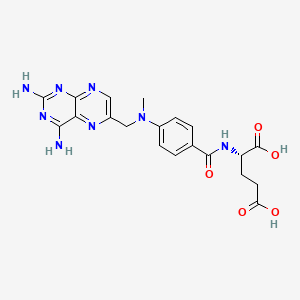
| Formula | C20H22N8O5 |
|---|---|
| Molecular weight | 454.45 g/mol |
| IUPAC name | (2S)-2-[[4-[(2,4-diaminopteridin-6-yl)methyl-methylamino]benzoyl]amino]pentanedioic acid |
| CAS | 59-05-2 |
| PubChem CID | 126941 |
| InChIKey | FBOZXECLQNJBKD-ZDUSSCGKSA-N |
| logP | 0.27 (XLogP -1.8) |
| Polar surface area | 210.54 Ų |
| H-bond acceptors / donors | 10 / 5 |
| Drug-likeness (QED) | 0.29 |
| Lipinski violations | 0 |
SMILES
CN(Cc1cnc2nc(N)nc(N)c2n1)c1ccc(C(=O)N[C@@H](CCC(=O)O)C(=O)O)cc1Biology & Pharmacokinetics
Pharmacokinetics
| BBB penetrant | No (logBB -1.5) |
|---|
Receptor binding (top 3)
| Target | Action | Affinity |
|---|---|---|
| dihydrofolate reductase (DHFR) | Inhibitor | pKi 8.9 |
| high mobility group box 1 (HMGB1) | Inhibitor | pKd 7.6 |
| Reduced folate transporter 1 (SLC19A1) | Inhibitor | pKi 5.3 |
Transporters
BCRP (Inhibitor)BCRP (Inhibitor)BSEP (Inhibitor)BSEP (Inhibitor)MATE1 (Inhibitor)MDR1 (Inhibitor)MRP1 (Inhibitor)MRP1 (Inhibitor)MRP2 (Inhibitor)MRP3 (Inhibitor)MRP4 (Inhibitor)MRP5 (Inhibitor)MRP7 (Inhibitor)OAT1 (Inhibitor)OAT3 (Inhibitor)OATP (Inhibitor)OATP1A2 (Inhibitor)OATP1B1 (Inhibitor)OATP1B1 (Inhibitor)OATP1B3 (Inhibitor)OATP1B3 (Inhibitor)OATP2B1 (Inhibitor)OCT1 (Inhibitor)OCT3 (Inhibitor)P-gp (Inhibitor)Transporter(unspecified) (Inhibitor)BCRP (Substrate)MDR1 (Substrate)MRP (Substrate)MRP1 (Substrate)MRP2 (Substrate)MRP3 (Substrate)MRP4 (Substrate)OAT (Substrate)OAT1 (Substrate)OAT2 (Substrate)OAT3 (Substrate)OAT4 (Substrate)OATP1A2 (Substrate)OATP1B1 (Substrate)OATP1B3 (Substrate)OATP2B1 (Substrate)OATP4C1 (Substrate)OCT2 (Substrate)P-gp (Substrate)PCFT (Substrate)PEPT1 (Substrate)Reduced folate carrier (Substrate)Transporter(unspecified) (Substrate)
Drug–drug interactions (100+, DDInter)
| Interacting drug | Severity | Management |
|---|---|---|
| Acetylsalicylic acid | major | |
| Acitretin | major | |
| Adalimumab | major | |
| Aminolevulinic acid | major | |
| Amoxicillin | major | |
| Ampicillin | major | |
| Bacampicillin | major | |
| Bacillus calmette-guerin substrain tice live antigen | major | |
| Baricitinib | major | |
| Benzylpenicillin | major | |
| Benzylpenicillin (potassium) | major | |
| Benzylpenicillin (sodium) | major | |
| Bismuth subsalicylate | major | |
| Bromfenac | major | |
| Carbenicillin | major | |
| Certolizumab pegol | major | |
| Choline salicylate | major | |
| Cidofovir | major | |
| Cladribine | major | |
| Cloxacillin | major | |
| Clozapine | major | |
| Deferasirox | major | |
| Deferiprone | major | |
| Dexlansoprazole | major | |
| Diatrizoate | major | |
| Diclofenac | major | |
| Dicloxacillin | major | |
| Diflunisal | major | |
| Esomeprazole | major | |
| Etanercept | major | |
| Etodolac | major | |
| Everolimus | major | |
| Fenoprofen | major | |
| Fingolimod | major | |
| Flurbiprofen | major | |
| Golimumab | major | |
| Human Rho(D) immune globulin | major | |
| Human botulinum neurotoxin A/B immune globulin | major | |
| Human cytomegalovirus immune globulin | major | |
| Human immunoglobulin G (intravenous and subcutaneous) | major |
Showing 40 of 100+.
Registered Products (16)
| Brand | Form / strength | Pack | Agent | Citizen (JOD) |
|---|---|---|---|---|
| Methotrexate Ebewe 2.5mg tablets (methotrexate) | Tablet 2.5 mg | 50 tab | Sabbagh Drug Store | 5.880 |
| Methotrexate Remedica | Tablet 2.5 mg | 100 tab | JAWEDA INT. DRUD STORE | 6.650 |
| Ebetrexat | Pre-filled Syringe 20 mg/ml | 1 PFS | Sabbagh Drug Store | 11.690 |
| Ebetrexat | Pre-filled Syringe 25 mg/1.25 ml | 1 PFS | Sabbagh Drug Store | 11.690 |
| Ebetrexat | Pre-filled Syringe 30 mg/1.5 ml | 1 PFS | Sabbagh Drug Store | 14.030 |
| EMTHEXATE TAB 2.5 | Tablet 2.5 mg | 100 tab | International Progness Drug Store | 17.610 |
| Cytotrexate HD | Vial 500 mg/5 ml | 1 vial | شركة مستودع ادوية جرينلاند | — |
| EMTHEXATE PF INJ 500MG/ VIAL | Injection 25 mg/ml | 20 ml | International Progness Drug Store | — |
| EMTHEXATE PF INJ 50MG/ VIAL | Powder for Injection 25 mg | 2 ml | International Progness Drug Store | — |
| METHOTREXATE INJ | Powder for Injection 25 mg | 1 vial | Khoury Drug Store | — |
| METHOTREXATE INJ | Powder for Injection 50 mg | 2 ml | Khoury Drug Store | — |
| Methotrexat Ebewe | Vial 5000 mg/50 ml | 1 vial | Sabbagh Drug Store | — |
| Methotrexat Ebewe | Vial 1000 mg/10 ml | 1 vial | Sabbagh Drug Store | — |
| Methotrexat Ebewe | Vial 50 mg/5 ml | 1 vial | Sabbagh Drug Store | — |
| Mizotra | Vial 50 mg/2 ml | 10 vial | Hikma Pharmaceuticals Co.Ltd/Jordan | — |
| Neometh Inj | Powder for Injection 50 mg | 2 ml | Ibn Rushd Drug Store | — |