Ampicillin
🧬 Cross-allergy: Penicillins
JFDA label: Ultracloxam
Mechanism of Action
Inhibitor of Bacterial penicillin-binding protein — Bacterial penicillin-binding protein inhibitor
| Target | Action | Gene / class |
|---|---|---|
| Bacterial penicillin-binding protein efficacy | INHIBITOR |
Indications
Approved
- Bacterial meningitis
- GI tract infections
- Gastrointestinal infections
- Genitourinary tract infections
- Injection
- Oral
- Respiratory tract infections
- Septicemia and endocarditis
- Urinary tract infections
Off-label
- Community-acquired pneumonia (children)
- Endocarditis, prophylaxis
- Endocarditis, treatment (HACEK organisms) (adults)
- Group B streptococcus (maternal dose for neonatal prophylaxis)
- Osteomyelitis, native vertebral
- Prophylaxis in patients with prosthetic joint implants undergoing dental procedures which produce bacteremia
- Prosthetic joint infection
- Surgical prophylaxis (liver transplantation)
- Urinary tract infection due to ampicillin-susceptible Enterococcus spp
Antimicrobial Spectrum
Expected / intrinsic spectrum (EUCAST breakpoints & labels) — not local resistance. Source: EUCAST v16 · curated · openfda-label.
Bacteria
| Organism | Activity | MIC |
|---|---|---|
| Acinetobacter calcoaceticus | Active | — |
| Anaerobes | Susceptible | 21.0 mg/L |
| Bacteroides fragilis | Active | — |
| Enterobacterales | Susceptible | 8.0 mg/L |
| Enterococcus faecalis | Susceptible | 4.0 mg/L |
| Enterococcus spp. | Susceptible | 4.0 mg/L |
| Escherichia coli | Susceptible | 8.0 mg/L |
| Haemophilus influenzae | Susceptible | 2.0 mg/L |
| Haemophilus influenzae | Susceptible | 14.0 mg/L |
| Listeria monocytogenes | Susceptible | 1.0 mg/L |
| Listeria monocytogenes | Susceptible | 1.0 mg/L |
| Moraxella catarrhalis | Susceptible | -1.0 mg/L |
| Morganella morganii | Active | — |
| Neisseria gonorrhoeae | Active | — |
| Pasteurella multocida | Susceptible | 1.0 mg/L |
| Proteus mirabilis | Active | — |
| Proteus vulgaris | Active | — |
| Providencia rettgeri | Active | — |
| Providencia stuartii | Active | — |
| Staphylococcus aureus | Active | — |
| Staphylococcus epidermidis | Active | — |
| Staphylococcus saprophyticus | Active | — |
| Streptococcus pneumoniae | Susceptible | 0.5 mg/L |
| Streptococcus pneumoniae | Susceptible | 0.06 mg/L |
| Streptococcus pyogenes | Active | — |
| Streptococcus viridans | Active | — |
| Viridans group streptococci | Susceptible | 0.5 mg/L |
| Haemophilus influenzae | Resistant | 2.0 mg/L |
Class profile
| gramStatus | Both |
|---|---|
| spectrumBreadth | Moderate |
| atypicalCoverage | No |
| isBactericidal | 1 |
| moaCategory | Cell wall synthesis inhibitor (beta-lactam, PBP binding) |
| pdIndex | Time-dependent |
| postAntibioticEffect | None |
| mrsaCoverage | 0 |
| resistanceMechanisms | Beta-lactamase production,PBP mutations,Reduced permeability |
Contraindications
Source: Lexicomp
- Hypersensitivity (eg, anaphylaxis) to ampicillin, any component of the formulation, or other penicillins Absolute
- infections caused by penicillinase-producing organisms Absolute
Adverse Reactions
Nervous system disorders (4)
Not Known Brain disease (penicillin-induced) · glossalgia · seizure · sore mouth
Hepatobiliary disorders (1)
Not Known Increased serum AST
Renal and urinary disorders (1)
Not Known Interstitial nephritis (rare)
Blood and lymphatic system disorders (6)
Not Known Agranulocytosis · anemia · eosinophilia · hemolytic anemia · immune thrombocytopenia · leukopenia
Immune system disorders (2)
Not Known Anaphylaxis · Serum sickness-like reaction
Gastrointestinal disorders (9)
Not Known Diarrhea · enterocolitis · glossitis · melanoglossia · nausea · oral candidiasis · pseudomembranous colitis · stomatitis · vomiting
Skin and subcutaneous tissue disorders (4)
Not Known Erythema multiforme · exfoliative dermatitis · skin rash · urticaria
General disorders and administration site conditions (1)
Not Known Fever
Other (4)
Not Known Appearance of a rash should be carefully evaluated to differentiate (if possible) nonallergic ampicillin rash from hypersensitivity reaction. Incidence is higher in patients with viral infection · lymphocytic leukemia · or patients that have hyperuricemia · Salmonella infection
Respiratory, thoracic and mediastinal disorders (1)
Not Known Stridor
Dosing
Source: Lexicomp
Warnings & Precautions
Source: Lexicomp
Hypersensitivity/anaphylactoid reactions
Serious and occasionally severe or fatal hypersensitivity (anaphylactoid) reactions have been reported in patients on penicillin therapy, especially with a history of beta-lactam hypersensitivity or a history of sensitivity to multiple allergens. Serious anaphylactoid reactions require emergency treatment and airway management. Appropriate treatments must be readily available.
Rash
Appearance of a rash should be carefully evaluated to differentiate a nonallergic ampicillin rash from a hypersensitivity reaction; rash occurs in 5% to 10% of children and is a generalized dull red, maculopapular rash, generally appearing 3 to 14 days after the start of therapy. It normally begins on the trunk and spreads over most of the body. It may be most intense at pressure areas, elbows, and knees.
Superinfection
Prolonged use may result in fungal or bacterial superinfection, including Clostridium difficile-associated diarrhea (CDAD) and pseudomembranous colitis; CDAD has been observed >2 months postantibiotic treatment. Disease-related concerns:
Infectious mononucleosis
A high percentage of patients with infectious mononucleosis have developed rash during therapy; ampicillin-class antibiotics not recommended in these patients. Rash (generalized maculopapular and pruritic) usually appears 7 to 10 days after initiation and usually resolves within a week of discontinuation. It is not known whether these patients are truly allergic to ampicillin
Renal impairment
Use with caution in patients with renal impairment; dosage adjustment recommended.
Pregnancy & Lactation
Pregnancy
Adverse events have not been observed in animal reproduction studies. Ampicillin crosses the placenta, providing detectable concentrations in the cord serum and amniotic fluid (Bolognese 1968; Fisher 1967; MacAulay 1966). Maternal use of ampicillin has generally not resulted in an increased risk of birth defects (Aselton 1985; Czeizel 2001b; Heinonen 1977; Jick 1981; Puhó 2007). Ampicillin is recommended for use in pregnant women for the management of preterm prelabor rupture of membranes (PROM) and for the prevention of early-onset group B streptococcal (GBS) disease in newborns. Ampicillin may also be used in certain situations prior to vaginal delivery in women at high risk for endocarditis (ACOG 120 2011; ACOG 188 2018; ACOG 485 2011; CDC [RR-10] 2010). The volume of distribution of ampicillin is increased during pregnancy and the half-life is decreased. As a result, serum concentrations in pregnant patients are approximately 50% of those in nonpregnant patients receiving the sam
Lactation
Ampicillin is present in breast milk. The manufacturer recommends that caution be exercised when administering ampicillin to breastfeeding women. Due to the low concentrations in human milk, minimal toxicity would be expected in the breastfed infant. Nondose-related effects could include modification of bowel flora and allergic sensitization.
Monitoring
| Efficacy | Culture and susceptibility testing; clinical resolution (temperature, WBC, CRP, procalcitonin) |
|---|---|
| Toxicity | Renal function (dose adjustment in renal impairment); hepatic function for hepatically cleared agents; signs of C. difficile infection (diarrhoea) |
| Clinical pearl | Culture results guide de-escalation to narrower-spectrum therapy. Review antibiotic appropriateness at 48–72 h (antimicrobial stewardship). |
| Counseling | Complete the full course. Report persistent diarrhoea, rash, or lack of improvement after 48–72 h. |
Chemistry & Properties
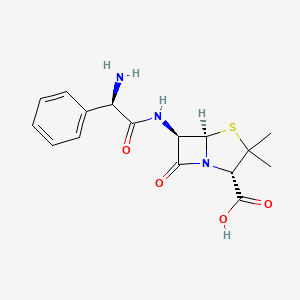
| Formula | C16H19N3O4S |
|---|---|
| Molecular weight | 349.41 g/mol |
| IUPAC name | (2S,5R,6R)-6-[[(2R)-2-amino-2-phenylacetyl]amino]-3,3-dimethyl-7-oxo-4-thia-1-azabicyclo[3.2.0]heptane-2-carboxylic acid |
| CAS | 69-53-4 |
| PubChem CID | 6249 |
| InChIKey | AVKUERGKIZMTKX-NJBDSQKTSA-N |
| logP | 0.32 (XLogP -1.1) |
| Polar surface area | 112.73 Ų |
| H-bond acceptors / donors | 5 / 3 |
| Drug-likeness (QED) | 0.67 |
| Lipinski violations | 0 |
SMILES
CC1(C)S[C@@H]2[C@H](NC(=O)[C@H](N)c3ccccc3)C(=O)N2[C@H]1C(=O)OBiology & Pharmacokinetics
Pharmacokinetics
| BBB penetrant | No |
|---|
Enzyme interactions
| Enzyme | Role | Detail |
|---|---|---|
| CYP2C19 | Substrate | — |
Transporters
BCRP (Inhibitor)BSEP (Inhibitor)MRP1 (Inhibitor)NTCP (Inhibitor)OATP1B1 (Inhibitor)OATP1B3 (Inhibitor)OATP1B3 (Inhibitor)OCT1 (Inhibitor)OCTN2 (Inhibitor)P-gp (Inhibitor)PEPT1 (Inhibitor)PEPT2 (Inhibitor)MRP2 (Substrate)P-gp (Substrate)
Drug–drug interactions (27, DDInter)
| Interacting drug | Severity | Management |
|---|---|---|
| Methotrexate | major | |
| Amikacin | moderate | |
| Balsalazide | moderate | |
| Chloramphenicol | moderate | |
| Chloroquine | moderate | |
| Demeclocycline | moderate | |
| Dexlansoprazole | moderate | |
| Dicoumarol | moderate | |
| Doxycycline | moderate | |
| Ethinylestradiol | moderate | |
| Gentamicin | moderate | |
| Iodide I-123 | moderate | |
| Iodide I-131 | moderate | |
| Kanamycin | moderate | |
| Lansoprazole | moderate | |
| Minocycline | moderate | |
| Mycophenolic acid | moderate | |
| Oxytetracycline | moderate | |
| Pemetrexed | moderate | |
| Picosulfuric acid | moderate | |
| Tetracycline | moderate | |
| Warfarin | moderate | |
| Clarithromycin | minor | |
| Clindamycin | minor | |
| Erythromycin | minor | |
| Heparin | minor | |
| Mefloquine | minor |
Registered Products (28)
| Brand | Form / strength | Pack | Agent | Citizen (JOD) |
|---|---|---|---|---|
| STANDACILLIN | Vial 0.5 g | 1 vial pack varies | Nabulsi Drug Store | 0.420 |
| Ampicillin | Vial 500 mg | 1 vial | moon light drugs store | 0.440 |
| Swisscillin | Vial 500 mg | 1 vial | مستودع ادوية أرغون | 0.440 |
| STANDACILLIN | Vial 1 g | 1 vial pack varies | Nabulsi Drug Store | 0.570 |
| Ampicillin | Vial 1 g | 1 vial | moon light drugs store | 0.590 |
| Swisscillin | Vial 1 g | 1 vial | مستودع ادوية أرغون | 0.710 |
| AMPIDAR FORTE G.F.SUSP. | Suspension 250 mg mg/5 ml | 100 ml | Dar Al Dawa Development and Investment Co Ltd/Jordan | 1.730 |
| AMPIDAR FORTE CAPS.500mg | Capsule 500 mg | 16 cap pack varies | Dar Al Dawa Development and Investment Co Ltd/Jordan | 1.770 |
| Ultracillin Forte Capsules | Capsule 500 mg | 2x8's pack varies | The Arab Pharmaceutical Manufactruing Co. | 1.770 |
| AMPIDAR FORTE CAPS.500mg | Capsule 500 mg | 20 cap pack varies | Dar Al Dawa Development and Investment Co Ltd/Jordan | 2.210 |
| Ultracillin Forte Capsules | Capsule 500 mg | 2x10 pack varies | The Arab Pharmaceutical Manufactruing Co. | 2.210 |
| PENCLODAR 500 CAPS. | Capsule 250 mg, 250 mg | 16 cap pack varies | Dar Al Dawa Development and Investment Co Ltd/Jordan | 2.340 |
| Ultracloxam | Tablet 250 mg, 250 mg | 2x8's | The Arab Pharmaceutical Manufactruing Co. | 2.600 |
| PENCLODAR 500 CAPS. | Capsule 250 mg, 250 mg | 20 cap pack varies | Dar Al Dawa Development and Investment Co Ltd/Jordan | 2.810 |
| Ampcare | Vial 500 mg | 10 vial | Oasis of Hope | 3.980 |
| PAMECIL VIAL | Vial 250 mg | 10 | Khoury Drug Store | 4.070 |
| Penbritin Caps. | Capsule 500 mg | 20 cap | Suleiman Tannous & Sons Co. Ltd | 4.080 |
| Pamecil Vial | Vial 500 mg | 10 vial pack varies | Al Hilal Drug Store | 7.090 |
| PAMECIL VIAL | Vial 1 g | 10 pack varies | Al Hilal Drug Store | 9.620 |
| PAMECIL CAP | Capsule 500 mg | 200 cap pack varies | Khoury Drug Store | 21.270 |
| PAMECIL CAP | Capsule 500 mg | 250 cap pack varies | Khoury Drug Store | 26.600 |
| AMPIDAR FORTE CAPS.500mg | Capsule 500 mg | 500 cap pack varies | Dar Al Dawa Development and Investment Co Ltd/Jordan | 35.700 |
| STANDACILLIN Vial | Vial 0.5 g | 100 vial pack varies | Nabulsi Drug Store | 37.700 |
| Ultracillin Forte Capsules | Capsule 500 mg | 500 cap pack varies | The Arab Pharmaceutical Manufactruing Co. | 46.900 |
| STANDACILLIN Vial | Vial 1 g | 100 pack varies | Nabulsi Drug Store | 51.000 |
| PENCLODAR 500 CAPS. | Capsule 250 mg, 250 mg | 500 cap pack varies | Dar Al Dawa Development and Investment Co Ltd/Jordan | 57.610 |
| Pamecil Vial | Vial 500 mg | 100 vial pack varies | Al Hilal Drug Store | 63.750 |
| PAMECIL VIAL | Vial 1 g | 100 vial pack varies | Al Hilal Drug Store | 86.590 |