Mycophenolic Acid
JFDA label: Myfortic Tab
- Experienced physician:
- Serious infections:
- Malignancies and serious infections:
- Embryo-fetal toxicity:
Mechanism of Action
Inhibitor of Inosine-5'-monophosphate dehydrogenase (IMPDH) — Inosine-5'-monophosphate dehydrogenase (IMPDH) inhibitor
| Target | Action | Gene / class |
|---|---|---|
| Inosine-5'-monophosphate dehydrogenase (IMPDH) efficacy | INHIBITOR |
Indications
Approved
- Organ transplantation
Off-label
- Acute graft-versus-host disease, refractory (treatment)
- Chronic graft-versus-host disease, refractory (treatment)
- Graft-versus-host disease (prevention)
- Hepatitis (autoimmune, refractory)
- Lupus nephritis
- Myasthenia gravis
- Psoriasis (moderate-to-severe)
- Rejection in heart transplant patients (recurrent or persistent)
- Rejection in liver transplant patients unable to tolerate tacrolimus or cyclosporine due to toxicity
- Systemic sclerosis (scleroderma)
Contraindications
Source: Lexicomp
- Additional contraindications (not in the US labeling): Pregnancy Absolute
- Hypersensitivity to mycophenolate mofetil, mycophenolic acid, mycophenolate sodium, or any component of the formulation Cellcept: Intravenous formulation is also contraindicated in patients who are allergic to polysorbate 80 Absolute
- breast-feeding Absolute
- women of childbearing potential and not using highly effective contraceptive methods Absolute
- women of childbearing potential not providing a pregnancy test result Absolute
Adverse Reactions
Cardiac disorders (6)
Very Common chest pain · edema · Hypertension · hypotension · peripheral edema · tachycardia
Nervous system disorders (24)
Very Common anxiety · dizziness · headache · insomnia · Pain · paresthesia
Common Abnormality in thinking · agitation · confusion · delirium · depression · drowsiness · emotional lability · hallucination · hypertonia · hypoesthesia · malaise · myasthenia · nervousness · neuropathy · psychosis · seizure · vertigo · voice disorder
Hepatobiliary disorders (9)
Very Common Abnormal hepatic function tests · ascites
Common Cholestatic jaundice · hepatic insuffiency · hepatitis · hyperbilirubinemia · increased serum alkaline phosphatase · increased serum transaminases · jaundice
Renal and urinary disorders (20)
Very Common increased blood urea nitrogen · Increased serum creatinine · renal function abnormality · Urinary tract infection
Common Dysuria · hematuria · Hydronephrosis · impotence · nocturia · oliguria · pelvic pain · prostatic disease · pyelonephritis · renal failure · renal tubular necrosis · scrotal edema · urinary frequency · urinary incontinence · urinary retention · urinary tract abnormality
Blood and lymphatic system disorders (17)
Very Common anemia · hypochromic anemia · leukocytosis · Leukopenia · thrombocytopenia
Common Blood coagulation disorder · bruise · hemophthalmos · hemorrhage · neoplasm · neutropenia · pancytopenia · petechia · polycythemia · prolonged partial thromboplastin time · prolonged prothrombin time · skin carcinoma
Metabolism and nutrition disorders (31)
Very Common hypercholesterolemia · Hyperglycemia · hyperkalemia · hypocalcemia · hypokalemia · hypomagnesemia · increased lactate dehydrogenase
Common Acidosis · albuminuria · alkalosis · Cushing's syndrome · dehydration · diabetes mellitus · gout · hirsutism · hypercalcemia · hyperlipidemia · hyperphosphatemia · hypervolemia · hypochloremia · hypoglycemia · hyponatremia · hypophosphatemia · hypoproteinemia · hypothyroidism · hypovolemia · increased gamma-glutamyl transferase · increased thirst · parathyroid disease · weight gain · weight loss
Gastrointestinal disorders (30)
Very Common Abdominal pain · anorexia · constipation · diarrhea · dyspepsia · nausea · vomiting
Common cholangitis · dysphagia · enlargement of abdomen · esophagitis · flatulence · gastric disease · gastric ulcer · gastritis · gastroenteritis · gastrointestinal hemorrhage · GI moniliasis · gingival hyperplasia · gingivitis · hernia · hiccups · intestinal obstruction · melena · Mucocutaneous candidiasis · oral candidiasis · oral mucosa ulcer · peritonitis · stomatitis · xerostomia
Skin and subcutaneous tissue disorders (11)
Very Common Skin rash
Common Acne vulgaris · alopecia · cellulitis · dermal ulcer · diaphoresis · fungal dermatitis · pallor · pruritus · skin hypertrophy · vesiculobullous dermatitis
Musculoskeletal and connective tissue disorders (9)
Very Common Back pain · tremor · weakness
Common Arthralgia · arthropathy · leg cramps · myalgia · neck pain · osteoporosis
Eye disorders (5)
Common Abnormal lacrimation · amblyopia · cataract · conjunctivitis · visual disturbance
Ear and labyrinth disorders (4)
Common Deafness · ear disease · otalgia · tinnitus
Infections and infestations (8)
Very Common candidiasis · herpes simplex infection · infection · Sepsis
Common abscess (local) · Cytomegalovirus disease · herpes zoster · infection (of ileus)
General disorders and administration site conditions (4)
Very Common Fever
Common Abnormal healing · cyst · fever and chills
Respiratory, thoracic and mediastinal disorders (24)
Very Common cough · Dyspnea · pleural effusion · pulmonary disease · respiratory tract infection · sinusitis
Common Apnea · asthma · atelectasis · bronchitis · epistaxis · flu-like symptoms · hemoptysis · hyperventilation · hypoxia · increased bronchial secretions · pharyngitis · pneumonia · pneumothorax · pulmonary edema · pulmonary hypertension · respiratory acidosis · respiratory tract infection (moniliasis) · rhinitis
Other (22)
Common Angina pectoris · arterial thrombosis · atrial fibrillation · atrial flutter · bradycardia · cardiac arrhythmia · cardiac failure · extrasystoles · facial edema · increased venous pressure · orthostatic hypotension · palpitations · pericardial effusion · peripheral vascular disorder · supraventricular extrasystole · supraventricular tachycardia · syncope · thrombosis · vasodilatation · vasospasm · ventricular premature contractions · ventricular tachycardia
Dosing
Source: Lexicomp
Warnings & Precautions
Source: Lexicomp
Infections
Risk for bacterial, viral, fungal, and protozoal infections, including opportunistic infections, is increased with immunosuppressant therapy; infections may be serious and potentially fatal. Due to the risk of oversuppression of the immune system, which may increase susceptibility to infection, combination immunosuppressant therapy should be used with caution.
New or reactivated viral infections
Polyomavirus associated nephropathy (PVAN), JC virus-associated progressive multifocal leukoencephalopathy (PML), cytomegalovirus (CMV) infections, and reactivation of hepatitis B (HBV) or hepatitis C (HCV) have been reported with use. A reduction in immunosuppression should be considered for patients with new or reactivated viral infections; however, in transplant recipients, the risk that reduced immunosuppression presents to the functioning graft should also be considered. PVAN, primarily from activation of BK virus, may lead to the deterioration of renal function and/or renal graft loss. PML, a potentially fatal condition, commonly presents with apathy, ataxia, cognitive deficiencies, confusion, and hemiparesis. Risk factors for development of PML include treatment with immunosuppressants and immune function impairment; consultation with a neurologist should be considered in any patient with neurological symptoms receiving immunosuppressants. Risk of CMV viremia or disease is increased in transplant recipients CMV seronegative at the time of transplant who receive a graft from a CMV seropositive donor; however, routine approaches to limiting CMV exist and should be utilized. In patients infected with HBV or HCV, viral reactivation may occur; these patients should be monitored for signs of active HBV or HCV.
Lymphoproliferative disorders
Risk of development of lymphoma and skin malignancy is increased. The risk for malignancies is related to intensity/duration of therapy. Patients should be monitored appropriately, instructed to limit exposure to sunlight/UV light to decrease the risk of skin cancer, and given supportive treatment should these conditions occur. Post-transplant lymphoproliferative disorder related to EBV infection has been reported in immunosuppressed organ transplant patients; risk is highest in EBV seronegative patients (including many young children).
Neutropenia
Neutropenia (including severe neutropenia) may occur, requiring dose reduction or interruption of treatment (risk greater from day 31-180 post-transplant).
Pure red cell aplasia (PRCA)
PRCA, a type of anemia which can range from subclinical to severe, has been reported in patients receiving mycophenolate concomitantly with other immunosuppressive agents (eg, tacrolimus, cyclosporine, corticosteroids). Symptoms may include fatigue, lethargy, or pallor. Although not precisely known, risk factors for the development of PRCA may include immunosuppression and treatment with immunosuppressant therapy. Dose reduction or discontinuation of immunosuppressive therapy may reverse PRCA; however, in transplant recipients, the risk of reduced immunosuppression and graft rejection should be considered. Disease-related concerns:
Gastrointestinal disorders
Use may rarely be associated with gastric or duodenal ulcers, GI bleeding and/or perforation. Use caution in patients with active serious digestive system disease; patients with active peptic ulcers were not included in clinical studies.
Hypoxanthine-guanine phosphoribosyltransferase deficiency
Theoretically, use should be avoided in patients with the rare hereditary deficiency of hypoxanthine-guanine phosphoribosyltransferase (such as Lesch-Nyhan or Kelley-Seegmiller syndrome).
Renal impairment
Use with caution in patients with renal impairment as toxicity may be increased; may require dosage adjustment in severe impairment. Concurrent drug therapy issues:
Drug-drug interactions
Potentially significant interactions may exist, requiring dose or frequency adjustment, additional monitoring, and/or selection of alternative therapy. Consult drug interactions database for more detailed information. Dosage form specific issues:
Non-interchangeability of dosage forms
Mycophenolate sodium and mycophenolate mofetil should not be used interchangeably without health care provider supervision because the rate of absorption following the administration of these two products is not equivalent. Single dose pharmacokinetic studies in adult renal transplant patients suggest that bioavailability is similar between oral mycophenolate mofetil (1,000 mg) and delayed release mycophenolic acid (720 mg) (Arns 2005). In clinical trials, comparative efficacy and safety profiles have been observed in adult renal transplant patients randomized to either oral mycophenolate mofetil (1,000 mg twice daily) or delayed release mycophenolic acid (720 mg twice daily) (Budde, 2004; 2003).
Phenylalanine
Some dosage forms may contain phenylalanine.
Polysorbate 80
Some dosage forms may contain polysorbate 80 (also known as Tweens). Hypersensitivity reactions, usually a delayed reaction, have been reported following exposure to pharmaceutical products containing polysorbate 80 in certain individuals (Isaksson, 2002; Lucente 2000; Shelley, 1995). Thrombocytopenia, ascites, pulmonary deterioration, and renal and hepatic failure have been reported in premature neonates after receiving parenteral products containing polysorbate 80 (Alade, 1986; CDC, 1984). See manufacturer’s labeling. Special populations:
Pregnancy
Mycophenolate is associated with an increased risk of congenital malformations and first trimester pregnancy loss when used by pregnant women. Females of reproductive potential must be counseled about pregnancy prevention and planning. Alternative agents should be considered for women planning a pregnancy. Females of reproductive potential should have a negative pregnancy test with a sensitivity of ≥25 milliunits/mL immediately before therapy and the test should be repeated 8-10 days later. Pregnancy tests should be repeated during routine follow-up visits. Acceptable forms of contraception should be used during treatment and for 6 weeks after therapy is discontinued. Other warnings/precautions:
Experienced physician
Should be administered under the supervision of a physician experienced in immunosuppressive therapy.
Immunizations
Live attenuated vaccines should be avoided during use; vaccinations may be less effective during therapy.
IV administration
Intravenous solutions should be given over at least 2 hours; never administer intravenous solution by rapid or bolus injection.
Pregnancy & Lactation
Pregnancy
[US Boxed Warning]: Mycophenolate is associated with an increased risk of congenital malformations and first trimester pregnancy loss when used by pregnant women. Females of reproductive potential must be counseled about pregnancy prevention and planning. Alternative agents with less potential for embryofetal toxicity should be considered for women planning a pregnancy. The following congenital malformations have been reported following exposure during pregnancy: External ear abnormalities, cleft lip and palate, anomalies of the distal limbs, heart, esophagus, kidney, and nervous system. The combination of ear, eye, and lip/palate abnormalities has been identified as mycophenolate embryopathy (Perez-Aytes 2017). Spontaneous abortions have also been noted. Females of reproductive potential (girls who have entered puberty and women with a uterus who have not passed through clinically confirmed menopause) should have a negative pregnancy test with a sensitivity of ≥25 milliunits/mL imme
Lactation
It is not known if mycophenolate is present in human milk. Due to the potential for serious adverse reactions in the breastfed infant, the manufacturer recommends a decision be made whether to discontinue breastfeeding or to discontinue the drug (during therapy or within 6 weeks after treatment is complete), taking into account the importance of treatment to the mother.
Monitoring
| Clinical pearl | Complete blood count (weekly for first month, twice monthly during months 2 and 3, then monthly thereafter through the first year); renal and liver function; signs and symptoms of organ rejection; signs and symptoms of bacterial, fungal, protozoal, new or reactivated viral, or opportunistic infections; neurological symptoms (eg, hemiparesis, confusion, cognitive deficiencies, ataxia) suggestive of PML, pregnancy test (sensitivity of ≥25 milliunits/mL; immediately prior to initiation and 8 to 10 days later in females of childbearing potential, followed by repeat tests during therapy); monitor skin (for lesions suspicious of skin cancer); monitor for signs of lymphoma |
|---|
Chemistry & Properties
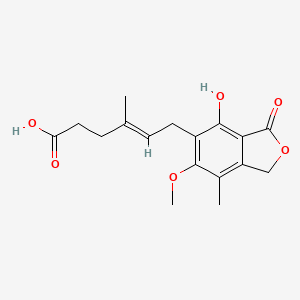
| Formula | C17H20O6 |
|---|---|
| Molecular weight | 320.34 g/mol |
| IUPAC name | (E)-6-(4-hydroxy-6-methoxy-7-methyl-3-oxo-1H-2-benzofuran-5-yl)-4-methylhex-4-enoic acid |
| CAS | 24280-93-1 |
| PubChem CID | 446541 |
| InChIKey | HPNSFSBZBAHARI-RUDMXATFSA-N |
| logP | 2.73 (XLogP 3.2) |
| Polar surface area | 93.06 Ų |
| H-bond acceptors / donors | 5 / 2 |
| Drug-likeness (QED) | 0.62 |
| Lipinski violations | 0 |
SMILES
COc1c(C)c2c(c(O)c1C/C=C(\C)CCC(=O)O)C(=O)OC2Biology & Pharmacokinetics
Pharmacokinetics
| BBB penetrant | No |
|---|
Enzyme interactions
| Enzyme | Role | Detail |
|---|---|---|
| CYP2C8 | Inhibitor | — |
| CYP2C9 | Substrate | — |
| CYP3A4 | Substrate | — |
Receptor binding (top 2)
| Target | Action | Affinity |
|---|---|---|
| inosine monophosphate dehydrogenase 1 (IMPDH1) | Inhibitor | pIC50 7.7 |
| inosine monophosphate dehydrogenase 2 (IMPDH2) | Inhibitor | pIC50 7.7 |
Transporters
BCRP (Inhibitor)BSEP (Inhibitor)MRP1 (Inhibitor)OAT1 (Inhibitor)OAT3 (Inhibitor)OATP1B1 (Inhibitor)OATP1B1 (Inhibitor)OATP1B3 (Inhibitor)OATP1B3 (Inhibitor)P-gp (Inhibitor)MDR1 (Substrate)MRP2 (Substrate)OAT3 (Substrate)P-gp (Substrate)Transporter(unspecified) (Substrate)
Drug–drug interactions (100+, DDInter)
| Interacting drug | Severity | Management |
|---|---|---|
| Activated charcoal | major | |
| Adalimumab | major | |
| Bacillus calmette-guerin substrain tice live antigen | major | |
| Baricitinib | major | |
| Certolizumab pegol | major | |
| Cholestyramine | major | |
| Cladribine | major | |
| Colesevelam | major | |
| Colestipol | major | |
| Deferiprone | major | |
| Dienogest | major | |
| Drospirenone | major | |
| Etanercept | major | |
| Ethinylestradiol | major | |
| Etonogestrel | major | |
| Fingolimod | major | |
| Golimumab | major | |
| Infliximab | major | |
| Leflunomide | major | |
| Levonorgestrel | major | |
| Measles virus vaccine live attenuated | major | |
| Medroxyprogesterone acetate | major | |
| Mestranol | major | |
| Mumps virus strain B level jeryl lynn live antigen | major | |
| Natalizumab | major | |
| Norethisterone | major | |
| Norgestimate | major | |
| Norgestrel | major | |
| Ozanimod | major | |
| Rifampicin | major | |
| Rotavirus vaccine | major | |
| Rubella virus vaccine | major | |
| Siponimod | major | |
| Smallpox (Vaccinia) Vaccine, Live | major | |
| Talimogene laherparepvec | major | |
| Teriflunomide | major | |
| Tofacitinib | major | |
| Typhoid vaccine (live) | major | |
| Upadacitinib | major | |
| Varicella Zoster Vaccine (Recombinant) | major |
Showing 40 of 100+.
Registered Products (2)
| Brand | Form / strength | Pack | Agent | Citizen (JOD) |
|---|---|---|---|---|
| Mycophenolic Acid Accord 360mg Gastro-Resistant Tablets | Tablet 360 mg | 120 tab | شركة مستودع ادوية جرينلاند | 126.060 |
| Myfortic Tab | Tablet 360 mg | 120 tab | The Jordan Drugstore Co | — |