Etonogestrel
JFDA label: Implanon NXT
Mechanism of Action
Agonist of Progesterone receptor — Progesterone receptor agonist
| Target | Action | Gene / class |
|---|---|---|
| Progesterone receptor efficacy | AGONIST | PGR |
Indications
Approved
- Contraception
Contraindications
Source: Lexicomp
- Hypersensitivity to etonogestrel or any component of the formulation Absolute
- breast cancer (known, suspected, or personal history of) Absolute
- hepatic tumors (benign or malignant) or active hepatic disease Absolute
- pregnancy (known or suspected) Absolute
- progestin-sensitive cancer (current or a history of) Absolute
- thrombosis or thromboembolic disorders (current or history of) Absolute
- undiagnosed abnormal genital bleeding. Documentation of allergenic cross-reactivity for progestins is limited. However, because of similarities in chemical structure and/or pharmacologic actions, the possibility of cross-sensitivity cannot be ruled out with certainty Absolute
Adverse Reactions
Nervous system disorders (6)
Very Common Headache
Common depression · Dizziness · emotional lability · nervousness · pain
Renal and urinary disorders (3)
Very Common mastalgia · Vaginitis
Common Leukorrhea
Immune system disorders (1)
Common Hypersensitivity reaction
Metabolism and nutrition disorders (4)
Very Common amenorrhea · Menstrual disease · weight gain
Common Dysmenorrhea
Gastrointestinal disorders (2)
Very Common Abdominal pain
Common Nausea
Skin and subcutaneous tissue disorders (2)
Very Common Acne vulgaris
Common Localized erythema
Musculoskeletal and connective tissue disorders (1)
Common Back pain
General disorders and administration site conditions (4)
Common Application site reaction · bruising at injection site · hematoma at injection site · local pain
Respiratory, thoracic and mediastinal disorders (2)
Very Common Pharyngitis
Common Flu-like symptoms
Dosing
Source: Lexicomp
Warnings & Precautions
Source: Lexicomp
Breast cancer
Breast cancer is a hormonal sensitive tumor and the prognosis for women with current or a recent history of breast cancer may be worse with progestin only contraceptive use (Curtis 2016a). Use is contraindicated in women with (or history of) breast cancer.
Ectopic pregnancy
Ectopic pregnancy (rare) may occur more commonly than in women using no contraception.
Ovarian cysts
Follicular development may occur and may continue to increase in size beyond what may occur in a normal cycle; generally, ovarian cysts resolve spontaneously without intervention; however, surgery may rarely be required.
Retinal vascular thrombosis
Discontinue if unexplained loss of vision, proptosis, diplopia, papilledema, or retinal vascular lesions occur and immediately evaluate for retinal vein thrombosis.
Thromboembolism
Combination hormonal contraceptives may increase the risk of thromboembolism and other vascular events (eg, deep vein thrombosis [DVT], myocardial infarction [MI], pulmonary embolism [PE]). Women with inherited thrombophilias (eg, protein C or S deficiency) may have increased risk of venous thromboembolism when using combination hormonal contraceptives (DeSancho 2010; van Vlijmen 2011). The risk of DVT/PE is expected to be less with progestin only contraceptives than that observed with combination hormonal contraceptives (Curtis 2016b). Use of etonogestrel is contraindicated in women with thrombosis or thromboembolic disorders (current or history of).
Vaginal bleeding
Changes in bleeding patterns are likely to occur. Presentation of undiagnosed, persistent, or recurrent abnormal vaginal bleeding warrants further evaluation to rule out malignancy.
Weight gain
Use commonly results in an average weight gain of ~2.8 pounds after 1 year and ~3.7 pounds after 2 years of treatment. Disease-related concerns:
Cardiovascular disease
Use with caution in patients with risk factors for cardiovascular disease (eg, hypertension, hypercholesterolemia, morbid obesity, diabetes, women who smoke) (Curtis 2016b)
Diabetes
May impair glucose tolerance; use caution in women with diabetes or prediabetes.
Diseases exacerbated by fluid retention
Use with caution in patients with diseases that may be exacerbated by fluid retention.
Gallbladder disease
Use of combination hormonal contraceptives may have an increased risk of developing gallbladder disease; it is not known if this risk increases with progestin only products.
Hepatic adenomas or carcinomas
Use of combination hormonal contraceptives is associated with hepatic adenomas (rare). The risk with progestin only contraceptives is not known. Etonogestrel is contraindicated with preexisting hepatic tumors.
Hepatic impairment
May be poorly metabolized in women with hepatic impairment. Discontinue if jaundice develops during therapy or if liver function becomes abnormal. Use is contraindicated in hepatic disease.
Hyperlipidemia
Use caution in patients treated for hyperlipidemia; progestins may increase low-density lipoprotein (LDL) concentrations.
Hypertension
According to the manufacturer, women with a history of hypertension-related diseases should be encouraged to use a nonhormonal form of contraception. In women with hypertension that is well-controlled, use may be considered; monitor blood pressure closely. If sustained hypertension develops during use, or if a significant increase in blood pressure does not respond adequately to antihypertensive therapy, remove the implant. Women with adequately controlled hypertension may use progestin only implants; other risk factors for cardiovascular disease (such as older age, smoking, diabetes) should be considered when prescribing (Curtis 2016b).
Renal impairment
Women with renal disease should be encouraged to use a nonhormonal form of contraception. Concurrent drug therapy issues:
Drug-drug interactions
Potentially significant interactions may exist, requiring dose or frequency adjustment, additional monitoring, and/or selection of alternative therapy. Consult drug interactions database for more detailed information. Special populations:
Contact lens wearers
Any changes with lens tolerance or vision should be evaluated by an ophthalmologist.
Obese
Use with caution in overweight women (may be less effective, especially in the presence of other risk factors); women >130% of ideal body weight were not included in clinical studies. However, contraceptive failure was not observed in obese women in a prospective study (Xu 2012). Progestin only implants may be used in women with a body mass index (BMI) ≥30 kg/m2 (Curtis 2016b).
Pediatric
Not for use prior to menarche.
Surgical patients
Consider removal during periods of prolonged immobilization due to surgery or illness. Dosage form specific issues:
Implant
Broken or bent implants while in the patient's arm have been reported; the release rate of etonogestrel may be slightly increased. Ensure implant is removed in its entirety. Other warnings/precautions:
Appropriate use
For use in women who request long-acting (up to 3 years) contraception. Insertion/removal should be done by a trained health care provider and implant must be palpable after insertion. Complications may occur from insertion and removal procedures, or inserting the implant too deep. Treatment should be instituted for infection at the insertion site; if infection persists, the implant should be removed. Expulsion may occur following incomplete insertion or infection. The implant must be removed by the end of the third year.
Cervical cancer
The use of combination hormonal contraceptives has been associated with a slight increased risk of cervical cancer; however, studies are not consistent and may be related to additional risk factors (Gierisch 2013). Women awaiting treatment for cervical or ovarian cancer may use progestin only contraceptives (Curtis 2016b).
HIV infection protection
Use does not protect against HIV infection or other sexually transmitted diseases (Curtis 2016a; Curtis 2016b).
Laboratory changes
The use of estrogens and/or progestins may change the results of some laboratory tests (eg, coagulation factors, lipids, glucose tolerance, binding proteins). The dose, route, and the specific estrogen/progestin influences these changes. In addition, personal risk factors (eg, cardiovascular disease, smoking, diabetes, age) also contribute to adverse events; use of specific products may be contraindicated in women with certain risk factors.
Pregnancy & Lactation
Pregnancy
Use is contraindicated in pregnant women. Pregnancy status should be evaluated prior to prescribing and implant should be removed if pregnancy occurs. In general, the use of combination hormonal contraceptives, when inadvertently used early in pregnancy, have not been associated with teratogenic effects. There is no evidence that the risk is different with etonogestrel. Due to the risk of thromboembolism, the manufacturer does not recommend insertion Etonogestrel serum concentrations decrease by 1 week after removal of the implant; pregnancies have been reported as early as 7 to 14 days after removal. Restart contraception immediately after removal if continued contraception is desired.
Lactation
Etonogestrel is present in breast milk. Etonogestrel was not found to affect the quality or quantity of breast milk. Concentrations of etonogestrel are highest during the first month following insertion (~2.2% of the weight-adjusted maternal daily dose). Breastfed infants of mothers with an etonogestrel implant were not found to have adverse physical or psychomotor development in comparison to those infants of mothers using nonhormonal contraception. According to the manufacturer, the decision
Monitoring
| Clinical pearl | Assessment of pregnancy status (prior to therapy); weight (optional; body mass index [BMI] at baseline may be helpful to monitor changes during therapy); assess potential health status changes at routine visits (Curtis 2016a). Monitor patient for vision changes; blood pressure; signs and symptoms of thromboembolic disorders; signs or symptoms of depression; glycemic control in patients with diabetes; lipid profiles in patients being treated for hyperlipidemias. Bleeding irregularities including amenorrhea; adequate diagnostic measures should be performed to rule out malignancy in all cases of undiagnosed abnormal vaginal bleeding. |
|---|
Chemistry & Properties
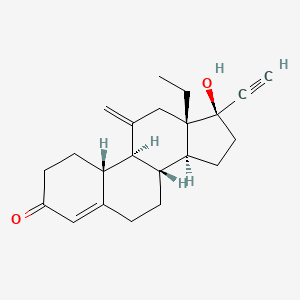
| Formula | C22H28O2 |
|---|---|
| Molecular weight | 324.46 g/mol |
| IUPAC name | (8S,9S,10R,13S,14S,17R)-13-ethyl-17-ethynyl-17-hydroxy-11-methylidene-2,6,7,8,9,10,12,14,15,16-decahydro-1H-cyclopenta[a]phenanthren-3-one |
| CAS | 54048-10-1 |
| PubChem CID | 6917715 |
| InChIKey | GCKFUYQCUCGESZ-BPIQYHPVSA-N |
| logP | 4.05 (XLogP 3.3) |
| Polar surface area | 37.3 Ų |
| H-bond acceptors / donors | 2 / 1 |
| Drug-likeness (QED) | 0.58 |
| Lipinski violations | 0 |
SMILES
C#C[C@]1(O)CC[C@H]2[C@@H]3CCC4=CC(=O)CC[C@@H]4[C@H]3C(=C)C[C@@]21CCBiology & Pharmacokinetics
Pharmacokinetics predicted
| Bioavailability | 70.0% |
|---|---|
| Half-life | 2.58 h |
| Volume of distribution | 2.894 L/kg |
| Protein binding | 96.9% |
| BBB penetrant | No |
Enzyme interactions
| Enzyme | Role | Detail |
|---|---|---|
| CYP2B6 | Inhibitor | — |
| CYP2C19 | Inhibitor | — |
| CYP2C19 | Substrate | — |
| CYP2C8 | Inhibitor | — |
| CYP3A4 | Substrate | — |
Transporters
BCRP (Inhibitor)BSEP (Inhibitor)MRP1 (Inhibitor)OATP1B1 (Inhibitor)OATP1B3 (Inhibitor)P-gp (Inhibitor)P-gp (Substrate)
Drug–drug interactions (100+, DDInter)
| Interacting drug | Severity | Management |
|---|---|---|
| Acitretin | major | |
| Bexarotene | major | |
| Brigatinib | major | |
| Carfilzomib | major | |
| Dabrafenib | major | |
| Encorafenib | major | |
| Griseofulvin | major | |
| Lumacaftor | major | |
| Mycophenolic acid | major | |
| Sugammadex | major | |
| Tranexamic acid | major | |
| Acarbose | moderate | |
| Acetohexamide | moderate | |
| Adalimumab | moderate | |
| Albiglutide | moderate | |
| Alefacept | moderate | |
| Alogliptin | moderate | |
| Aminoglutethimide | moderate | |
| Aminophylline | moderate | |
| Anakinra | moderate | |
| Apalutamide | moderate | |
| Aprepitant | moderate | |
| Artemether | moderate | |
| Canagliflozin | moderate | |
| Canakinumab | moderate | |
| Certolizumab pegol | moderate | |
| Chlorpropamide | moderate | |
| Cladribine | moderate | |
| Clarithromycin | moderate | |
| Clotrimazole | moderate | |
| Cobicistat | moderate | |
| Cyclosporine | moderate | |
| Dapagliflozin | moderate | |
| Dasatinib | moderate | |
| Deferasirox | moderate | |
| Dulaglutide | moderate | |
| Elagolix | moderate | |
| Emapalumab | moderate | |
| Empagliflozin | moderate | |
| Enasidenib | moderate |
Showing 40 of 100+.
Registered Products (3)
| Brand | Form / strength | Pack | Agent | Citizen (JOD) |
|---|---|---|---|---|
| Ornibel | Implant 0.015 mg, 0.120 mg | 1 Ring | Nairoukh Drug Store | 6.740 |
| Nuvaring Vaginal Ring | Vaginal 2.7 mg, 11.7 mg | 1 sachet | Sabbagh Drug Store | 9.480 |
| Implanon NXT | Implant 68 mg | 1 App containing 1 Implant | Sabbagh Drug Store | 108.300 |