Apalutamide
JFDA label: Erleada
Mechanism of Action
Antagonist of Androgen receptor — Androgen Receptor antagonist
| Target | Action | Gene / class |
|---|---|---|
| Androgen receptor efficacy | ANTAGONIST | AR |
Indications
Approved
- Prostate cancer, non-metastatic, castration-resistant
Adverse Reactions
Cardiac disorders (4)
Very Common Hypertension · peripheral edema
Common cardiac failure · Ischemic heart disease
Nervous system disorders (2)
Very Common falling · Fatigue
Blood and lymphatic system disorders (1)
Very Common Anemia, bone fracture
Metabolism and nutrition disorders (8)
Very Common hot flash · Hypercholesterolemia · hyperglycemia · hyperkalemia · hypertriglyceridemia · increased thyroid stimulating hormone level · weight loss
Common Hypothyroidism
Gastrointestinal disorders (3)
Very Common decreased appetite · Diarrhea · nausea
Skin and subcutaneous tissue disorders (2)
Very Common Skin rash
Common Pruritus
Dosing
Source: Lexicomp
Warnings & Precautions
Source: Lexicomp
Dermatologic toxicity
Rashes (usually macular or maculo-papular) were reported in nearly one-fourth of patients who received apalutamide; including some that were grade 3 or 4. Rash onset usually occurred at median of 82 days and typically resolved within a median of 60 days in most patients. Some patients required systemic corticosteroids to manage rash. Rash recurred in approximately half of patients who were re-challenged with apalutamide.
Falls/fractures
Fall and fractures have occurred in patients receiving apalutamide. Grade 3 or 4 fractures have been reported. In a clinical study, the median time to onset of fracture was ~10 months (range: ~0.6 to 32 months); the study did not perform routine bone density assessments or osteoporosis treatment with bone modifying agents. Evaluate patients for fall and fracture risk. Patients at risk for fractures should be monitored and managed according to established management guidelines. Consider the use of bone modifying agents.
QT prolongation
Based on exposure-QT analysis in an uncontrolled, single-arm dedicated QTc interval assessment study, a concentration-dependent increase in QTcF was noted with apalutamide (and the active metabolite). The maximum mean QTcF change from baseline was 12.4 msec.
Seizures
Seizures occurred in patients receiving apalutamide. It is not known if antiepileptic medications can prevent apalutamide-related seizures. In a clinical study, a small number of patients experienced seizures, with the onset occurring from ~12 months to 16 months after treatment initiation. Patients with a history of seizure, predisposing factors for seizure, or receiving medications known to reduce seizure threshold or to induce seizures were excluded from the study. There is no experience in reinitiating apalutamide in patients who experienced a seizure. Advise patients of the risk of seizures during apalutamide treatment and of the risk of engaging in activities where sudden loss of consciousness could cause serious harm to themselves or others. Discontinue apalutamide permanently if seizures develop during treatment.
Thyroid dysfunction
Hypothyroidism and elevated thyroid stimulating hormone (TSH) have been reported with apalutamide; the median onset was ~4 months (there were no grade 3 or 4 hypothyroid events). Thyroid replacement therapy was initiated in some patients; if clinically indicated, thyroid replacement therapy should be initiated and/or dose-adjusted. Disease-related concerns:
Cardiovascular disease
Androgen-deprivation therapy may increase the risk for cardiovascular disease (Levine 2010). Concurrent drug therapy issues:
Drug-drug interactions
Potentially significant interactions may exist, requiring dose or frequency adjustment, additional monitoring, and/or selection of alternative therapy. Consult drug interactions database for more detailed information.
Pregnancy & Lactation
Pregnancy
Use is contraindicated during pregnancy. Animal reproduction studies have not been conducted. Based on the mechanism of action, apalutamide may cause fetal harm if administered during pregnancy. Males with female partners of reproductive potential should use effective contraception during therapy and for 3 months after the last apalutamide dose. Apalutamide may impair fertility in males of reproductive potential (based on findings in animal studies).
Lactation
It is not known if apalutamide is present in breast milk. Apalutamide is not approved for use in females.
Monitoring
| Clinical pearl | Monitor thyroid function (eg, TSH) as clinically necessary. Monitor for signs/symptoms of seizure and dermatologic toxicity. Assess for fall and fracture risk. Monitor adherence. |
|---|
Chemistry & Properties
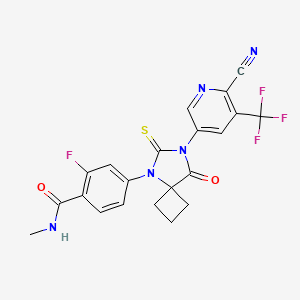
| Formula | C21H15F4N5O2S |
|---|---|
| Molecular weight | 477.44 g/mol |
| IUPAC name | 4-[7-[6-cyano-5-(trifluoromethyl)-3-pyridinyl]-8-oxo-6-sulfanylidene-5,7-diazaspiro[3.4]octan-5-yl]-2-fluoro-N-methylbenzamide |
| CAS | 956104-40-8 |
| PubChem CID | 24872560 |
| InChIKey | HJBWBFZLDZWPHF-UHFFFAOYSA-N |
| logP | 3.53 (XLogP 3.0) |
| Polar surface area | 89.33 Ų |
| H-bond acceptors / donors | 5 / 1 |
| Drug-likeness (QED) | 0.54 |
| Lipinski violations | 0 |
SMILES
CNC(=O)c1ccc(N2C(=S)N(c3cnc(C#N)c(C(F)(F)F)c3)C(=O)C23CCC3)cc1FBiology & Pharmacokinetics
Pharmacokinetics predicted
| Bioavailability | 10.0% |
|---|---|
| Half-life | 1.179 h |
| Volume of distribution | 3.11 L/kg |
| Protein binding | 95.7% |
| BBB penetrant | No |
Enzyme interactions
| Enzyme | Role | Detail |
|---|---|---|
| CYP1A2 | Substrate | — |
| CYP2C19 | Inhibitor | — |
| CYP2C8 | Inhibitor | — |
| CYP3A4 | Substrate | — |
Receptor binding (top 1)
| Target | Action | Affinity |
|---|---|---|
| Androgen receptor (AR) | Antagonist | pIC50 6.7 |
Transporters
BCRP (Inhibitor)BSEP (Inhibitor)MATE1 (Inhibitor)MATE2 (Inhibitor)MRP1 (Inhibitor)OAT3 (Inhibitor)OATP1B1 (Inhibitor)OATP1B3 (Inhibitor)OCT2 (Inhibitor)P-gp (Inhibitor)P-gp (Substrate)
Drug–drug interactions (100+, DDInter)
| Interacting drug | Severity | Management |
|---|---|---|
| Abemaciclib | major | |
| Abiraterone | major | |
| Acalabrutinib | major | |
| Alpelisib | major | |
| Amiodarone | major | |
| Amisulpride | major | |
| Amlodipine | major | |
| Anagrelide | major | |
| Apixaban | major | |
| Apremilast | major | |
| Arsenic trioxide | major | |
| Artemether | major | |
| Avapritinib | major | |
| Axitinib | major | |
| Bedaquiline | major | |
| Benzhydrocodone | major | |
| Bepridil | major | |
| Bictegravir | major | |
| Boceprevir | major | |
| Bortezomib | major | |
| Bosutinib | major | |
| Brigatinib | major | |
| Bupropion | major | |
| Buspirone | major | |
| Butorphanol | major | |
| Cabozantinib | major | |
| Capmatinib | major | |
| Ceritinib | major | |
| Cisapride | major | |
| Citalopram | major | |
| Clozapine | major | |
| Cobicistat | major | |
| Cobimetinib | major | |
| Copanlisib | major | |
| Crizotinib | major | |
| Daclatasvir | major | |
| Darolutamide | major | |
| Dasatinib | major | |
| Deflazacort | major | |
| Delavirdine | major |
Showing 40 of 100+.
Registered Products (1)
| Brand | Form / strength | Pack | Agent | Citizen (JOD) |
|---|---|---|---|---|
| Erleada | Tablet 60 mg | 120 tab | Adatco Drug Store | — |