Bosutinib
JFDA label: Volopem
Mechanism of Action
Inhibitor of Tyrosine-protein kinase ABL1 — Tyrosine-protein kinase ABL inhibitor; Inhibitor of Proto-oncogene tyrosine-protein kinase Src — Tyrosine-protein kinase SRC inhibitor; Inhibitor of Tyrosine-protein kinase HCK — Tyrosine-protein kinase HCK inhibitor; Inhibitor of Tyrosine-protein kinase Lyn — Tyrosine-protein kinase Lyn inhibitor
| Target | Action | Gene / class |
|---|---|---|
| Proto-oncogene tyrosine-protein kinase Src efficacy | INHIBITOR | SRC |
| Tyrosine-protein kinase ABL1 efficacy | INHIBITOR | ABL1 |
| Tyrosine-protein kinase HCK efficacy | INHIBITOR | HCK |
| Tyrosine-protein kinase Lyn efficacy | INHIBITOR | LYN |
Indications
Approved
- Chronic myelogenous leukemia
Contraindications
Source: Lexicomp
- Additional contraindications (not in the US labeling): History of long QT syndrome or with persistent QT interval >480 milliseconds Absolute
- Hypersensitivity to bosutinib or any component of the formulation Absolute
- hepatic impairment Absolute
- uncorrected hypokalemia or hypomagnesemia Absolute
Adverse Reactions
Cardiac disorders (5)
Very Common chest pain · Edema
Common Hypertension · pericardial effusion · prolonged Q-T interval on ECG
Nervous system disorders (4)
Very Common dizziness · Fatigue · headache
Common Pain
Hepatobiliary disorders (7)
Very Common abnormal hepatic function tests · Increased serum ALT · increased serum AST
Common Hepatic injury · hepatic insufficiency · hepatotoxicity · increased serum bilirubin
Renal and urinary disorders (4)
Very Common Renal insufficiency
Common acute renal failure · Increased serum creatinine · renal failure
Blood and lymphatic system disorders (5)
Very Common anemia · leukopenia · neutropenia · Thrombocytopenia
Common Febrile neutropenia
Metabolism and nutrition disorders (6)
Very Common hypokalemia · Hypophosphatemia
Common dehydration · Fluid retention · hyperkalemia · increased gamma-glutamyl transferase
Gastrointestinal disorders (10)
Very Common abdominal pain · decreased appetite · Diarrhea · increased serum lipase · nausea · vomiting
Common Dysgeusia · gastritis · gastrointestinal hemorrhage · increased serum amylase
Skin and subcutaneous tissue disorders (3)
Very Common pruritus · Skin rash
Common Urticaria
Musculoskeletal and connective tissue disorders (5)
Very Common Arthralgia · back pain · weakness
Common Increased creatine phosphokinase · myalgia
Ear and labyrinth disorders (1)
Common Tinnitus
Infections and infestations (1)
Common Influenza
General disorders and administration site conditions (1)
Very Common Fever
Respiratory, thoracic and mediastinal disorders (7)
Very Common cough · dyspnea · nasopharyngitis · pleural effusion · Respiratory tract infection
Common Bronchitis · pneumonia
Other (1)
Not Known Genitourinary: Decreased estimated GFR (eGFR)
Dosing
Source: Lexicomp
Warnings & Precautions
Source: Lexicomp
Bone marrow suppression
Anemia, neutropenia, and thrombocytopenia may occur. May require treatment interruption, dose reduction, or discontinuation. Monitor blood counts weekly during first month, then monthly thereafter (or as clinically indicated).
Fluid retention/edema
Fluid retention, manifesting as pericardial effusion, pleural effusion, pulmonary edema and/or peripheral edema may occur; may be severe. Monitor for fluid retention (eg, weight gain) and manage appropriately; may require treatment interruption, dose reduction, or discontinuation.
GI toxicity
Diarrhea, nausea, vomiting, and abdominal pain may occur. Monitor; may require treatment interruption, dose reduction, discontinuation, or other management (eg, medications or fluids). For patients experiencing diarrhea (all grades), the median time to onset in patients with CML resistant or intolerant to prior therapy was 2 days; median duration (per event) was 2 days and the median number of diarrhea episodes per patient was 3 (range: 1 to 268); manage diarrhea with antidiarrheals and/or fluid replacement. Similarly, the median time to onset for diarrhea (all grades) in patients with newly-diagnosed CML was 3 days; the median duration per events was 3 days. Bosutinib is associated with a moderate emetic potential (Hesketh 2017; Roila 2016); nausea and vomiting may be managed with antiemetics and fluid replacement. GI hemorrhages have also been reported.
Hepatotoxicity
Serum transaminase (ALT and/or AST) elevations have been reported. In patients with transaminase elevation, ~80% developed the transaminase elevation within the first 3 months of therapy. In a clinical study in patients with newly-diagnosed chronic phase CML, the median time to onset of elevated ALT and AST was 32 and 43 days, respectively; the median duration was 20 and 15 days, respectively. In patients with CML resistant or intolerant to prior therapy, the mediation time to onset of ALT and AST elevation was 35 and 33 days, respectively, and the median duration (for each) was 21 days. One case of drug-induced liver injury has been reported in a breast cancer clinical trial (not an approved indication); full recovery occurred after discontinuation. Monitor transaminases monthly for the first 3 months (and as clinically indicated; monitor more frequently if elevations occur). May require therapy interruption, dosage reduction, or therapy discontinuation.
Hypersensitivity
Hypersensitivity reactions have been reported, including anaphylaxis and anaphylactic shock (rare).
Pancreatitis
Acute pancreatitis has been reported (rare); use caution in patients with a prior history of pancreatitis.
QT prolongation
QTcF >500 milliseconds was observed rarely in clinical trials (Cortes 2012); patients with significant or uncontrolled cardiovascular disease (including prolonged QT interval at baseline) were not studied.
Renal toxicity
Declines in glomerular filtration rates throughout bosutinib treatment have been observed in clinical studies; monitor renal function at baseline and during therapy, particularly in patients with preexisting impairment or other risk factors for renal dysfunction. Consider dosage adjustment in patients with renal dysfunction at baseline or with treatment emergent impairment. Disease-related concerns:
Hepatic impairment
Bosutinib exposure is increased in patients with hepatic impairment; dose reduction is recommended.
Renal impairment
Bosutinib exposure is increased in patients with moderate or severe renal impairment. Consider dosage adjustment in patients with renal dysfunction at baseline or with treatment emergent impairment. Concurrent drug therapy issues:
Drug-drug interactions
Potentially significant interactions may exist, requiring dose or frequency adjustment, additional monitoring, and/or selection of alternative therapy. Consult drug interactions database for more detailed information.
Gastrointestinal medications
Proton pump inhibitors (PPIs) may decrease bosutinib effects; consider using short acting antacids or H2 antagonists instead of PPIs. Separate administration of antacids or H2 antagonists from bosutinib by at least 2 hours.
Pregnancy & Lactation
Pregnancy
Based on data from animal reproduction studies and the mechanism of action, bosutinib may cause fetal harm if administered in pregnancy. Verify pregnancy status in females of reproductive potential prior to initiating therapy. Females of reproductive potential should use effective contraception during bosutinib treatment and for at least 1 month after the last bosutinib dose. Bosutinib may impair fertility in males and females of reproductive potential (based on findings in animal studies).
Lactation
It is not known if bosutinib is present in breast milk. Due to the potential for serious adverse reactions in the breastfed infant, breastfeeding is not recommended by the manufacturer during therapy and for at least 1 month after the last bosutinib dose.
Monitoring
| Clinical pearl | CBC with differential and platelets (weekly during first month, then monthly thereafter, or as clinically indicated); hepatic enzymes (monthly for first 3 months and as clinically indicated; monitor more frequently with transaminase elevations); renal function (at baseline and throughout therapy); pregnancy test (prior to treatment initiation in females of reproductive potential); diarrhea episodes; fluid/edema status (eg, weight gain). Monitor adherence. |
|---|
Chemistry & Properties
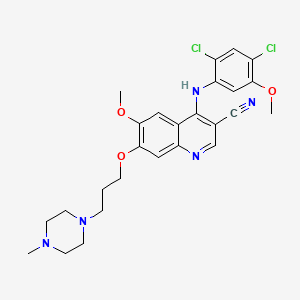
| Formula | C26H29Cl2N5O3 |
|---|---|
| Molecular weight | 530.46 g/mol |
| IUPAC name | 4-(2,4-dichloro-5-methoxyanilino)-6-methoxy-7-[3-(4-methylpiperazin-1-yl)propoxy]quinoline-3-carbonitrile |
| CAS | 380843-75-4 |
| PubChem CID | 5328940 |
| InChIKey | UBPYILGKFZZVDX-UHFFFAOYSA-N |
| logP | 5.19 (XLogP 5.4) |
| Polar surface area | 82.88 Ų |
| H-bond acceptors / donors | 8 / 1 |
| Drug-likeness (QED) | 0.38 |
| Lipinski violations | 2 |
SMILES
COc1cc(Nc2c(C#N)cnc3cc(OCCCN4CCN(C)CC4)c(OC)cc23)c(Cl)cc1ClBiology & Pharmacokinetics
Pharmacokinetics
| BBB penetrant | No |
|---|
Enzyme interactions
| Enzyme | Role | Detail |
|---|---|---|
| CYP1A2 | Inhibitor | — |
| CYP1A2 | Substrate | — |
| CYP2C19 | Inhibitor | — |
| CYP2C19 | Substrate | — |
| CYP2C8 | Inhibitor | — |
| CYP2D6 | Inhibitor | — |
| CYP3A4 | Inhibitor | — |
| CYP3A4 | Substrate | — |
Receptor binding (top 16)
| Target | Action | Affinity |
|---|---|---|
| mitogen-activated protein kinase kinase kinase kinase 5 (MAP4K5) | Inhibitor | pIC50 9.5 |
| TXK tyrosine kinase (TXK) | Inhibitor | pIC50 9.5 |
| ABL proto-oncogene 1, non-receptor tyrosine kinase (ABL1) | Inhibitor | pIC50 9.0 |
| SRC proto-oncogene, non-receptor tyrosine kinase (SRC) | Inhibitor | pIC50 9.0 |
| FYN proto-oncogene, Src family tyrosine kinase (FYN) | Inhibitor | pIC50 8.7 |
| fyn related Src family tyrosine kinase (FRK) | Inhibitor | pIC50 8.7 |
| tyrosine kinase non receptor 2 (TNK2) | Inhibitor | pIC50 8.6 |
| salt inducible kinase 1 (SIK1) | Inhibitor | pIC50 8.5 |
| salt inducible kinase 2 (SIK2) | Inhibitor | pIC50 8.5 |
| serine/threonine kinase 24 (STK24) | Inhibitor | pIC50 8.4 |
| LYN proto-oncogene, Src family tyrosine kinase (LYN) | Inhibitor | pIC50 8.1 |
| SIK family kinase 3 (SIK3) | Inhibitor | pIC50 7.7 |
| serine/threonine kinase 10 (STK10) | Inhibitor | pIC50 7.3 |
| calcium/calmodulin dependent protein kinase ID (CAMK1D) | Inhibitor | pIC50 7.0 |
| calcium/calmodulin-dependent protein kinase II gamma subunit (CAMK2G) | Inhibitor | pIC50 6.7 |
Transporters
BCRP (Inhibitor)BCRP (Inhibitor)BSEP (Inhibitor)CNT1 (Inhibitor)CNT2 (Inhibitor)CNT3 (Inhibitor)ENT1 (Inhibitor)MDR1 (Inhibitor)MRP1 (Inhibitor)OAT1 (Inhibitor)OAT3 (Inhibitor)OATP1B1 (Inhibitor)OATP1B1 (Inhibitor)OATP1B3 (Inhibitor)OATP1B3 (Inhibitor)OATP2B1 (Inhibitor)OCT1 (Inhibitor)OCT2 (Inhibitor)P-gp (Inhibitor)MDR1 (Substrate)P-gp (Substrate)Transporter(unspecified) (Substrate)
Drug–drug interactions (100+, DDInter)
| Interacting drug | Severity | Management |
|---|---|---|
| Adalimumab | major | |
| Amiodarone | major | |
| Amisulpride | major | |
| Amprenavir | major | |
| Anagrelide | major | |
| Apalutamide | major | |
| Aprepitant | major | |
| Arsenic trioxide | major | |
| Atazanavir | major | |
| Bacillus calmette-guerin substrain tice live antigen | major | |
| Baricitinib | major | |
| Bedaquiline | major | |
| Bepridil | major | |
| Berotralstat | major | |
| Boceprevir | major | |
| Bosentan | major | |
| Cabozantinib | major | |
| Carbamazepine | major | |
| Cenobamate | major | |
| Ceritinib | major | |
| Certolizumab pegol | major | |
| Chloroquine | major | |
| Ciprofloxacin | major | |
| Cisapride | major | |
| Citalopram | major | |
| Cladribine | major | |
| Clarithromycin | major | |
| Clozapine | major | |
| Cobicistat | major | |
| Conivaptan | major | |
| Crizotinib | major | |
| Dalfopristin | major | |
| Darunavir | major | |
| Deferiprone | major | |
| Delavirdine | major | |
| Dexamethasone | major | |
| Diltiazem | major | |
| Disopyramide | major | |
| Dofetilide | major | |
| Dolasetron | major |
Showing 40 of 100+.
Registered Products (2)
| Brand | Form / strength | Pack | Agent | Citizen (JOD) |
|---|---|---|---|---|
| Volopem | Tablet 500 mg | 28 tab | Hikma Pharmaceuticals Co.Ltd/Jordan | — |
| Volopem | Tablet 100 mg | 28 tab | Hikma Pharmaceuticals Co.Ltd/Jordan | — |