Baricitinib
JFDA label: Baritava
- vascular toxicity — ChEMBL drug_warning (Black Box Warning) | United States
- carcinogenicity — ChEMBL drug_warning (Black Box Warning) | United States
- respiratory toxicity — ChEMBL drug_warning (Black Box Warning) | United States
- infectious disease — ChEMBL drug_warning (Black Box Warning) | United States
- SERIOUS INFECTIONS, MORTALITY, MALIGNANCY, MAJOR ADVERSE CARDIOVASCULAR EVENTS (MACE), and THROMBOSIS WARNING: SERIOUS INFECTIONS, MORTALITY, MALIGNANCY, MAJOR ADVERSE CARDIOVASCULAR EVENTS (MACE), an
Mechanism of Action
Inhibitor of Tyrosine-protein kinase JAK1 — Tyrosine-protein kinase JAK1 inhibitor; Inhibitor of Tyrosine-protein kinase JAK2 — Tyrosine-protein kinase JAK2 inhibitor
| Target | Action | Gene / class |
|---|---|---|
| Tyrosine-protein kinase JAK1 efficacy | INHIBITOR | JAK1 |
| Tyrosine-protein kinase JAK2 efficacy | INHIBITOR | JAK2 |
Indications
Approved
- Arthritis, Rheumatoid — rheumatoid arthritis
Off-label
- Alopecia Areata
- Arthritis, Juvenile
- Brain Injuries
- Dermatitis, Atopic
- Dermatomyositis
- Diabetes Mellitus, Type 1
- Diabetic Nephropathies
- Giant Cell Arteritis
- HIV Infections
- Influenza, Human
- Lichen Planus
- Liver Cirrhosis, Biliary
- Lupus Erythematosus, Systemic
- Mastitis
- Myalgia
- Myositis
- Pneumonia
- Psoriasis
- Purpura, Thrombocytopenic, Idiopathic
- Renal Insufficiency, Chronic
- Sepsis
- Severe Acute Respiratory Syndrome
- Sjogren's Syndrome
- Subarachnoid Hemorrhage
- Uveitis
- Vitiligo
Contraindications
Source: openFDA
- None. None. Absolute
Dosing
Source: openFDA
Warnings & Precautions
Source: openFDA
Boxed Warning
SERIOUS INFECTIONS, MORTALITY, MALIGNANCY, MAJOR ADVERSE CARDIOVASCULAR EVENTS (MACE), and THROMBOSIS WARNING: SERIOUS INFECTIONS, MORTALITY, MALIGNANCY, MAJOR ADVERSE CARDIOVASCULAR EVENTS (MACE), and THROMBOSIS See full prescribing information for complete boxed warning. Increased risk of serious bacterial, fungal, viral and opportunistic infections leading to hospitalization or death, including tuberculosis (TB). Interrupt treatment with OLUMIANT if serious infection occurs until the infection is controlled. OLUMIANT should not be given to patients with active tuberculosis. Test for latent TB before and during therapy, except for COVID-19; treat latent TB prior to use. Monitor all patients for active TB during treatment, even patients with initial negative, latent TB test. ( 5.1 ) Higher rate of all-cause mortality, including sudden cardiovascular death with another Janus kinase inhibitor (JAK) vs. TNF blockers in rheumatoid arthritis (RA) patients. ( 5.2 ) Malignancies have occurred in patients treated with OLUMIANT. Higher rate of lymphomas and lung cancers with another JAK inhibitor vs. TNF blockers in RA patients. ( 5.3 ) Higher rate of MACE (defined as cardiovascular death, myocardial infarction, and stroke) with another JAK inhibitor vs. TNF blockers in RA patients. ( 5.4 ) Thrombosis has occurred in patients treated with OLUMIANT. Increased incidence of pulmonary embolism, venous and arterial thrombosis with another JAK inhibitor vs. TNF blockers. ( 5.5 ) SERIOUS INFECTIONS Patients treated with OLUMIANT are at risk for developing serious infections that may lead to hospitalization or death [see Warnings and Precautions ( 5.1 ) and Adverse Reactions ( 6.1 )] . Most patients with rheumatoid arthritis who developed these infections were taking concomitant immunosuppressants such as methotrexate or corticosteroids. If a serious infection develops, interrupt OLUMIANT until the infection is controlled. Reported infections include: Active tuberculosis, which may present with pulmonary or extrapulmonary disease. OLUMIANT should not be given to patients with active tuberculosis. Patients, except those with COVID-19, should be tested for latent tuberculosis before initiating OLUMIANT and during therapy. If positive, start treatment for latent infection prior to OLUMIANT use. Invasive fungal infections, including candidiasis and pneumocystosis. Patients with invasive fungal infections may present with disseminated, rather than localized, disease. Bacterial
Warnings & Precautions
Hypersensitivity : Serious reactions have been reported. Discontinue OLUMIANT if a serious hypersensitivity reaction occurs. ( 5.6 ) Gastrointestinal Perforations : Monitor patients who may be at increased risk and evaluate promptly new onset of abdominal symptoms. ( 5.7 ) Laboratory Abnormalities : Monitor for changes in lymphocytes, neutrophils, hemoglobin, liver enzymes, and lipids. ( 5.8 ) Vaccinations : Avoid use with live vaccines. ( 5.9 )
Serious Infections Serious and sometimes fatal infections due to bacte
Serious Infections Serious and sometimes fatal infections due to bacterial, mycobacterial, invasive fungal, viral, or other opportunistic pathogens have been reported in patients with rheumatoid arthritis receiving OLUMIANT. The most common serious infections reported with OLUMIANT included pneumonia, herpes zoster, and urinary tract infection [see Adverse Reactions ( 6.1 )] . Among opportunistic infections, tuberculosis, multidermatomal herpes zoster, esophageal candidiasis, pneumocystosis, acute histoplasmosis, cryptococcosis, cytomegalovirus, and BK virus were reported with OLUMIANT. Some patients have presented with disseminated rather than localized disease, and were often taking concomitant immunosuppressants such as methotrexate or corticosteroids. Avoid use of OLUMIANT in patients with an active, serious infection, including localized infections. Consider the risks and benefits of treatment prior to initiating OLUMIANT in patients: with chronic or recurrent infection who have been exposed to tuberculosis with a history of a serious or an opportunistic infection who have resided or traveled in areas of endemic tuberculosis or endemic mycoses; or with underlying conditions that may predispose them to infection. In patients with rheumatoid arthritis or alopecia areata, closely monitor for the development of signs and symptoms of infection during and after treatment with OLUMIANT. Interrupt OLUMIANT in patients with rheumatoid arthritis or alopecia areata, if the patient develops a serious infection, an opportunistic infection, or sepsis. A patient who develops a new infection during treatment with OLUMIANT should undergo prompt and complete diagnostic testing appropriate for an immunocompromised patient; appropriate antimicrobial therapy should be initiated, the patient should be closely monitored, and OLUMIANT should be interrupted if the patient is not responding to therapy. Do not resume OLUMIANT until the infection is controlled. In patients with COVID-19, monitor for signs and symptoms of new infections during and after treatment with OLUMIANT. There is limited information regarding the use of OLUMIANT in patients with COVID-19 and concomitant active serious infections. The risks and benefits of treatment with OLUMIANT in COVID-19 patients with other concurrent infections should be considered. Tuberculosis Evaluate patients for active infection prior to administration of OLUMIANT. OLUMIANT should not be given to patients with active TB. Test pati
Mortality In a large, randomized, postmarketing safety study of anothe
Mortality In a large, randomized, postmarketing safety study of another JAK inhibitor in RA patients 50 years of age and older with at least one cardiovascular risk factor, a higher rate of all-cause mortality, including sudden cardiovascular death, was observed in patients treated with the JAK inhibitor compared with TNF blockers. Consider the benefits and risks for the individual patient prior to initiating or continuing therapy with OLUMIANT.
Malignancy and Lymphoproliferative Disorders Malignancies were observe
Malignancy and Lymphoproliferative Disorders Malignancies were observed in clinical studies of OLUMIANT [see Adverse Reactions ( 6.1 )] . In a large, randomized, postmarketing safety study of another JAK inhibitor in RA patients, a higher rate of malignancies (excluding non-melanoma skin cancer (NMSC)) was observed in patients treated with the JAK inhibitor compared to those treated with TNF blockers. A higher rate of lymphomas was observed in patients treated with the JAK inhibitor compared to those treated with TNF blockers. A higher rate of lung cancers was observed in current or past smokers treated with the JAK inhibitor compared to those treated with TNF blockers. In this study, current or past smokers had an additional increased risk of overall malignancies. Consider the benefits and risks for the individual patient prior to initiating or continuing therapy with OLUMIANT, particularly in patients with a known malignancy (other than successfully treated NMSC), patients who develop a malignancy, and patients who are current or past smokers. Non-melanoma skin cancers Non-melanoma skin cancers (NMSCs) have been reported in patients treated with OLUMIANT. Periodic skin examination is recommended for patients who are at increased risk for skin cancer.
Major Adverse Cardiovascular Events In a large, randomized, postmarket
Major Adverse Cardiovascular Events In a large, randomized, postmarketing safety study of another JAK inhibitor in RA patients 50 years of age and older with at least one cardiovascular risk factor, a higher rate of major adverse cardiovascular events (MACE) defined as cardiovascular death, non-fatal myocardial infarction (MI), and non-fatal stroke was observed with the JAK inhibitor compared to those treated with TNF blockers. Patients who are current or past smokers are at additional increased risk. Consider the benefits and risks for the individual patient prior to initiating or continuing therapy with OLUMIANT, particularly in patients who are current or past smokers and patients with other cardiovascular risk factors. Patients should be informed about the symptoms of serious cardiovascular events and the steps to take if they occur. Discontinue OLUMIANT in patients that have experienced a myocardial infarction or stroke.
Thrombosis Thrombosis, including deep venous thrombosis (DVT) and pulm
Thrombosis Thrombosis, including deep venous thrombosis (DVT) and pulmonary embolism (PE), has been observed at an increased incidence in patients treated with OLUMIANT compared to placebo. In addition, arterial thrombosis events in the extremities have been reported in clinical studies with OLUMIANT. Many of these adverse events were serious and some resulted in death. There was no clear relationship between platelet count elevations and thrombotic events. In a large, randomized, postmarketing safety study of another JAK inhibitor in RA patients 50 years of age and older with at least one cardiovascular risk factor, higher rates of overall thrombosis, DVT, and PE were observed compared to those treated with TNF blockers. If clinical features of DVT/PE or arterial thrombosis occur, patients should discontinue OLUMIANT and be evaluated promptly and treated appropriately. Avoid OLUMIANT in patients that may be at increased risk of thrombosis.
Hypersensitivity Reactions such as angioedema, urticaria, and rash tha
Hypersensitivity Reactions such as angioedema, urticaria, and rash that may reflect drug hypersensitivity have been observed in patients receiving OLUMIANT, including serious reactions. If a serious hypersensitivity reaction occurs, promptly discontinue OLUMIANT while evaluating the potential causes of the reaction [see Adverse Reactions ( 6.2 )] .
Gastrointestinal Perforations Gastrointestinal perforations have been
Gastrointestinal Perforations Gastrointestinal perforations have been reported in clinical studies with OLUMIANT. Monitor OLUMIANT-treated patients who may be at increased risk for gastrointestinal perforation (e.g., patients with a history of diverticulitis). Evaluate promptly patients presenting with new onset abdominal symptoms for early identification of gastrointestinal perforation.
Laboratory Abnormalities Neutropenia – Treatment with OLUMIANT was ass
Laboratory Abnormalities Neutropenia – Treatment with OLUMIANT was associated with an increased incidence of neutropenia (ANC less than 1000 cells/mm 3 ) compared to placebo. In patients with rheumatoid arthritis or alopecia areata, avoid initiation or interrupt OLUMIANT treatment in patients with an ANC less than 1000 cells/mm 3 . In patients with COVID-19, there is limited information regarding use of OLUMIANT in patients with ANC less than 1000 cells/mm 3 . Avoid initiation or interrupt OLUMIANT treatment in patients with COVID-19 and an ANC less than 500 cells/mm 3 . Evaluate at baseline and thereafter according to routine patient management. Adjust dosing based on ANC [see Dosage and Administration ( 2.1 , 2.5 ) and Adverse Reactions ( 6.1 )] . Lymphopenia – ALC less than 500 cells/mm 3 were reported in OLUMIANT clinical trials. Lymphocyte counts less than the lower limit of normal were associated with infection in patients treated with OLUMIANT, but not placebo. In patients with rheumatoid arthritis or alopecia areata, avoid initiation or interrupt OLUMIANT treatment in patients with an ALC less than 500 cells/mm 3 . In patients with COVID-19, there is limited information regarding use of OLUMIANT in patients with ALC less than 200 cells/mm 3 . Avoid initiation or interrupt OLUMIANT treatment in patients with COVID-19 and an ALC less than 200 cells/mm 3 . Evaluate at baseline and thereafter according to routine patient management. Adjust dosing based on ALC [see Dosage and Administration ( 2.1 , 2.5 )] . Anemia – Decreases in hemoglobin levels to less than 8 g/dL were reported in OLUMIANT clinical trials. In patients with rheumatoid arthritis or alopecia areata, avoid initiation or interrupt OLUMIANT treatment in patients with hemoglobin less than 8 g/dL. Evaluate at baseline and thereafter according to routine patient management. Adjust dosing based on hemoglobin levels [see Dosage and Administration ( 2.1 , 2.5 )] . In patients with COVID-19, there is limited information regarding use of OLUMIANT in patients with hemoglobin less than 8 g/dL. Liver Enzyme Elevations – Treatment with OLUMIANT was associated with increased incidence of liver enzyme elevation compared to placebo. Increases of ALT ≥5 times the upper limit of normal (ULN) and increases of AST ≥10 times the ULN were observed in patients in OLUMIANT clinical trials. Evaluate at baseline and thereafter according to routine patient management. Prompt investigation of the cause of liver enzym
Vaccinations Avoid use of live vaccines with OLUMIANT. Update immuniza
Vaccinations Avoid use of live vaccines with OLUMIANT. Update immunizations in patients with rheumatoid arthritis or alopecia areata prior to initiating OLUMIANT therapy in agreement with current immunization guidelines.
Pregnancy & Lactation
Lactation
The manufacturer recommends that women avoid nursing during therapy and for 4 days after the last dose.
Chemistry & Properties
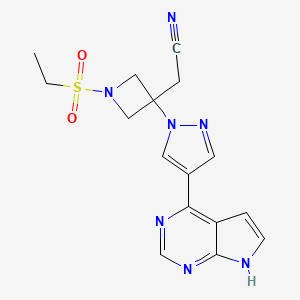
| Formula | C16H17N7O2S |
|---|---|
| Molecular weight | 371.43 g/mol |
| IUPAC name | 2-[1-ethylsulfonyl-3-[4-(7H-pyrrolo[2,3-d]pyrimidin-4-yl)pyrazol-1-yl]azetidin-3-yl]acetonitrile |
| CAS | 1187594-09-7 |
| PubChem CID | 44205240 |
| InChIKey | XUZMWHLSFXCVMG-UHFFFAOYSA-N |
| logP | 1.1 (XLogP -0.5) |
| Polar surface area | 120.56 Ų |
| H-bond acceptors / donors | 7 / 1 |
| Drug-likeness (QED) | 0.72 |
| Lipinski violations | 0 |
SMILES
CCS(=O)(=O)N1CC(CC#N)(n2cc(-c3ncnc4[nH]ccc34)cn2)C1Biology & Pharmacokinetics
Pharmacokinetics predicted
| Bioavailability | 10.0% |
|---|---|
| Half-life | 1.391 h |
| Volume of distribution | 1.083 L/kg |
| Protein binding | 41.6% |
| BBB penetrant | No |
Enzyme interactions
| Enzyme | Role | Detail |
|---|---|---|
| CYP1A2 | Substrate | — |
| CYP2C8 | Inhibitor | — |
| CYP2C9 | Substrate | — |
| CYP3A4 | Inhibitor | — |
| CYP3A4 | Substrate | — |
Receptor binding (top 7)
| Target | Action | Affinity |
|---|---|---|
| Janus kinase 2 (JAK2) | Inhibitor | pIC50 8.2 |
| Janus kinase 1 (JAK1) | Inhibitor | pIC50 8.2 |
| AP2 associated kinase 1 (AAK1) | Inhibitor | pKd 7.8 |
| BMP2 inducible kinase (BMP2K) | Inhibitor | pKd 7.4 |
| tyrosine kinase 2 (TYK2) | Inhibitor | pIC50 7.2 |
| cyclin G associated kinase (GAK) | Inhibitor | pKd 6.9 |
| Janus kinase 3 (JAK3) | Inhibitor | pIC50 6.1 |
Transporters
BCRP (Inhibitor)BCRP (Inhibitor)BSEP (Inhibitor)MATE2 (Inhibitor)MDR1 (Inhibitor)MRP1 (Inhibitor)OAT1 (Inhibitor)OAT2 (Inhibitor)OAT3 (Inhibitor)OATP1B1 (Inhibitor)OATP1B1 (Inhibitor)OATP1B3 (Inhibitor)OATP1B3 (Inhibitor)OCT1 (Inhibitor)OCT2 (Inhibitor)P-gp (Inhibitor)Transporter(unspecified) (Inhibitor)BCRP (Substrate)MATE1 (Substrate)MATE2 (Substrate)MDR1 (Substrate)MRP2 (Substrate)MRP3 (Substrate)OAT1 (Substrate)OAT3 (Substrate)OATP1B1 (Substrate)OATP1B3 (Substrate)P-gp (Substrate)Transporter(unspecified) (Substrate)
Drug–drug interactions (100+, DDInter)
| Interacting drug | Severity | Management |
|---|---|---|
| Abatacept | major | |
| Abemaciclib | major | |
| Acalabrutinib | major | |
| Adalimumab | major | |
| Aflibercept | major | |
| Aldesleukin | major | |
| Alefacept | major | |
| Alemtuzumab | major | |
| Altretamine | major | |
| Anakinra | major | |
| Antilymphocyte immunoglobulin (horse) | major | |
| Antithymocyte immunoglobulin (rabbit) | major | |
| Asparaginase Escherichia coli | major | |
| Atezolizumab | major | |
| Avapritinib | major | |
| Axicabtagene ciloleucel | major | |
| Azacitidine | major | |
| Azathioprine | major | |
| Bacillus calmette-guerin substrain tice live antigen | major | |
| Basiliximab | major | |
| Belantamab mafodotin | major | |
| Belatacept | major | |
| Belimumab | major | |
| Belinostat | major | |
| Bendamustine | major | |
| Betamethasone | major | |
| Bexarotene | major | |
| Bleomycin | major | |
| Blinatumomab | major | |
| Bortezomib | major | |
| Bosutinib | major | |
| Brentuximab vedotin | major | |
| Brexucabtagene autoleucel | major | |
| Brigatinib | major | |
| Brodalumab | major | |
| Budesonide | major | |
| Busulfan | major | |
| Cabazitaxel | major | |
| Canakinumab | major | |
| Capecitabine | major |
Showing 40 of 100+.
Registered Products (2)
| Brand | Form / strength | Pack | Agent | Citizen (JOD) |
|---|---|---|---|---|
| Baritava | Tablet 2 mg | 28 tab | Hikma Pharmaceuticals LLC P.O. Box: 182400 Amman 11118 - Jordan | — |
| Baritava | Tablet 4 mg | 28 tab | HIKMA PHARMACEUTICALS - JORDAN | — |