Bendamustine
JFDA label: Ribomustin 25mg
Mechanism of Action
Bendamustine is an alkylating agent (nitrogen mustard derivative) with a benzimidazole ring (purine analog) which demonstrates only partial cross-resistance (in vitro) with other alkylating agents. It leads to cell death via single and double strand DNA cross-linking. Bendamustine is active against quiescent and dividing cells. The primary cytotoxic activity is due to bendamustine (as compared to metabolites).
Indications
Approved
- Chronic lymphocytic leukemia
- Non-Hodgkin lymphoma
Off-label
- Hodgkin lymphoma (relapsed or refractory)
- Multiple myeloma (salvage therapy)
- Non-Hodgkin lymphoma, indolent (eg, follicular, marginal zone), and mantle cell
- Non-Hodgkin lymphoma, mantle cell (relapsed or refractory)
- Waldenström macroglobulinemia
- first-line treatment
Contraindications
Source: Lexicomp
- Known hypersensitivity (eg, anaphylactic or anaphylactoid reactions) to bendamustine or any component of the formulation. Bendeka is also contraindicated in patients with hypersensitivity to polyethylene glycol 400, propylene glycol, or monothioglycerol Absolute
Adverse Reactions
Cardiac disorders (5)
Very Common Peripheral edema
Common chest pain · exacerbation of hypertension · hypotension · Tachycardia
Nervous system disorders (10)
Very Common chills · dizziness · Fatigue · headache · insomnia
Common Anxiety · depression · pain
Not Known Drowsiness · malaise
Hepatobiliary disorders (3)
Very Common Increased serum bilirubin
Common Increased serum ALT · increased serum AST
Renal and urinary disorders (2)
Common Increased serum creatinine · Urinary tract infection
Blood and lymphatic system disorders (8)
Very Common bone marrow depression · decreased hemoglobin · decreased neutrophils · leukopenia · Lymphocytopenia · thrombocytopenia
Common Febrile neutropenia
Not Known Hemolysis
Immune system disorders (1)
Common Hypersensitivity
Metabolism and nutrition disorders (7)
Very Common dehydration · Weight loss
Common hyperglycemia · hyperuricemia · hypocalcemia · Hypokalemia · hyponatremia
Gastrointestinal disorders (16)
Very Common abdominal pain · anorexia · constipation · decreased appetite · diarrhea · dyspepsia · Nausea · stomatitis · vomiting
Common abdominal distention · dysgeusia · Gastroesophageal reflux disease · oral candidiasis · upper abdominal pain · xerostomia
Not Known Mucositis
Skin and subcutaneous tissue disorders (7)
Very Common Skin rash
Common hyperhidrosis · night sweats · Pruritus · xeroderma
Not Known Dermatitis · skin necrosis
Musculoskeletal and connective tissue disorders (5)
Very Common Back pain · weakness
Common Arthralgia · limb pain · ostealgia
Infections and infestations (3)
Common herpes simplex infection · Herpes zoster · infection
General disorders and administration site conditions (3)
Very Common Fever
Common catheter pain · Infusion site pain
Respiratory, thoracic and mediastinal disorders (9)
Very Common Cough · dyspnea
Common nasal congestion · nasopharyngitis · pharyngolaryngeal pain · pneumonia · sinusitis · Upper respiratory tract infection · wheezing
Dosing
Source: Lexicomp
Warnings & Precautions
Source: Lexicomp
Bone marrow suppression
Myelosuppression (neutropenia, thrombocytopenia, and anemia) is a common toxicity; may require therapy delay and/or dose reduction; monitor blood counts frequently (nadirs typically occurred in the third week of treatment). Complications due to febrile neutropenia and severe thrombocytopenia have been reported (some fatal). ANC should recover to ≥1,000/mm3 and platelets to ≥75,000/mm3 prior to cycle initiation.
Dermatologic toxicity
Serious and fatal dermatologic toxicities, including Stevens-Johnson syndrome (SJS) and toxic epidermal necrolysis (TEN), drug reaction with eosinophilia and systemic symptoms (DRESS), bullous exanthema, and rash have been reported. Skin reactions have been reported with monotherapy and in combination with other antineoplastic agents or allopurinol and may be progressive or worsen with continued treatment. The risk for severe skin toxicity is increased with concurrent use of allopurinol and other medications known to cause skin toxicity. Monitor closely for dermatologic toxicity. Withhold or discontinue treatment for severe or progressive skin reaction.
Extravasation
Bendamustine is an irritant with vesicant-like properties; ensure proper needle or catheter placement prior to and during infusion; avoid extravasation. Erythema, marked swelling, and pain have been reported with extravasation.
GI toxicities
Bendamustine is associated with a moderate emetic potential (Dupuis 2011; Hesketh 2017; Roila 2016); antiemetics are recommended to prevent nausea and vomiting.
Hepatotoxicity
Serious and fatal cases of liver injury have been reported, usually within the first 3 months of treatment initiation. Confounding factors in some patients included combination therapy, progressive disease, and/or hepatitis B reactivation. Monitor liver function tests.
Hypersensitivity/infusion reaction
Infusion reactions, which may include chills, fever, pruritus, and rash, are common. Rarely, anaphylactic and anaphylactoid reactions have occurred, particularly with the second or subsequent cycle(s). Patients who experienced grade 3 or higher allergic reactions should not be rechallenged. Consider premedication with antihistamines, antipyretics and corticosteroids for patients with a history of grade 1 or 2 infusion reaction. Discontinue for severe allergic reaction or grade 4 infusion reaction; consider discontinuation with grade 3 infusion reaction.
Hypokalemia
Has been reported with use; monitor potassium closely in patients with cardiac disease.
Infection
Pneumonia, hepatitis, sepsis, and septic shock have been reported. Fatalities due to infection have occurred. Patients with myelosuppression are more susceptible to infection; monitor closely. Reactivation of hepatitis B, cytomegalovirus, Mycobacterium tuberculosis, and herpes zoster infection may occur in patients receiving bendamustine. Monitor; may require infection prophylaxis and/or treatment prior to bendamustine administration.
Secondary malignancy
Malignancies (including myelodysplastic syndrome, myeloproliferative disorders, acute myeloid leukemia and bronchial cancer) and premalignant diseases have been reported in patients who have received bendamustine.
Tumor lysis syndrome
Tumor lysis syndrome (usually occurring in the first treatment cycle) may occur as a consequence of antineoplastic treatment, including treatment with bendamustine. May lead to life-threatening acute renal failure (without intervention); vigorous hydration and prophylactic measures (eg, antihyperuricemic therapy) should be instituted prior to treatment in high-risk patients; monitor closely. Note: Allopurinol may increase the risk for bendamustine skin toxicity. Disease-related concerns:
Hepatic impairment
Use with caution in patients with mild hepatic impairment. A pharmacokinetic study showed only slight differences in bendamustine AUC and Cmax in patients with mild hepatic impairment (defined in the study as total bilirubin 1 to 1.5 × ULN or AST > ULN), as compared to patients with normal hepatic function (Owen 2010). Use is not recommended in patients with moderate (AST or ALT 2.5 to 10 × ULN and total bilirubin 1.5 to 3 × ULN) or severe (total bilirubin >3 × ULN) hepatic impairment.
Renal impairment
Use with caution in patients with mild to moderate renal impairment. According to the manufacturer, use is not recommended in patients with CrCl max in patients with mild (CrCl >50 to ≤80 mL/minute) and moderate (CrCl >30 to ≤50 mL/minute) renal dysfunction, compared to patients with normal renal function (Owen 2010). A retrospective safety study found higher rates of grades 3 and 4 BUN increases and thrombocytopenia, and grades 1 and 2 fatigue, nausea, and alopecia in patients with renal impairment (CrCl Concurrent drug therapy issues:
Drug-drug interactions
Potentially significant interactions may exist, requiring dose or frequency adjustment, additional monitoring, and/or selection of alternative therapy. Consult drug interactions database for more detailed information. Dosage form specific issues:
Closed system transfer device incompatibility
Bendamustine solution (Treanda: 45 mg/0.5 mL and 180 mg/2 mL) contains N,N-dimethylacetamide, which is incompatible with closed-system transfer devices (CSTDs), adapters, and syringes containing polycarbonate or acrylonitrile-butadiene-styrene (ABS). When used to prepare or transfer the concentrated bendamustine solution into the infusion bag, the plastic components of these devices may dissolve, resulting in subsequent leakage and potential infusion of dissolved plastic into the patient (ISMP [Smetzer 2015]). Do not use the liquid solution formulation if CSTDs, adapters, and syringes containing polycarbonate or ABS are used prior to dilution in the infusion bag. According to the Treanda manufacturer, after dilution into the infusion bag, devices containing polycarbonate or ABS (including infusion sets) may be used.
Formulations
Several formulations of bendamustine are available: a liquid solution (45 mg/0.5 mL and 180 mg/2 mL [Treanda] and 100 mg/4 mL [Bendeka]) and a powder for reconstitution (5 mg/mL after reconstitution [Treanda]). Concentrations, storage, and compatibility differ between formulations. Use caution when selecting bendamustine formulation for preparation and administration. Do not mix or combine the formulations.
Propylene glycol
Some dosage forms may contain propylene glycol; large amounts are potentially toxic and have been associated with hyperosmolality, lactic acidosis, seizures and respiratory depression; use caution (AAP 1997; Zar 2007). See manufacturer's labeling.
Pregnancy & Lactation
Pregnancy
Adverse events were observed in animal reproduction studies. May cause fetal harm if administered during pregnancy. For women and men of reproductive potential, effective contraception should be used during and for 3 months after treatment.
Lactation
It is not known if bendamustine is present in breast milk. Due to the potential for serious adverse reactions in the breastfed infant, a decision should be made to discontinue bendamustine or discontinue breastfeeding, taking into account the benefits of treatment to the mother.
Monitoring
| Clinical pearl | CBC with differential and platelets (monitored weekly [initially] in clinical trials); serum creatinine; liver function tests (ALT, AST, and total bilirubin; prior to and during treatment); monitor potassium and uric acid levels in patients at risk for tumor lysis syndrome; monitor for infusion reactions anaphylaxis, infection (including reactivations), and dermatologic toxicity; monitor IV site during and after infusion. |
|---|
Chemistry & Properties
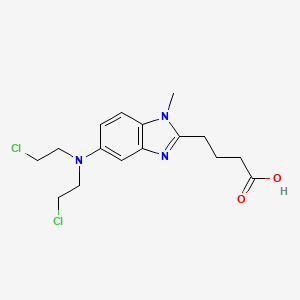
| Formula | C16H21Cl2N3O2 |
|---|---|
| Molecular weight | 358.27 g/mol |
| IUPAC name | 4-[5-[bis(2-chloroethyl)amino]-1-methylbenzimidazol-2-yl]butanoic acid |
| CAS | 16506-27-7 |
| PubChem CID | 65628 |
| InChIKey | YTKUWDBFDASYHO-UHFFFAOYSA-N |
| logP | 3.26 (XLogP 2.9) |
| Polar surface area | 58.36 Ų |
| H-bond acceptors / donors | 4 / 1 |
| Drug-likeness (QED) | 0.70 |
| Lipinski violations | 0 |
SMILES
Cn1c(CCCC(=O)O)nc2cc(N(CCCl)CCCl)ccc21Biology & Pharmacokinetics
Pharmacokinetics predicted
| Bioavailability | 10.0% |
|---|---|
| Half-life | 1.075 h |
| Volume of distribution | 0.214 L/kg |
| Protein binding | 95.4% |
| BBB penetrant | No |
Enzyme interactions
| Enzyme | Role | Detail |
|---|---|---|
| CYP1A2 | Substrate | — |
| CYP2C9 | Substrate | — |
Transporters
BCRP (Inhibitor)BSEP (Inhibitor)MATE1 (Inhibitor)MRP1 (Inhibitor)OATP1B1 (Inhibitor)OATP1B3 (Inhibitor)OATP1B3 (Inhibitor)P-gp (Inhibitor)BCRP (Substrate)MDR1 (Substrate)P-gp (Substrate)
Drug–drug interactions (100+, DDInter)
| Interacting drug | Severity | Management |
|---|---|---|
| Adalimumab | major | |
| Bacillus calmette-guerin substrain tice live antigen | major | |
| Baricitinib | major | |
| Certolizumab pegol | major | |
| Cladribine | major | |
| Clozapine | major | |
| Deferiprone | major | |
| Etanercept | major | |
| Fingolimod | major | |
| Golimumab | major | |
| Infliximab | major | |
| Leflunomide | major | |
| Measles virus vaccine live attenuated | major | |
| Mumps virus strain B level jeryl lynn live antigen | major | |
| Natalizumab | major | |
| Ozanimod | major | |
| Rotavirus vaccine | major | |
| Rubella virus vaccine | major | |
| Samarium (153Sm) lexidronam | major | |
| Siponimod | major | |
| Smallpox (Vaccinia) Vaccine, Live | major | |
| Talimogene laherparepvec | major | |
| Teriflunomide | major | |
| Tofacitinib | major | |
| Typhoid vaccine (live) | major | |
| Upadacitinib | major | |
| Varicella Zoster Vaccine (Recombinant) | major | |
| Yellow Fever Vaccine | major | |
| Abametapir (topical) | moderate | |
| Albendazole | moderate | |
| Aldesleukin | moderate | |
| Alefacept | moderate | |
| Alemtuzumab | moderate | |
| Allopurinol | moderate | |
| Amiodarone | moderate | |
| Amobarbital | moderate | |
| Anagrelide | moderate | |
| Anakinra | moderate | |
| Anthrax vaccine | moderate | |
| Azathioprine | moderate |
Showing 40 of 100+.
Registered Products (4)
| Brand | Form / strength | Pack | Agent | Citizen (JOD) |
|---|---|---|---|---|
| Bendavival | Vial 100 mg | 1 vial | Hikma Pharmaceuticals Co.Ltd/Jordan | — |
| Bendavival | Vial 25 mg | 1 vial | Hikma Pharmaceuticals Co.Ltd/Jordan | — |
| Ribomustin | Vial 25 mg | 5 vial | Ibn Rushd Drug Store | — |
| Ribomustin | Vial 100 mg | 1 vial | Ibn Rushd Drug Store | — |