Allopurinol
JFDA label: Zanuric-100mg tablet
Mechanism of Action
Inhibitor of Xanthine dehydrogenase/oxidase — Xanthine dehydrogenase inhibitor
| Target | Action | Gene / class |
|---|---|---|
| Xanthine dehydrogenase/oxidase efficacy | INHIBITOR | XDH |
Indications
Approved
- Calcium oxalate calculi (recurrent)
- Cancer therapy-induced hyperuricemia
- EULAR guidelines
- Gout
- IV
- Oral
Off-label
- Lesch-Nyhan syndrome–associated hyperuricemia (pediatrics)
Contraindications
Source: Lexicomp
- Additional contraindications (not in US labeling): Breast-feeding mothers and children (except those with cancer therapy-induced hyperuricemia or Lesch-Nyhan syndrome) Note: While not an absolute contraindication, the American College of Rheumatology suggests avoiding the use of allopurinol in patients with the HLA-B*5801 genotype due to the increased risk of allopurinol hypersensitivity syndrome (AHS). The guidelines suggest HLA-B*5801 screening in patients with a high incidence of this gen Absolute
- Severe hypersensitivity reaction to allopurinol or any component of the formulation Absolute
- this includes patients of Korean descent who have stage 3 or worse chronic kidney disease, as well as patients of Han Chinese or Thai descent regardless of kidney function (ACR guidelines [Khanna 2012]) Absolute
Adverse Reactions
Hepatobiliary disorders (3)
Uncommon Elevated liver enzymes / hepatitis
Not Known Increased liver enzymes · increased serum alkaline phosphatase
Renal and urinary disorders (1)
Uncommon Renal impairment (toxicity accumulation)
Immune system disorders (1)
Rare Allopurinol hypersensitivity syndrome (DRESS)
Metabolism and nutrition disorders (1)
Not Known Gout (acute)
Gastrointestinal disorders (3)
Common Nausea / GI upset
Not Known Diarrhea · nausea
Skin and subcutaneous tissue disorders (3)
Common Rash (mild)
Rare Stevens-Johnson syndrome / toxic epidermal necrolysis (HLA-B*5801 risk)
Not Known Skin rash
Musculoskeletal and connective tissue disorders (1)
Very Common Gout flare (initiation)
Dosing
Source: Lexicomp
Warnings & Precautions
Source: Lexicomp
Bone marrow suppression
Bone marrow suppression has been reported in patients receiving allopurinol, most of whom received concomitant medications with a potential for hematologic toxicity. The onset occurs between 6 weeks to 6 years after allopurinol initiation. Varying degrees of bone marrow depression affecting one or more cell lines may occur (rare) in patients receiving allopurinol alone.
CNS effects
May occasionally cause drowsiness; patients must be cautioned about performing tasks that require mental alertness (eg, operating machinery or driving).
Hepatotoxicity
Cases of hepatotoxicity (reversible) have been reported. Asymptomatic elevations of serum alkaline phosphatase or serum transaminases have been observed. Monitor for signs/symptoms of hepatotoxicity and evaluate liver function if they occur. Periodic liver function tests are recommended during the early stages of therapy in patients with preexisting hepatic impairment.
Hypersensitivity
Allopurinol has been associated with hypersensitivity reactions. In some instances a skin rash may be followed by more severe hypersensitivity reactions, including exfoliative, urticarial, and purpuric lesions, Stevens-Johnson syndrome, generalized vasculitis, and/or hepatotoxicity (irreversible); some reactions have been fatal (rare). Discontinue at first sign of skin rash or other signs indicative of allergic reaction. Consider HLA-B*5801 testing in patients at a higher risk for allopurinol hypersensitivity syndrome (eg, Korean patients with stage 3 or worse CKD and Han Chinese and Thai descent regardless of renal function) prior to initiation of therapy (ACR guidelines [Khanna 2012]). Disease-related concerns:
Acute gout attacks
Even when normal or subnormal serum uric acid levels have been attained, an increase in acute gout attacks has been reported during the early stages of allopurinol administration. When allopurinol is initiated, maintenance colchicine doses should generally be administered as prophylaxis. Additionally, it is recommended to initiate with a low allopurinol dose (100 mg daily) and increase at weekly intervals by 100 mg until a serum uric acid level of 6 mg/dL or less is attained (do not exceed the maximum recommended dose of 800 mg/day). In some cases, colchicine or anti-inflammatory agents may be required to suppress gouty attacks. After several months of therapy, attacks usually decrease in duration and severity. These episodes may be due to mobilization of urates from tissue deposits, causing fluctuations in the serum uric acid levels. Even with adequate allopurinol therapy, several months may be required to deplete the uric acid pool enough to achieve control of the acute attacks.
Renal impairment
Dose reductions are recommended in patients with renal impairment; monitor closely. Patients with reduced renal function receiving thiazide diuretics in combination with allopurinol may be at increased risk for hypersensitivity reactions. Some patients with pre-existing renal disease or poor urate clearance have shown a rise in BUN with allopurinol. Patients with renal impairment should be carefully monitored during the early stages of allopurinol treatment; reduce the dose or withdraw therapy if increased renal function abnormalities appear and persist. Renal failure associated with allopurinol has been observed in patients with hyperuricemia secondary to neoplastic diseases. Concurrent conditions including multiple myeloma and congestive myocardial disease were present among patients whose renal dysfunction increased after allopurinol was begun. Renal failure is also frequently associated with gouty nephropathy and rarely with hypersensitivity reactions associated with allopurinol. Albuminuria has been observed among patients who developed clinical gout following chronic glomerulonephritis and chronic pyelonephritis. Concurrent drug therapy issues:
Drug-drug interactions
Potentially significant drug interactions may exist, requiring dose or frequency adjustment, additional monitoring, and/or selection of alternative therapy. Consult drug interactions database for more detailed information.
Concomitant medications
Concomitant use of allopurinol (at doses of 300 to 600 mg/day) with mercaptopurine or azathioprine will require a reduction in the mercaptopurine or azathioprine dose to approximately one-third to one-fourth of the usual dose. Subsequent dose adjustments may be necessary based on therapeutic response and toxicity. Other warnings/precautions:
Appropriate use
Do not use to treat asymptomatic hyperuricemia.
Hydration
Fluid intake sufficient to yield a daily urinary output of at least 2 L and maintenance of a neutral or (preferably) a slightly alkaline urine are desirable in order to avoid possible formation of xanthine calculi due to allopurinol therapy and to help prevent renal urate precipitation in patients receiving concomitant uricosuric agents.
Pregnancy & Lactation
Pregnancy
Adverse events were observed in some animal reproduction studies. Allopurinol crosses the placenta (Torrance 2009). An increased risk of adverse fetal events has not been observed (limited data) (Hoeltzenbein 2013).
Lactation
Allopurinol and its metabolite are excreted into breast milk; the metabolite was also detected in the serum of the breast-feeding infant (Kamilli 1993). The manufacturer recommends caution be used when administering allopurinol to breast-feeding women.
Monitoring
| Clinical pearl | CBC, serum uric acid levels every 2 to 5 weeks during dose titration until desired level is achieved and every 6 months thereafter (ACR guidelines [Khanna 2012]), liver function tests (periodically in patients with preexisting hepatic disease), renal function (BUN, serum creatinine or creatinine clearance [prior to initiation and periodically]), prothrombin time (periodically in patients receiving warfarin); consider HLA-B*5801 testing prior to initiation of therapy in patients at a higher risk for allopurinol hypersensitivity syndrome (see Contraindications) (ACR guidelines [Khanna 2012]). Monitor hydration status, for signs and symptoms of hypersensitivity, hepatotoxicity. |
|---|
Chemistry & Properties
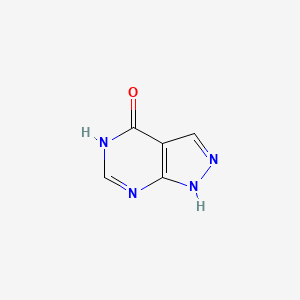
| Formula | C5H4N4O |
|---|---|
| Molecular weight | 136.11 g/mol |
| IUPAC name | 1,5-dihydropyrazolo[5,4-d]pyrimidin-4-one |
| CAS | 315-30-0 |
| PubChem CID | 135401907 |
| InChIKey | OFCNXPDARWKPPY-UHFFFAOYSA-N |
| logP | 0.06 (XLogP -0.7) |
| Polar surface area | 74.69 Ų |
| H-bond acceptors / donors | 4 / 2 |
| Drug-likeness (QED) | 0.54 |
| Lipinski violations | 0 |
SMILES
Oc1ncnc2[nH]ncc12Biology & Pharmacokinetics
Pharmacokinetics predicted
| Bioavailability | 10.0% |
|---|---|
| Half-life | 2.039 h |
| Volume of distribution | 0.576 L/kg |
| Protein binding | 2.5% |
| BBB penetrant | No |
Receptor binding (top 2)
| Target | Action | Affinity |
|---|---|---|
| xanthine dehydrogenase (XDH) | Inhibitor | pIC50 5.4 |
| xanthine dehydrogenase (XDH) | Inhibitor | pKi 5.2 |
Transporters
BCRP (Inhibitor)BSEP (Inhibitor)BSEP (Inhibitor)MRP1 (Inhibitor)MRP2 (Inhibitor)MRP3 (Inhibitor)MRP4 (Inhibitor)OATP1B1 (Inhibitor)OATP1B1 (Inhibitor)OATP1B3 (Inhibitor)OATP1B3 (Inhibitor)OATP2B1 (Inhibitor)OCT1 (Inhibitor)P-gp (Inhibitor)BCRP (Substrate)OAT2 (Substrate)OAT3 (Substrate)P-gp (Substrate)
Drug–drug interactions (21, DDInter)
| Interacting drug | Severity | Management |
|---|---|---|
| Azathioprine | major | |
| Deferiprone | major | |
| Mercaptopurine | major | |
| Aluminum hydroxide | moderate | |
| Attapulgite | moderate | |
| Bendamustine | moderate | |
| Cyclophosphamide | moderate | |
| Cyclosporine | moderate | |
| Dicoumarol | moderate | |
| Kaolin | moderate | |
| Magaldrate | moderate | |
| Pemetrexed | moderate | |
| Sucralfate | moderate | |
| Warfarin | moderate | |
| Aminophylline | minor | |
| Amoxicillin | minor | |
| Chlorpropamide | minor | |
| Oxtriphylline | minor | |
| Pentostatin | minor | |
| Tamoxifen | minor | |
| Theophylline | minor |
Registered Products (12)
| Brand | Form / strength | Pack | Agent | Citizen (JOD) |
|---|---|---|---|---|
| Zanuric-100mg tablet | Tablet 100 mg | 30 tab pack varies | AL-RAM PHARMA.INDUS.CO.LTD/JORDAN | 0.860 |
| Goutex | Tablet 100 mg | 30 tab pack varies | Jordan Sweden Medical & Sterilization Co. | 1.490 |
| Zanuric-300mg tablet | Tablet 300 mg | 30 tab pack varies | AL-RAM PHARMA.INDUS.CO.LTD/JORDAN | 2.000 |
| Zanuric-100mg tablet | Tablet 100 mg | 100 tab pack varies | AL-RAM PHARMA.INDUS.CO.LTD/JORDAN | 2.720 |
| Goutex | Tablet 300 mg | 30 tab | Jordan Sweden Medical & Sterilization Co. | 2.940 |
| Zyloric Tablets | Tablet 300 mg | 28 tab | Suleiman Tannous & Sons Co. Ltd | 3.130 |
| Zanuric-300mg tablet | Tablet 300 mg | 60 tab pack varies | AL-RAM PHARMA.INDUS.CO.LTD/JORDAN | 3.800 |
| Goutex | Tablet 100 mg | 100 tab pack varies | Jordan Sweden Medical & Sterilization Co. | 5.760 |
| Zyloric Tablets | Tablet 100 mg | 100 tab | Suleiman Tannous & Sons Co. Ltd | 5.760 |
| Zanuric-300mg tablet | Tablet 300 mg | 100 tab pack varies | AL-RAM PHARMA.INDUS.CO.LTD/JORDAN | 6.270 |
| Zanuric-100mg tablet | Tablet 100 mg | 1000 tab pack varies | AL-RAM PHARMA.INDUS.CO.LTD/JORDAN | 24.480 |
| Zanuric-300mg tablet | Tablet 300 mg | 1000 tab pack varies | AL-RAM PHARMA.INDUS.CO.LTD/JORDAN | 56.670 |