Theophylline
JFDA label: Theolin S.R 200 Capsules
Mechanism of Action
Inhibitor of Phosphodiesterase 4 — Phosphodiesterase 4 inhibitor; Inhibitor of Phosphodiesterase 3 — Phosphodiesterase 3 inhibitor; Antagonist of Adenosine receptor — Adenosine receptor antagonist
| Target | Action | Gene / class |
|---|---|---|
| Adenosine receptor efficacy | ANTAGONIST | |
| Phosphodiesterase 3 efficacy | INHIBITOR | |
| Phosphodiesterase 4 efficacy | INHIBITOR |
Indications
Approved
- Asthma
- COPD
- Injection
- Oral
- Reversible airflow obstruction
Contraindications
Source: Lexicomp
- Additional contraindications (not in US labeling): Hypersensitivity to xanthine derivatives Absolute
- Hypersensitivity to theophylline or any component of the formulation Absolute
- allergy to corn-related products (injection only) Absolute
- coadministration with ephedrine in children Absolute
- coronary artery disease (where cardiac stimulation might prove harmful) Absolute
- peptic ulcers Absolute
Adverse Reactions
Cardiac disorders (2)
Not Known Cardiac flutter · tachycardia
Nervous system disorders (6)
Not Known Headache · hyperactivity (children) · insomnia · restlessness · seizure · status epilepticus (nonconvulsive)
Renal and urinary disorders (2)
Not Known Difficulty in micturition (elderly males with prostatism) · diuresis (transient)
Metabolism and nutrition disorders (1)
Not Known Hypercalcemia (with concomitant hyperthyroid disease)
Gastrointestinal disorders (4)
Not Known Gastroesophageal reflux (aggravation) · gastrointestinal ulcer (aggravation) · nausea · vomiting
Musculoskeletal and connective tissue disorders (1)
Not Known Tremor
Dosing
Source: Lexicomp
Warnings & Precautions
Source: Lexicomp
Theophylline toxicity
Severe and potentially fatal theophylline toxicity may occur if reduced theophylline clearance occurs. Theophylline clearance may be decreased in patients with acute pulmonary edema, heart failure, cor pulmonale, fever (≥102°F for ≥24 hours or lesser temperature elevations for longer periods), hepatic disease, acute hepatitis, cirrhosis, hypothyroidism, sepsis with multiorgan failure, shock, neonates (term and premature), infants 60 years of age, and patients following cessation of smoking. Consider benefits versus risks and the need for more intensive monitoring in these patients; reduced infusion rate required. If a patient develops signs and symptoms of theophylline toxicity (eg, nausea or persistent, repetitive vomiting), a serum theophylline level should be measured immediately and subsequent doses withheld. Disease-related concerns:
Cardiovascular disease
Use with caution in patients with cardiac arrhythmias (excluding bradyarrhythmias); use may exacerbate arrhythmias.
Cystic fibrosis
Use with caution in patients with cystic fibrosis; increased theophylline clearance may occur.
Hepatic impairment
Use with caution in patients with hepatic impairment (eg, cirrhosis, acute hepatitis, cholestasis); risk of severe and potentially fatal theophylline toxicity is increased; theophylline clearance is decreased ≥50% in these patients. Dose reduction and frequent monitoring of serum theophylline concentration are required.
Hyperthyroidism
Use with caution in patients with hyperthyroidism; increased theophylline clearance may occur.
Peptic ulcer disease
Use with caution in patients with active peptic ulcer disease; use may exacerbate peptic ulcer.
Seizure disorder
Use with caution in patients with seizure disorders; use may exacerbate seizure disorder. Concurrent drug therapy issues:
Drug-drug interactions
Potentially significant interactions may exist, requiring dose or frequency adjustment, additional monitoring, and/or selection of alternative therapy. Consult drug interactions database for more detailed information. Special populations:
Elderly
Use extreme caution in the elderly; these patients are at greater risk of serious theophylline toxicity.
Pediatric
Select dose with caution and with frequent monitoring of concentrations (especially Dosage form specific issues:
Propylene glycol
Some dosage forms may contain propylene glycol; large amounts are potentially toxic and have been associated hyperosmolality, lactic acidosis, seizures, and respiratory depression; use caution (AAP 1997; Zar 2007). Other warnings/precautions:
Appropriate use
Do not increase dose in response to acute exacerbation of symptoms unless steady state serum theophylline concentration is
Pregnancy & Lactation
Pregnancy
Adverse effects have been observed in animal reproduction studies. Theophylline crosses the placenta; adverse effects may be seen in the newborn. Use is generally safe when used at the recommended doses (serum concentrations 5 to 12 mcg/mL) however maternal adverse events may be increased and efficacy may be decreased in pregnant women. Theophylline metabolism may change during pregnancy; the half-life is similar to that observed in otherwise healthy, nonsmoking adults with asthma during the first and second trimesters (~8.7 hours), but may increase to 13 hours (range: 8 to 18 hours) during the third trimester. The volume of distribution is also increased during the third trimester. Monitor serum levels. The recommendations for the use of theophylline in pregnant women with asthma are similar to those used in nonpregnant adults (National Heart, Lung, and Blood Institute Guidelines 2004).
Lactation
Theophylline is present in breast milk. The concentration of theophylline in breast milk is similar to the maternal serum concentration. Irritability may be observed in the nursing infant. Serious adverse events in the infant are unlikely unless toxic serum levels are present in the mother.
LactMed: monitor the infant.
Monitoring
| Efficacy | Serum theophylline 10–20 mg/L (non-smokers); 10–15 mg/L (elderly); lung function (FEV₁/PEFR) |
|---|---|
| Toxicity | Nausea, palpitations, tremor at 20–30 mg/L; seizures and arrhythmias at > 40 mg/L; ECG for cardiac monitoring |
| Clinical pearl | Clearance is dramatically affected by smoking (induces CYP1A2), CYP1A2/3A4 inhibitors (erythromycin, ciprofloxacin, cimetidine), and heart failure or cirrhosis. Level can rise dangerously if smoking is stopped abruptly. |
| Counseling | Take at the same time each day with or without food. Do not abruptly change smoking habits without medical review. Report palpitations, persistent vomiting, or agitation. |
Chemistry & Properties
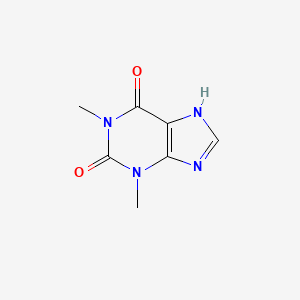
| Formula | C7H10N4O3 |
|---|---|
| Molecular weight | 198.18 g/mol |
| IUPAC name | 1,3-dimethyl-7H-purine-2,6-dione |
| CAS | 58-55-9 |
| PubChem CID | 2153 |
| InChIKey | INQSMEFCAIHTJG-UHFFFAOYSA-N |
| logP | -1.04 (XLogP 0.0) |
| Polar surface area | 72.68 Ų |
| H-bond acceptors / donors | 5 / 1 |
| Drug-likeness (QED) | 0.56 |
| Lipinski violations | 0 |
SMILES
Cn1c(=O)c2nc[nH]c2n(C)c1=O.OBiology & Pharmacokinetics
Pharmacokinetics
| BBB penetrant | Yes (logBB -0.3) |
|---|
Enzyme interactions
| Enzyme | Role | Detail |
|---|---|---|
| CYP1A2 | Substrate | — |
| CYP2B6 | Substrate | — |
| CYP2C19 | Substrate | — |
| CYP2C9 | Substrate | — |
| CYP2D6 | Substrate | — |
| CYP3A4 | Substrate | — |
Transporters
BCRP (Inhibitor)BSEP (Inhibitor)BSEP (Inhibitor)MCT1 (Inhibitor)MRP1 (Inhibitor)MRP3 (Inhibitor)MRP4 (Inhibitor)OAT1 (Inhibitor)OAT2 (Inhibitor)OATP1B1 (Inhibitor)OATP1B1 (Inhibitor)OATP1B3 (Inhibitor)OATP1B3 (Inhibitor)OATP2B1 (Inhibitor)OCT1 (Inhibitor)OCT3 (Inhibitor)P-gp (Inhibitor)MDR1 (Substrate)OAT2 (Substrate)P-gp (Substrate)Transporter(unspecified) (Substrate)
Drug–drug interactions (100+, DDInter)
| Interacting drug | Severity | Management |
|---|---|---|
| Acebutolol | major | |
| Atenolol | major | |
| Betaxolol | major | |
| Betaxolol (ophthalmic) | major | |
| Bisoprolol | major | |
| Bupropion | major | |
| Carteolol | major | |
| Carteolol (ophthalmic) | major | |
| Carvedilol | major | |
| Ciprofloxacin | major | |
| Deferasirox | major | |
| Enoxacin | major | |
| Esmolol | major | |
| Fluvoxamine | major | |
| Halothane | major | |
| Iohexol | major | |
| Iopamidol | major | |
| Labetalol | major | |
| Levobetaxolol (ophthalmic) | major | |
| Levobunolol (ophthalmic) | major | |
| Metipranolol (ophthalmic) | major | |
| Metoprolol | major | |
| Mexiletine | major | |
| Nadolol | major | |
| Nebivolol | major | |
| Penbutolol | major | |
| Pindolol | major | |
| Propranolol | major | |
| Riociguat | major | |
| Sotalol | major | |
| Timolol | major | |
| Timolol (ophthalmic) | major | |
| Tramadol | major | |
| Abametapir (topical) | moderate | |
| Activated charcoal | moderate | |
| Adalimumab | moderate | |
| Adenosine | moderate | |
| Alefacept | moderate | |
| Aminoglutethimide | moderate | |
| Amiodarone | moderate |
Showing 40 of 100+.
Registered Products (4)
| Brand | Form / strength | Pack | Agent | Citizen (JOD) |
|---|---|---|---|---|
| Theolin S.R 200 Capsules | Capsule 200 mg | 20 cap pack varies | UNITED PHARM.MFG.CO.LTD(UPM)/JORDAN | 1.250 |
| Theolin S.R 300 Capsules | Capsule 300 mg | 20 cap pack varies | UNITED PHARM.MFG.CO.LTD(UPM)/JORDAN | 1.900 |
| Theolin S.R 200 Capsules | Capsule 200 mg | 500 cap pack varies | UNITED PHARM.MFG.CO.LTD(UPM)/JORDAN | 25.630 |
| Theolin S.R 300 Capsules | Capsule 300 mg | 500 cap pack varies | UNITED PHARM.MFG.CO.LTD(UPM)/JORDAN | 38.950 |