Carvedilol
JFDA label: DILATREND TAB
Mechanism of Action
Antagonist of Adrenergic receptor beta — Adrenergic receptor beta antagonist; Antagonist of Adrenergic receptor alpha-1 — Adrenergic receptor alpha-1 antagonist
| Target | Action | Gene / class |
|---|---|---|
| Adrenergic receptor alpha-1 efficacy | ANTAGONIST | |
| Adrenergic receptor beta efficacy | ANTAGONIST |
Indications
Approved
- Heart failure
- Hypertension
- Left ventricular dysfunction following myocardial infarction (MI)
Off-label
- Atrial fibrillation (rate control)
- Chronic stable angina
- Gastroesophageal variceal hemorrhage prophylaxis in patients with cirrhosis
- Non-ST-elevation acute coronary syndrome
Contraindications
Source: Curated · Lexicomp
- Decompensated cardiac failure requiring IV inotropic therapy Absolute
- Serious hypersensitivity to carvedilol or any component of the formulation Absolute
- Severe bradycardia or sick sinus syndrome without pacemaker Absolute
- bronchial asthma or related bronchospastic conditions Absolute
- cardiogenic shock Absolute
- decompensated cardiac failure requiring intravenous inotropic therapy Absolute
- second- or third-degree AV block, sick sinus syndrome, and severe bradycardia (except in patients with a functioning artificial pacemaker) Absolute
- severe hepatic impairment Documentation of allergenic cross-reactivity for drugs alpha/beta adrenergic blocking agents is limited. However, because of similarities in chemical structure and/or pharmacologic actions, the possibility of cross-sensitivity cannot be ruled out with certainty Absolute
Adverse Reactions
Cardiac disorders (14)
Very Common Hypotension
Common angina · AV block · Bradycardia · Bradycardia · cerebrovascular accident · dependent edema · generalized edema · hyper-/hypovolemia · hypertension · orthostatic hypotension · palpitation · peripheral edema · syncope
Vascular disorders (2)
Very Common Hypotension (orthostatic)
Common Cold extremities
Nervous system disorders (12)
Very Common Dizziness · Dizziness · fatigue
Common depression · fever · Headache · hypoesthesia · hypotonia · insomnia · malaise · somnolence · vertigo
Hepatobiliary disorders (3)
Common Alkaline phosphatase increased · GGT increased · transaminases increased
Renal and urinary disorders (8)
Common albuminuria · BUN increased · creatinine increased · glycosuria · hematuria · Impotence · nonprotein nitrogen increased · renal insufficiency
Blood and lymphatic system disorders (4)
Common Anemia · prothrombin decreased · purpura · thrombocytopenia
Metabolism and nutrition disorders (10)
Very Common Hyperglycemia
Common diabetes mellitus · gout · Hypercholesterolemia · Hyperglycaemia (worsening in diabetes) · hyperkalemia · hypertriglyceridemia · hyperuricemia · hypoglycemia · hyponatremia
Gastrointestinal disorders (8)
Very Common diarrhea · Weight gain
Common abdominal pain · melena · Nausea · periodontitis · vomiting · weight loss
Musculoskeletal and connective tissue disorders (6)
Very Common Weakness
Common arthralgia · arthritis · Back pain · muscle cramps · paresthesia
General disorders and administration site conditions (6)
Very Common Fatigue
Common allergy · flu-like syndrome · Injury · sudden death · Weight gain / fluid retention
Respiratory, thoracic and mediastinal disorders (9)
Common Cough · dyspnea · nasal congestion · nasopharyngitis · pulmonary edema · rales · rhinitis · sinus congestion
Uncommon Bronchospasm
Other (3)
Common Blurred vision
Not Known Frequency ranges include data from hypertension and heart failure trials. Higher rates of adverse reactions have generally been noted in patients with heart failure. However · the frequency of adverse effects associated with placebo is also increased in this population
Dosing
Source: Lexicomp
Warnings & Precautions
Source: Lexicomp
Anaphylactic reactions
Use caution with history of severe anaphylaxis to allergens; patients taking beta-blockers may become more sensitive to repeated challenges. Treatment of anaphylaxis (eg, epinephrine) in patients taking beta-blockers may be ineffective or promote undesirable effects.
Bradycardia
May occur; reduce dosage if heart rate drops to • Floppy iris syndrome: Intraoperative floppy iris syndrome has been observed in cataract surgery patients who were on or were previously treated with alpha1-blockers; there appears to be no benefit in discontinuing alpha-blocker therapy prior to surgery. Instruct patients to inform ophthalmologist of carvedilol use when considering eye surgery.
Hypotension/syncope
Symptomatic hypotension with or without syncope may occur with carvedilol (usually within the first 30 days of therapy); close monitoring of patient is required especially with initial dosing and dosing increases; blood pressure must be lowered at a rate appropriate for the patient's clinical condition. Initiation with a low dose, gradual up-titration, and administration with food may help to decrease the occurrence of hypotension or syncope. Advise patients to avoid driving or other hazardous tasks during initiation of therapy due to the risk of syncope. Disease-related concerns:
Angina
Use with caution in patients suspected of having Prinzmetal variant angina.
Bronchospastic disease
In general, patients with bronchospastic disease should not receive beta-blockers; if used at all, should be used cautiously with close monitoring.
Diabetes
Use with caution in patients with diabetes mellitus; may potentiate hypoglycemia and/or mask signs and symptoms (eg, sweating, anxiety, tachycardia). In patients with heart failure and diabetes, use of carvedilol may worsen hyperglycemia; may require adjustment of antidiabetic agents.
Heart failure (HF)
Heart failure patients may experience a worsening of renal function (rare); risk factors include ischemic heart disease, diffuse vascular disease, underlying renal dysfunction, and/or systolic BP • Hepatic impairment: Use with caution in patients with mild to moderate hepatic impairment; use is contraindicated in patients with severe hepatic impairment.
Myasthenia gravis
Use with caution in patients with myasthenia gravis.
Peripheral vascular disease (PVD)
May precipitate or aggravate symptoms of arterial insufficiency in patients with PVD; use with caution and monitor for progression of arterial obstruction.
Pheochromocytoma (untreated)
Use with caution; adequate alpha-blockade should be initiated prior to use of any beta-blocker.
Psoriasis
Beta-blocker use has been associated with induction or exacerbation of psoriasis, but cause and effect have not been firmly established.
Thyroid disease
May mask signs of hyperthyroidism (eg, tachycardia). If hyperthyroidism is suspected, carefully manage and monitor; abrupt withdrawal may exacerbate symptoms of hyperthyroidism or precipitate thyroid storm. Concurrent drug therapy issues:
Drug-drug interactions
Potentially significant interactions may exist, requiring dose or frequency adjustment, additional monitoring, and/or selection of alternative therapy. Consult drug interactions database for more detailed information. Special populations:
Elderly
Bradycardia may be observed more frequently in elderly patients (>65 years of age); dosage reductions may be necessary. Dosage form specific issues:
Polysorbate 80
Some dosage forms may contain polysorbate 80 (also known as Tweens). Hypersensitivity reactions, usually a delayed reaction, have been reported following exposure to pharmaceutical products containing polysorbate 80 in certain individuals (Isaksson, 2002; Lucente 2000; Shelley, 1995). Thrombocytopenia, ascites, pulmonary deterioration, and renal and hepatic failure have been reported in premature neonates after receiving parenteral products containing polysorbate 80 (Alade, 1986; CDC, 1984). See manufacturer’s labeling. Other warnings/precautions:
Abrupt withdrawal
Beta-blocker therapy should not be withdrawn abruptly (particularly in patients with CAD), but gradually tapered to avoid acute tachycardia, hypertension, and/or ischemia. Severe exacerbation of angina, ventricular arrhythmias, and myocardial infarction (MI) have been reported following abrupt withdrawal of beta-blocker therapy. Temporary and prompt resumption of beta-blocker therapy may be indicated with worsening of angina or acute coronary insufficiency.
Major surgery
Chronic beta-blocker therapy should not be routinely withdrawn prior to major surgery.
Pregnancy & Lactation
Pregnancy
Adverse events have been observed in animal reproduction studies. Adverse events, such as fetal/neonatal bradycardia, hypoglycemia, and reduced birth weight, have been observed following in utero exposure to beta-blockers as a class. Adequate facilities for monitoring infants at birth is generally recommended. Untreated chronic maternal hypertension and preeclampsia are also associated with adverse events in the fetus, infant, and mother (ACOG 2015; Magee 2014). Although beta-blockers may be used when treatment of hypertension or heart failure in pregnancy is indicated, agents other than carvedilol are preferred (ACOG 2013; ESC [Regitz-Zagrosek 2011]; Magee 2014).
Lactation
It is not known if carvedilol is present in breast milk. According to the manufacturer, the decision to continue or discontinue breastfeeding during therapy should take into account the risk of infant exposure, the benefits of breastfeeding to the infant, and benefits of treatment to the mother. Breastfeeding is not recommended for women with heart failure related to peripartum cardiomyopathy due to the high metabolic demands of lactation and breastfeeding (ESC [Regitz-Zagrosek 2011]; Sliwa 2010
Monitoring
| Clinical pearl | Heart rate, blood pressure (base need for dosage increase on trough blood pressure measurements and for tolerance on standing systolic pressure 1 hour after dosing); renal studies, BUN, liver function; blood glucose in diabetics; in patients with increased risk for developing renal dysfunction, monitor during dosage titration. |
|---|
Chemistry & Properties
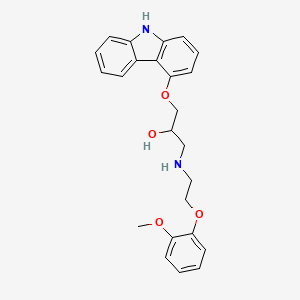
| Formula | C24H26N2O4 |
|---|---|
| Molecular weight | 406.48 g/mol |
| IUPAC name | 1-(9H-carbazol-4-yloxy)-3-[2-(2-methoxyphenoxy)ethylamino]propan-2-ol |
| CAS | 72956-09-3 |
| PubChem CID | 2585 |
| InChIKey | OGHNVEJMJSYVRP-UHFFFAOYSA-N |
| logP | 3.74 (XLogP 4.2) |
| Polar surface area | 75.74 Ų |
| H-bond acceptors / donors | 5 / 3 |
| Drug-likeness (QED) | 0.35 |
| Lipinski violations | 0 |
SMILES
COc1ccccc1OCCNCC(O)COc1cccc2[nH]c3ccccc3c12Biology & Pharmacokinetics
Pharmacokinetics
| BBB penetrant | No |
|---|
Enzyme interactions
| Enzyme | Role | Detail |
|---|---|---|
| CYP1A2 | Inhibitor | — |
| CYP1A2 | Substrate | — |
| CYP2C19 | Substrate | — |
| CYP2C8 | Inhibitor | — |
| CYP2C9 | Substrate | — |
| CYP2D6 | Inhibitor | — |
| CYP2D6 | Substrate | — |
| CYP3A4 | Inhibitor | — |
Receptor binding (top 5)
| Target | Action | Affinity |
|---|---|---|
| adrenergic Beta2 (ADRB2) | Binding | pKi 9.0 |
| adrenergic Beta1 (ADRB1) | Binding | pKi 8.8 |
| α1A-adrenoceptor (ADRA1A) | Antagonist | pKi 8.4 |
| β3-adrenoceptor (ADRB3) | Antagonist | pKi 8.3 |
| adrenergic Beta3 (ADRB3) | Binding | pKi 6.6 |
Transporters
BCRP (Inhibitor)BSEP (Inhibitor)BSEP (Inhibitor)MATE1 (Inhibitor)MATE2 (Inhibitor)MDR1 (Inhibitor)MRP1 (Inhibitor)MRP4 (Inhibitor)OATP1B1 (Inhibitor)OATP1B3 (Inhibitor)OCT1 (Inhibitor)OCT2 (Inhibitor)OCTN1 (Inhibitor)OCTN2 (Inhibitor)P-gp (Inhibitor)Transporter(unspecified) (Inhibitor)MDR1 (Substrate)P-gp (Substrate)
Drug–drug interactions (100+, DDInter)
| Interacting drug | Severity | Management |
|---|---|---|
| Aminophylline | major | |
| Betrixaban | major | |
| Ceritinib | major | |
| Dolasetron | major | |
| Dyphylline | major | |
| Edoxaban | major | |
| Epinephrine | major | |
| Fingolimod | major | |
| Formoterol | major | |
| Indacaterol | major | |
| Iobenguane (I-131) | major | |
| Methacholine | major | |
| Olodaterol | major | |
| Orciprenaline | major | |
| Oxtriphylline | major | |
| Pazopanib | major | |
| Pirbuterol | major | |
| Salbutamol | major | |
| Salmeterol | major | |
| Siponimod | major | |
| Talazoparib | major | |
| Terbutaline | major | |
| Theophylline | major | |
| Venetoclax | major | |
| Vilanterol | major | |
| Abiraterone | moderate | |
| Acetohexamide | moderate | |
| Aldesleukin | moderate | |
| Alectinib | moderate | |
| Alimemazine | moderate | |
| Alpelisib | moderate | |
| Amifostine | moderate | |
| Anagrelide | moderate | |
| Atropine | moderate | |
| Betamethasone | moderate | |
| Binimetinib | moderate | |
| Brigatinib | moderate | |
| Brimonidine (ophthalmic) | moderate | |
| Brimonidine (topical) | moderate | |
| Budesonide | moderate |
Showing 40 of 100+.
Registered Products (13)
| Brand | Form / strength | Pack | Agent | Citizen (JOD) |
|---|---|---|---|---|
| Vacodil | Tablet 6.25 mg | 30 tab | AL Rahma Drug Store | 1.880 |
| Unidil 3.125mg F.C Tab | Film-Coated Tablet 3.125 mg | 30 tab | UNITED PHARM.MFG.CO.LTD(UPM)/JORDAN | 2.030 |
| DILATREND TAB | Tablet 6.25 mg | 30 tab | Shawi & Rushedat Drug Store | 3.280 |
| Unidil 6.25mg F.C Tab | Film-Coated Tablet 6.25 mg | 30 tab | UNITED PHARM.MFG.CO.LTD(UPM)/JORDAN | 3.320 |
| Carvidol Tablet | Tablet 6.25 mg | 30 tab pack varies | Pharma International Company/ Jordan | 3.600 |
| Vacodil | Tablet 25 mg | 30 tab | AL Rahma Drug Store | 3.820 |
| Unidil 12.5mg F.C Tab | Film-Coated Tablet 12.5 mg | 30 tab | UNITED PHARM.MFG.CO.LTD(UPM)/JORDAN | 5.040 |
| DILATREND TAB | Tablet 25 mg | 30 tab | Shawi & Rushedat Drug Store | 5.430 |
| Carvidol Tablet | Tablet 25 mg | 30 tab pack varies | Pharma International Company/ Jordan | 5.450 |
| Unidil 25mg F.C Tab | Film-Coated Tablet 25 mg | 30 tab | UNITED PHARM.MFG.CO.LTD(UPM)/JORDAN | 5.450 |
| Carvidol Tablet | Tablet 12.5 mg | 30 tab | Pharma International Company/ Jordan | 5.460 |
| Carvidol Tablet | Tablet 6.25 mg | 500 tab pack varies | Pharma International Company/ Jordan | 51.000 |
| Carvidol Tablet | Tablet 25 mg | 500 tab pack varies | Pharma International Company/ Jordan | 79.030 |