Terbutaline
JFDA label: Neoterb
- Prolonged tocolysis:
Mechanism of Action
Relaxes bronchial and uterine smooth muscle by action on beta2-receptors with less effect on heart rate
Indications
Approved
- Asthma/Bronchospasm
Off-label
- Extravasation management, sympathomimetic vasoconstrictors
- Premature labor (acute
- short-term [≤72 hours] tocolysis)
Contraindications
Source: Lexicomp
- Hypersensitivity to terbutaline, sympathomimetic amines, or any component of the formulation Injection: Additional contraindications: Prolonged (>48 to 72 hours) tocolysis, especially for maintenance in the outpatient setting Oral: Additional contraindications: Acute or maintenance tocolysis Bricanyl Turbuhaler [Canadian product]: History of tachyarrhythmias Absolute
- as tocolytic in patients at risk of premature labor or threatened abortion Absolute
Adverse Reactions
Cardiac disorders (2)
Common Hypertension · tachycardia
Nervous system disorders (6)
Very Common Nervousness · restlessness
Common Dizziness · drowsiness · headache · insomnia
Metabolism and nutrition disorders (2)
Very Common Decreased serum potassium · increased serum glucose
Gastrointestinal disorders (4)
Common Dysgeusia · nausea · vomiting · xerostomia
Skin and subcutaneous tissue disorders (1)
Common Diaphoresis
Musculoskeletal and connective tissue disorders (3)
Very Common Tremor
Common Muscle cramps · weakness
Dosing
Source: Lexicomp
Warnings & Precautions
Source: Lexicomp
Bronchospasm
Rarely, paradoxical bronchospasm may occur with use of inhaled bronchodilating agents; this should be distinguished from inadequate response.
Hypersensitivity reactions
Immediate hypersensitivity reactions (urticaria, angioedema, rash, bronchospasm) have been reported.
Serious effects/fatalities
Do not exceed recommended dose; serious adverse events, including fatalities, have been associated with excessive use of inhaled sympathomimetics. Concurrent drug therapy issues:
Drug-drug interactions
Potentially significant interactions may exist, requiring dose or frequency adjustment, additional monitoring, and/or selection of alternative therapy. Consult drug interactions database for more detailed information. Disease-related concerns:
Asthma
Appropriate use: When used as a bronchodilator, optimize anti-inflammatory treatment before initiating maintenance treatment with terbutaline. Do not use as a component of chronic therapy without an anti-inflammatory agent. Only the mildest form of asthma (Step 1 and/or exercise-induced) would not require concurrent use based upon asthma guidelines.
Cardiovascular disease
Use with caution in patients with cardiovascular disease (arrhythmia or hypertension or HF); beta-agonists may cause elevation in blood pressure, heart rate and result in CNS stimulation/excitation. Beta2-agonists may also increase risk of arrhythmias.
Diabetes
Use with caution in patients with diabetes mellitus; beta2-agonists may increase serum glucose.
Glaucoma
Use with caution in patients with glaucoma; may elevate intraocular pressure.
Hyperthyroidism
Use with caution in hyperthyroidism; may stimulate thyroid activity.
Hypokalemia
Use with caution in patients with hypokalemia or taking concomitant drugs that cause hypokalemia; beta2-agonists may decrease serum potassium.
Preterm labor
Terbutaline is not FDA approved for and should not be used for prolonged tocolysis (>48 to 72 hours). Use for maintenance tocolysis should not be done in the outpatient setting. Adverse events observed in pregnant women include arrhythmias, increased heart rate, hyperglycemia (transient), hypokalemia, myocardial ischemia, and pulmonary edema. Heart rate may be increased in the fetus and hypoglycemia may occur in the neonate. Oral terbutaline is contraindicated for acute or chronic use in the management of preterm labor.
Seizures
Use with caution in patients with seizure disorders; beta-agonists may result in CNS stimulation/excitation. Other warnings/precautions:
Patient information
Patients must be instructed to seek medical attention in cases where acute symptoms are not relieved or a previous level of response is diminished. The need to increase frequency of use may indicate deterioration of asthma, and treatment must not be delayed.
Pregnancy & Lactation
Pregnancy
Adverse events have been observed in animal reproduction studies. Terbutaline crosses the placenta; umbilical cord concentrations are ~11% to 48% of maternal blood levels. Uncontrolled asthma is associated with adverse events on pregnancy (increased risk of perinatal mortality, pre-eclampsia, preterm birth, low birth weight infants). Terbutaline is not recommended for the treatment of asthma during pregnancy; inhaled beta2-receptor agonists are preferred (NAEPP 2005). [US Boxed Warning]: Terbutaline is not FDA approved for and should not be used for prolonged tocolysis (>48 to 72 hours). Use for maintenance tocolysis should not be done in the outpatient setting. Adverse events observed in pregnant women include arrhythmias, increased heart rate, hyperglycemia (transient), hypokalemia, myocardial ischemia, and pulmonary edema. Heart rate may be increased in the fetus and hypoglycemia may occur in the neonate. Terbutaline has been used in the management of preterm labor. Tocolytics
Lactation
Terbutaline is excreted in breast milk; concentrations are similar to or higher than those in the maternal plasma. Based on information from four cases, exposure to the breast-fed infant would be 2-receptor agonists are not considered a contraindication to breast-feeding (NAEPP 2005).
Monitoring
| Clinical pearl | Serum potassium, glucose; intake/output; heart rate, blood pressure, respiratory rate; chest pain, shortness of breath; monitor for signs and symptoms of pulmonary edema (when used as a tocolytic); monitor FEV1, peak flow, and/or other pulmonary function tests (when used as bronchodilator). If used for extravasation management, monitor and document extravasation site. |
|---|
Chemistry & Properties
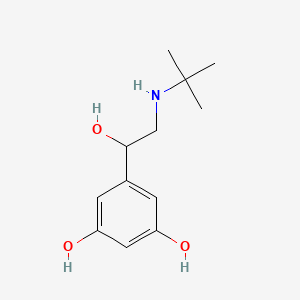
| Formula | C12H19NO3 |
|---|---|
| Molecular weight | 225.29 g/mol |
| IUPAC name | 5-[2-(tert-butylamino)-1-hydroxyethyl]benzene-1,3-diol |
| CAS | 23031-25-6 |
| PubChem CID | 5403 |
| InChIKey | XWTYSIMOBUGWOL-UHFFFAOYSA-N |
| logP | 1.52 (XLogP 0.9) |
| Polar surface area | 72.72 Ų |
| H-bond acceptors / donors | 4 / 4 |
| Drug-likeness (QED) | 0.63 |
| Lipinski violations | 0 |
SMILES
CC(C)(C)NCC(O)c1cc(O)cc(O)c1Biology & Pharmacokinetics
Pharmacokinetics
| BBB penetrant | No |
|---|
Enzyme interactions
| Enzyme | Role | Detail |
|---|---|---|
| CYP2C19 | Substrate | — |
| CYP2D6 | Substrate | — |
Receptor binding (top 3)
| Target | Action | Affinity |
|---|---|---|
| β2-adrenoceptor (ADRB2) | Agonist | pEC50 7.3 |
| β1-adrenoceptor (ADRB1) | Agonist | pEC50 5.8 |
| adrenergic Beta2 (ADRB2) | Binding | pKi 5.6 |
Transporters
BCRP (Inhibitor)BSEP (Inhibitor)BSEP (Inhibitor)MDR1 (Inhibitor)MRP1 (Inhibitor)MRP3 (Inhibitor)MRP4 (Inhibitor)OATP1B1 (Inhibitor)OATP1B3 (Inhibitor)OCT1 (Inhibitor)P-gp (Inhibitor)MDR1 (Substrate)OCT1 (Substrate)OCT2 (Substrate)OCTN2 (Substrate)P-gp (Substrate)Transporter(unspecified) (Substrate)
Drug–drug interactions (100+, DDInter)
| Interacting drug | Severity | Management |
|---|---|---|
| Amiodarone | major | |
| Amisulpride | major | |
| Anagrelide | major | |
| Arsenic trioxide | major | |
| Bedaquiline | major | |
| Bepridil | major | |
| Cabozantinib | major | |
| Carteolol | major | |
| Carteolol (ophthalmic) | major | |
| Carvedilol | major | |
| Ceritinib | major | |
| Cisapride | major | |
| Citalopram | major | |
| Clozapine | major | |
| Cocaine (nasal) | major | |
| Cocaine (topical) | major | |
| Crizotinib | major | |
| Disopyramide | major | |
| Dofetilide | major | |
| Dolasetron | major | |
| Dronedarone | major | |
| Droperidol | major | |
| Efavirenz | major | |
| Escitalopram | major | |
| Gatifloxacin | major | |
| Grepafloxacin | major | |
| Halofantrine | major | |
| Haloperidol | major | |
| Ibutilide | major | |
| Iloperidone | major | |
| Ivosidenib | major | |
| Labetalol | major | |
| Lefamulin | major | |
| Levacetylmethadol | major | |
| Levobunolol (ophthalmic) | major | |
| Lumefantrine | major | |
| Macimorelin | major | |
| Mesoridazine | major | |
| Methadone | major | |
| Metipranolol (ophthalmic) | major |
Showing 40 of 100+.
Registered Products (5)
| Brand | Form / strength | Pack | Agent | Citizen (JOD) |
|---|---|---|---|---|
| Talin syrup | Syrup 1.5 mg/5 ml | 60 ml | THE JORDANIAN PHARMACEUTICAL MANUFACTURING COMPANY/JORDAN | 0.950 |
| Neoterb | Suspension 1.5 mg/5 ml | 100 ml | Reda Jardaneh Drug Store | 1.080 |
| Talin | Tablet 2.5 mg | 30 tab | THE JORDANIAN PHARMACEUTICAL MANUFACTURING COMPANY/JORDAN | 1.300 |
| Talin | Tablet 5 mg | 30 tab pack varies | THE JORDANIAN PHARMACEUTICAL MANUFACTURING COMPANY/JORDAN | 2.000 |
| Talin | Tablet 5 mg | 1000 tab pack varies | THE JORDANIAN PHARMACEUTICAL MANUFACTURING COMPANY/JORDAN | 53.330 |