Labetalol
JFDA label: Betralox 100mg/20ml
Mechanism of Action
Blocks alpha1-, beta1-, and beta2-adrenergic receptor sites; elevated renins are reduced. The ratios of alpha- to beta-blockade differ depending on the route of administration estimated to be 1:3 (oral) and 1:7 (IV) (Goa 1989).
Indications
Approved
- Hypertension
Off-label
- Chronic hypertension in pregnancy
- Hypertension during acute ischemic stroke
- Hypertensive emergency in pregnancy
- Pediatric hypertension
- Subarachnoid hemorrhage
Contraindications
Source: Lexicomp
- Hypersensitivity to labetalol or any component of the formulation Absolute
- bronchial asthma or a history of obstructive airway disease Absolute
- cardiogenic shock Absolute
- conditions associated with severe and prolonged hypotension Documentation of allergenic cross-reactivity for alpha/beta adrenergic blocking agents is limited. However, because of similarities in chemical structure and/or pharmacologic actions, the possibility of cross-sensitivity cannot be ruled out with certainty Absolute
- heart block greater than first degree (except in patients with a functioning artificial pacemaker) Absolute
- severe bradycardia Absolute
- uncompensated cardiac failure Absolute
Adverse Reactions
Cardiac disorders (5)
Very Common Orthostatic hypotension
Common edema · flushing · Hypotension · ventricular arrhythmia
Nervous system disorders (6)
Very Common Dizziness · fatigue
Common drowsiness · headache · Paresthesia · vertigo
Hepatobiliary disorders (1)
Common Increased serum transaminases
Renal and urinary disorders (3)
Common Ejaculatory failure · impotence · Increased blood urea nitrogen
Gastrointestinal disorders (4)
Very Common Nausea
Common dysgeusia · Dyspepsia · vomiting
Skin and subcutaneous tissue disorders (3)
Common Diaphoresis · pruritus · skin rash
Musculoskeletal and connective tissue disorders (1)
Common Weakness
Eye disorders (1)
Common Visual disturbance
Respiratory, thoracic and mediastinal disorders (2)
Common dyspnea · Nasal congestion
Dosing
Source: Lexicomp
Warnings & Precautions
Source: Lexicomp
Anaphylactic reactions
Use caution with history of severe anaphylaxis to allergens; patients taking beta-blockers may become more sensitive to repeated challenges. Treatment of anaphylaxis (eg, epinephrine) in patients taking beta-blockers may be ineffective or promote undesirable effects.
Floppy iris syndrome
Intraoperative floppy iris syndrome has been observed in cataract surgery patients who were treated with alpha1-blockers. There appears to be no benefit in discontinuing alpha-blocker therapy prior to surgery.
Hepatic injury
Severe hepatocellular injury has been reported (rare). The hepatic injury is usually reversible, but hepatic necrosis and death have been reported. Injury has occurred after both short- and long-term treatment and may be slowly progressive despite minimal symptomatology. Periodically monitor LFTs. If liver injury or jaundice occurs, discontinue labetalol and do not restart.
Hypotension/syncope
Symptomatic hypotension with or without syncope may occur with labetalol; close monitoring of patient is required especially with initial dosing and dosing increases; blood pressure must be lowered at a rate appropriate for the patient's clinical condition. Initiation with a low dose and gradual up-titration may help to decrease the occurrence of hypotension or syncope. Advise patients to avoid driving or other hazardous tasks during initiation of therapy due to the risk of syncope. Orthostatic hypotension may occur with IV administration; patient should remain supine during and for up to 3 hours after IV administration Disease-related concerns:
Bronchospastic disease
In general, patients with bronchospastic disease should not receive beta-blockers; if used at all, should be used cautiously with close monitoring.
Diabetes
Use with caution in patients with diabetes mellitus; may potentiate hypoglycemia and/or mask signs and symptoms. May also reduce release of insulin in response to hyperglycemia; dosage of antidiabetic agents may need to be adjusted.
Heart failure (HF)
Use with extreme caution in patients with compensated heart failure and monitor for a worsening of the condition.
Hepatic impairment
Use with caution in patients with hepatic impairment; bioavailability is increased due to decreased first-pass metabolism.
Myasthenia gravis
Use beta blockers with caution in patients with myasthenia gravis.
Peripheral vascular disease (PVD) and Raynaud disease
Beta blockers may precipitate or aggravate symptoms of arterial insufficiency in patients with PVD and Raynaud disease; use with caution and monitor for progression of arterial obstruction.
Pheochromocytoma
Labetalol may be effective in lowering blood pressure and relieving symptoms in patients with pheochromocytoma; however, patients may experience paradoxical hypertensive responses due to inadequate alpha-1 blockade (Manger 2002; Mazza 2014). Adequate alpha-1 blockade should be initiated prior to use of any beta-blocker in this setting; use with caution in patients with pheochromocytoma or consider alternative therapy. If possible, obtain diagnostic tests for pheochromocytoma prior to use since labetalol may spuriously cause falsely elevated levels of plasma catecholamine and urinary metanephrine (Bravo 2002; MacCarthy 1983).
Psoriasis
Beta-blocker use has been associated with induction or exacerbation of psoriasis, but cause and effect have not been firmly established.
Psychiatric disease
Use with caution in patients with a history of psychiatric illness. Although the risk is small, labetalol may cause or exacerbate CNS depression; however, the use of beta-blockers should not be withheld if benefit exceeds this risk (Verbeek 2011).
Thyroid disease
Beta blockers may mask signs of hyperthyroidism (eg, tachycardia). If hyperthyroidism is suspected, carefully manage and monitor; abrupt withdrawal may exacerbate symptoms of hyperthyroidism or precipitate thyroid storm. Concurrent drug therapy issues:
Drug-drug interactions
Potentially significant interactions may exist, requiring dose or frequency adjustment, additional monitoring, and/or selection of alternative therapy. Consult drug interactions database for more detailed information. Special populations:
Elderly
Bradycardia may be observed more frequently in elderly patients (>65 years of age); dosage reductions may be necessary. Dosage form specific issues:
Benzyl alcohol and derivatives
Some dosage forms may contain sodium benzoate/benzoic acid; benzoic acid (benzoate) is a metabolite of benzyl alcohol; large amounts of benzyl alcohol (≥99 mg/kg/day) have been associated with a potentially fatal toxicity (“gasping syndrome”) in neonates; the “gasping syndrome” consists of metabolic acidosis, respiratory distress, gasping respirations, CNS dysfunction (including convulsions, intracranial hemorrhage), hypotension, and cardiovascular collapse (AAP ["Inactive" 1997]; CDC, 1982); some data suggests that benzoate displaces bilirubin from protein binding sites (Ahlfors, 2001); avoid or use dosage forms containing benzyl alcohol derivative with caution in neonates. See manufacturer’s labeling. Other warnings/precautions:
Abrupt withdrawal
Beta-blocker therapy should not be withdrawn abruptly (particularly in patients with CAD), but gradually tapered to avoid acute tachycardia, hypertension, and/or ischemia. Severe exacerbation of angina, ventricular arrhythmias, and myocardial infarction (MI) have been reported following abrupt withdrawal of beta-blocker therapy. Temporary but prompt resumption of beta-blocker therapy may be indicated with worsening of angina or acute coronary insufficiency.
Major surgery
Chronic beta-blocker therapy should not be routinely withdrawn prior to major surgery.
Pregnancy & Lactation
Pregnancy
Safe
Preferred beta-blocker in pregnancy. First-line oral agent for hypertension in many guidelines. IV route for acute severe hypertension
Lactation
Labetalol is present in breast milk. The relative infant dose (RID) of labetalol is 3.6% when calculated using the highest breast milk concentration located and compared to an infant therapeutic dose of 3 mg/kg/day. In general, breastfeeding is considered acceptable when the RID is 25% breastfeeding should generally be avoided (Anderson 2016; Ito 2000). Using the highest milk concentration (0.71 mcg/mL), the estimated daily infant dose via breast milk is 0.1065 mg/kg/day. This milk concentrati
Monitoring
| Clinical pearl | Blood pressure, standing and sitting/supine, pulse, cardiac monitor and blood pressure monitor recommended for IV administration; consult individual institutional policies and procedures |
|---|
Chemistry & Properties
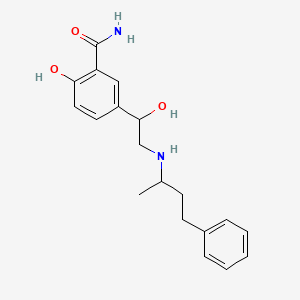
| Formula | C19H24N2O3 |
|---|---|
| Molecular weight | 328.41 g/mol |
| IUPAC name | 2-hydroxy-5-[1-hydroxy-2-(4-phenylbutan-2-ylamino)ethyl]benzamide |
| CAS | 36894-69-6 |
| PubChem CID | 3869 |
| InChIKey | SGUAFYQXFOLMHL-UHFFFAOYSA-N |
| logP | 2.14 (XLogP 3.1) |
| Polar surface area | 95.58 Ų |
| H-bond acceptors / donors | 4 / 4 |
| Drug-likeness (QED) | 0.60 |
| Lipinski violations | 0 |
SMILES
CC(CCc1ccccc1)NCC(O)c1ccc(O)c(C(N)=O)c1Biology & Pharmacokinetics
Pharmacokinetics predicted
| Bioavailability | 70.0% |
|---|---|
| Half-life | 1.031 h |
| Volume of distribution | 3.879 L/kg |
| Protein binding | 47.4% |
| BBB penetrant | No |
Enzyme interactions
| Enzyme | Role | Detail |
|---|---|---|
| CYP2D6 | Inhibitor | IC₅₀ 0.8000000000000004 µM |
| CYP2D6 | Substrate | — |
Receptor binding (top 2)
| Target | Action | Affinity |
|---|---|---|
| β2-adrenoceptor (ADRB2) | Antagonist | pKi 8.0 |
| α1A-adrenoceptor (ADRA1A) | Antagonist | pKi 7.3 |
Transporters
ASBT (Inhibitor)BCRP (Inhibitor)BSEP (Inhibitor)BSEP (Inhibitor)MDR1 (Inhibitor)MRP1 (Inhibitor)OATP1B1 (Inhibitor)OATP1B3 (Inhibitor)OATP1B3 (Inhibitor)OCT1 (Inhibitor)OCTN2 (Inhibitor)P-gp (Inhibitor)MDR1 (Substrate)OATP1A2 (Substrate)P-gp (Substrate)Transporter(unspecified) (Substrate)
Drug–drug interactions (100+, DDInter)
| Interacting drug | Severity | Management |
|---|---|---|
| Aminophylline | major | |
| Ceritinib | major | |
| Dolasetron | major | |
| Dyphylline | major | |
| Epinephrine | major | |
| Fingolimod | major | |
| Formoterol | major | |
| Indacaterol | major | |
| Iobenguane (I-131) | major | |
| Leflunomide | major | |
| Methacholine | major | |
| Olodaterol | major | |
| Orciprenaline | major | |
| Oxtriphylline | major | |
| Pirbuterol | major | |
| Salbutamol | major | |
| Salmeterol | major | |
| Siponimod | major | |
| Terbutaline | major | |
| Teriflunomide | major | |
| Theophylline | major | |
| Vilanterol | major | |
| Acetohexamide | moderate | |
| Aldesleukin | moderate | |
| Alectinib | moderate | |
| Alimemazine | moderate | |
| Amifostine | moderate | |
| Apalutamide | moderate | |
| Asparaginase Escherichia coli | moderate | |
| Atropine | moderate | |
| Betamethasone | moderate | |
| Brentuximab vedotin | moderate | |
| Brigatinib | moderate | |
| Brimonidine (ophthalmic) | moderate | |
| Brimonidine (topical) | moderate | |
| Budesonide | moderate | |
| Calcium Phosphate | moderate | |
| Calcium acetate | moderate | |
| Calcium carbonate | moderate | |
| Calcium citrate | moderate |
Showing 40 of 100+.
Registered Products (3)
| Brand | Form / strength | Pack | Agent | Citizen (JOD) |
|---|---|---|---|---|
| Betralox | Vial 100 mg/20 ml | 5 vial | MS PHARMA/JORDAN | — |
| LabetaKern 5mg/ml Solution for Injection | Powder for Injection 100 mg | 5 amp | InterPharma | — |
| Switalol | Vial 100 mg/20 ml | 1 vial | ٠ستÙدع أدÙÙØ© اÙÙÙÙÙÙÙ | — |