Budesonide
JFDA label: Symbicort Turbuhaler
- infectious disease — ChEMBL drug_warning (Black Box Warning) | United States
Mechanism of Action
Agonist of Glucocorticoid receptor — Glucocorticoid receptor agonist
| Target | Action | Gene / class |
|---|---|---|
| Glucocorticoid receptor efficacy | AGONIST | NR3C1 |
Indications
Approved
- Asthma — asthma
- Bronchitis, Chronic — chronic bronchitis
- Colitis, Ulcerative — ulcerative colitis
- Crohn Disease — Crohn's disease
- Emphysema — emphysema
- Esophageal Diseases — esophageal disease
- Glomerulonephritis, IGA — IGA glomerulonephritis
- Lung Diseases, Obstructive — Airway obstruction
- Nasal Obstruction — Nasal congestion
- Pulmonary Disease, Chronic Obstructive — chronic obstructive pulmonary disease
- Rhinitis, Allergic, Perennial — Rhinitis, Allergic, Perennial
- Rhinitis, Allergic, Seasonal — allergic rhinitis
Off-label
- Altitude Sickness
- Anosmia
- Aspergillosis, Allergic Bronchopulmonary
- Breast Neoplasms
- Bronchiolitis Obliterans
- Bronchiolitis Obliterans Syndrome
- Bronchopulmonary Dysplasia
- Colitis, Collagenous
- Colitis, Lymphocytic
- Colitis, Microscopic
- Diarrhea
- Eosinophilic Esophagitis
- Esophageal Stenosis
- Graft vs Host Disease
- Hepatitis, Autoimmune
- Hypersensitivity
- Inflammatory Bowel Diseases
- Liver Cirrhosis, Biliary
- Lung Neoplasms
- Malnutrition
- Melanoma
- Multiple Myeloma
- Nasal Polyps
- Proctitis
- Proctocolitis
- Radiation Pneumonitis
- Respiratory Distress Syndrome
- Respiratory Tract Diseases
- Severe Acute Respiratory Syndrome
- Sinusitis
- Sleep Apnea, Obstructive
- Snoring
- Status Asthmaticus
Contraindications
Source: openFDA
- Budesonide delayed-release capsules are contraindicated in patients with hypersensitivity to budesonide or any of the ingredients of budesonide delayed-release capsules. Serious hypersensitivity reactions, including anaphylaxis have occurred [see Adverse Reactions (6.2) ] . Hypersensitivity to budesonide or any of the ingredients in budesonide delayed-release capsules. ( 4 ) Absolute
Dosing
Source: openFDA
Warnings & Precautions
Source: openFDA
Warnings & Precautions
Hypercorticism and Adrenal Axis Suppression: May occur with treatment; monitor for signs and symptoms; pediatrics and patients with hepatic impairment may be at increased risk. ( 2.4 , 5.1 , 8.4 , 8.6 ) Symptoms of Steroid Withdrawal in Patients Transferred from Other Systemic Corticosteroids: Taper slowly from corticosteroids with high systemic effects; monitor for withdrawal symptoms and unmasking of allergies (rhinitis, eczema). ( 5.2 ) Immunosuppression and Increased Risk of Infection: Increased risk of viral, bacterial, fungal, protozoal and helminthic infections, including potentially fatal varicella and measles infection. Monitor patients for new or worsening infection and consider drug discontinuation. Avoid use in patients with fungal infections, Strongyloides infestation, cerebral malaria and ocular herpes simplex. Screen for hepatitis B infection. ( 5.3 ) Karposi’s Sarcoma: Reported to occur in patients receiving corticosteroid therapy, most often for chronic conditions. ( 5.4 ) Other Corticosteroid Effects: Monitor patients with concomitant conditions where corticosteroids may have unwanted effects (e.g., hypertension, diabetes mellitus). ( 5.5 )
Hypercorticism and Adrenal Axis Suppression Systemic effects such as h
Hypercorticism and Adrenal Axis Suppression Systemic effects such as hypercorticism and adrenal axis suppression may occur with use of corticosteroids, including budesonide [see Adverse Reactions (6.1) , Clinical Pharmacology (12.2) ] . Pediatric patients with Crohn’s disease have a slightly higher systemic exposure of budesonide and increased cortisol suppression than adults with Crohn’s disease [see Use in Specific Populations (8.4) , Clinical Pharmacology (12.2) ] . Monitor patients for signs and symptoms of hypercorticism and adrenal axis suppression during treatment with budesonide. Patients with moderate to severe hepatic impairment (Child-Pugh Class B and C respectively) could be at an increased risk of hypercorticism and adrenal axis suppression due to an increased systemic exposure of oral budesonide. Avoid use in patients with severe hepatic impairment (Child-Pugh Class C). Monitor for increased signs and/or symptoms of hypercorticism and consider reducing the dosage in patients with moderate hepatic impairment (Child-Pugh Class B) [see Dosage and Administration (2.4) , Use in Specific Populations (8.6) , Clinical Pharmacology (12.3) ] . Corticosteroids, including budesonide, can reduce the response of the hypothalamus-pituitary-adrenal (HPA) axis to stress. In situations where patients are subject to surgery or other stress situations, supplementation with a systemic corticosteroid is recommended.
Symptoms of Steroid Withdrawal in Patients Transferred from Other Syst
Symptoms of Steroid Withdrawal in Patients Transferred from Other Systemic Corticosteroids Monitor patients who are transferred from corticosteroid treatment with high systemic effects to corticosteroids with lower systemic availability, such as budesonide, since symptoms attributed to withdrawal of steroid therapy, including those of acute adrenal axis suppression or benign intracranial hypertension, may develop. Adrenocortical function monitoring may be required in these patients and the dose of corticosteroid treatment with high systemic effects should be reduced cautiously. Replacement of systemic corticosteroids with budesonide may unmask allergies (e.g., rhinitis and eczema), which were previously controlled by the systemic drug.
Immunosuppression and Increased Risk of Infection Corticosteroids, inc
Immunosuppression and Increased Risk of Infection Corticosteroids, including budesonide, suppress the immune system and increase the risk of infection with any pathogen, including viral, bacterial, fungal, protozoan, or helminthic pathogens. Corticosteroids can: Reduce resistance to new infections Exacerbate existing infections Increase the risk of disseminated infections Increase the risk of reactivation or exacerbation of latent infections Mask some signs of infection Corticosteroid-associated infections can be mild but can be severe and at times fatal. The rate of infectious complications increases with increasing corticosteroid dosages. Monitor patients for the development of infection and consider discontinuation of budesonide if the patient develops an infection while on treatment. Tuberculosis If budesonide is used in patients with latent tuberculosis or tuberculin reactivity, reactivation of tuberculosis may occur. Closely monitor such patients for reactivation. During prolonged budesonide therapy, patients with latent tuberculosis or tuberculin reactivity should receive chemoprophylaxis. Varicella Zoster and Measles Viral Infections Varicella and measles can have a serious or even fatal course in non-immune pediatric and adult patients taking corticosteroids, including budesonide. In corticosteroid-treated patients who have not had these diseases or are non-immune, particular care should be taken to avoid exposure to varicella and measles: If a budesonide-treated patient is exposed to varicella, prophylaxis with varicella zoster immune globulin may be indicated. If varicella develops, treatment with antiviral agents may be considered. If a budesonide-treated patient is exposed to measles, prophylaxis with immunoglobulin may be indicated. Hepatitis B Virus Reactivation Hepatitis B virus reactivation can occur in patients who are hepatitis B carriers treated with immunosuppressive dosages of corticosteroids, including budesonide. Reactivation can also occur infrequently in corticosteroid-treated patients who appear to have resolved hepatitis B infection. Screen patients for hepatitis B infection before initiating immunosuppressive (e.g., prolonged) treatment with budesonide. For patients who show evidence of hepatitis B infection, recommend consultation with physicians with expertise in managing hepatitis B regarding monitoring and consideration for hepatitis B antiviral therapy. Fungal Infections Corticosteroids, including budesonide, may exacerbat
Kaposi's Sarcoma Kaposi’s sarcoma has been reported to occur in patien
Kaposi's Sarcoma Kaposi’s sarcoma has been reported to occur in patients receiving corticosteroid therapy, most often for chronic conditions. Discontinuation of corticosteroids may result in clinical improvement of Kaposi’s sarcoma.
Other Corticosteroid Effects Monitor patients with hypertension, diabe
Other Corticosteroid Effects Monitor patients with hypertension, diabetes mellitus, osteoporosis, peptic ulcer, glaucoma or cataracts, or with a family history of diabetes or glaucoma, or with any other condition where corticosteroids may have unwanted effects.
Pregnancy & Lactation
Pregnancy
Safe
Inhaled corticosteroids should be continued in asthmatic patients. Poorly controlled asthma is far more dangerous than inhaled steroids
Lactation
Expert opinion considers inhaled, nasal, oral and rectal corticosteroids acceptable to use during breastfeeding.[ 1 - 3 ]
Chemistry & Properties
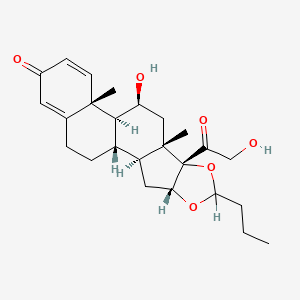
| Formula | C25H34O6 |
|---|---|
| Molecular weight | 430.54 g/mol |
| IUPAC name | (1S,2S,4R,8S,9S,11S,12S,13R)-11-hydroxy-8-(2-hydroxyacetyl)-9,13-dimethyl-6-propyl-5,7-dioxapentacyclo[10.8.0.02,9.04,8.013,18]icosa-14,17-dien-16-one |
| CAS | 51333-22-3 |
| PubChem CID | 5281004 |
| InChIKey | VOVIALXJUBGFJZ-KWVAZRHASA-N |
| logP | 2.72 (XLogP 2.5) |
| Polar surface area | 93.06 Ų |
| H-bond acceptors / donors | 6 / 2 |
| Drug-likeness (QED) | 0.71 |
| Lipinski violations | 0 |
SMILES
CCCC1O[C@@H]2C[C@H]3[C@@H]4CCC5=CC(=O)C=C[C@]5(C)[C@H]4[C@@H](O)C[C@]3(C)[C@]2(C(=O)CO)O1Biology & Pharmacokinetics
Pharmacokinetics predicted
| Bioavailability | 70.0% |
|---|---|
| Half-life | 2.315 h |
| Volume of distribution | 8.125 L/kg |
| Protein binding | 94.9% |
| BBB penetrant | Yes |
Enzyme interactions
| Enzyme | Role | Detail |
|---|---|---|
| CYP2B6 | Inhibitor | — |
| CYP3A4 | Inhibitor | — |
| CYP3A4 | Substrate | — |
Receptor binding (top 3)
| Target | Action | Affinity |
|---|---|---|
| Mineralocorticoid receptor (NR3C2) | Agonist | pEC50 7.8 |
| Progesterone receptor (PGR) | Agonist | pEC50 7.6 |
| Glucocorticoid receptor (NR3C1) | Agonist | pEC50 7.4 |
Transporters
BCRP (Inhibitor)BCRP (Inhibitor)BSEP (Inhibitor)BSEP (Inhibitor)MDR1 (Inhibitor)MRP1 (Inhibitor)MRP2 (Inhibitor)MRP3 (Inhibitor)MRP4 (Inhibitor)NTCP (Inhibitor)OATP1B1 (Inhibitor)OATP1B1 (Inhibitor)OATP1B3 (Inhibitor)OATP1B3 (Inhibitor)OATP2B1 (Inhibitor)OCT1 (Inhibitor)OCT2 (Inhibitor)P-gp (Inhibitor)BCRP (Substrate)MDR1 (Substrate)OATP1A2 (Substrate)OATP1B1 (Substrate)OATP1B3 (Substrate)P-gp (Substrate)
Drug–drug interactions (100+, DDInter)
| Interacting drug | Severity | Management |
|---|---|---|
| Adalimumab | major | |
| Amprenavir | major | |
| Atazanavir | major | |
| Baricitinib | major | |
| Bempedoic acid | major | |
| Boceprevir | major | |
| Brexucabtagene autoleucel | major | |
| Ceritinib | major | |
| Certolizumab pegol | major | |
| Cladribine | major | |
| Clarithromycin | major | |
| Cobicistat | major | |
| Conivaptan | major | |
| Delavirdine | major | |
| Desmopressin | major | |
| Dinutuximab | major | |
| Etanercept | major | |
| Fingolimod | major | |
| Fosamprenavir | major | |
| Golimumab | major | |
| Idelalisib | major | |
| Indinavir | major | |
| Infliximab | major | |
| Itraconazole | major | |
| Ketoconazole | major | |
| Leflunomide | major | |
| Lonafarnib | major | |
| Mifepristone | major | |
| Natalizumab | major | |
| Nefazodone | major | |
| Nelfinavir | major | |
| Ozanimod | major | |
| Posaconazole | major | |
| Ritonavir | major | |
| Saquinavir | major | |
| Siponimod | major | |
| Smallpox (Vaccinia) Vaccine, Live | major | |
| Talimogene laherparepvec | major | |
| Telaprevir | major | |
| Telithromycin | major |
Showing 40 of 100+.
Registered Products (17)
| Brand | Form / strength | Pack | Agent | Citizen (JOD) |
|---|---|---|---|---|
| Rhinomax | Implant 64 mcg/dose | 8 ml | Amman Pharmaceutical Industries Co | 5.790 |
| RHINOCORT AQUA NS | Inhaler 64 mcg/dose | 120 DOSE | Al-Amad Drug Store | 6.430 |
| Budecort Respules | Ampoule 0.5 mg/2 ml | 20 amp | ORIENT DRUG STORE CO | 8.200 |
| Budesonide/Kleva | Inhaler 100 mcg | 200 dose | AL Rahma Drug Store | 8.880 |
| Resata | Solution 100 mcg/dose | 10 ml | Mohamad Zreiqat Drug Store | 8.900 |
| Pulmicort Turbuhaler | Inhaler 200 mcg | 100 Dose | Shawi & Rushedat Drug Store | 9.720 |
| Zephyr Nebuliser suspension for inhalation | Suspension Budesonide 0.5 mg/1 mg/ml | 20 amp | Pharma International Company | 10.410 |
| Pulmicort Susp. | Suspension 0.5 mg/ml | 2 ml | Shawi & Rushedat Drug Store | 14.870 |
| Bufomix Easyhalar | Inhaler 160 mcg, 4.5 mcg | 60 Dose pack varies | Hikma Pharmaceuticals Co.Ltd/Jordan | 18.850 |
| Symbicort Turbuhaler | Inhaler 160 mcg/dose, Dihydrate 4.5 mcg/dose | 60 dose pack varies | Shawi & Rushedat Drug Store | 19.090 |
| Bufomix Easyhalar | Inhaler 320 mcg, 9 mcg | 60 Dose | Hikma Pharmaceuticals Co.Ltd/Jordan | 30.160 |
| Symbicort Turbuhaler 320 mcg/9mcg | Inhaler 320 mcg/dose, 9 mcg/dose | 60 Doses | Shawi & Rushedat Drug Store | 30.180 |
| Entocort Cap | Capsule 3 mg | 50 cap | Awtar Pharmaceutical Co | 33.690 |
| Bufomix Easyhalar | Inhaler 160 mcg, 4.5 mcg | 120 Dose pack varies | Hikma Pharmaceuticals Co.Ltd/Jordan | 35.820 |
| Symbicort Turbuhaler | Inhaler 160 mcg/dose, Dihydrate 4.5 mcg/dose | 120 Dose pack varies | Shawi & Rushedat Drug Store | 36.370 |
| Breztri Aerosphere pressurised inhalation, suspension | Suspension 160 mcg, 5 mcg, 7.2 mcg | 120 Actuations | Shawi & Rushedat Drug Store | 51.610 |
| Cortiment | Tablet 9 mg | 30 tab | Petra Drug Store | 79.640 |